THE DAOIST DAILY DIARY

01/31/2022

I thought we would end January on a one-sentence quote from my favorite teacher that sums up the ten rule-type precepts as well as the coming quality precepts, which we will look at tomorrow.

“On the level of body, addictions must be ended. On the level of mind, habits must be ended. On the level of spirit, poisons must be ended.” – Damo Mitchell, Lotus Neigong and the Internal Arts Academy

01/30/2022

Today was another gorgeous Sunday in Los Angeles. A great day for hiking, which I enjoyed along the hillside trails of my favorite park. It was also a great day for tai chi, qigong and tui shou for those of you that took advantage of the weather.

NOTE: A note of CAUTION from yesterday’s post on the tenth and final rule-type precept of Daoism. Trying to follow this rule is not for everyone. Those of you who, for whatever reason, have low self-esteem should first try to build up your feelings about yourself despite being frustrated, unaccomplished or dissatisfied with your life. In this day and age with all the images of success and self-importance that are showered upon us daily by the media, it is easy to get down on yourself. Realizing that you need to put all others ahead of you will only knock down your self-esteem another notch or two. So, hold off on this precept until you can build up that self-image to some extent. Remember, it’s not that you are not worthy or respectable. It’s that you are not more worthy or more respectable or more special than anyone else.

01/29/2022

Today we take a closer look at the tenth and final rule-type precept of Daoism: As long as all beings have not attained the Tao, I will not expect to do so myself. In other words, put other’s attainment of Dao before one’s own. Except for Buddhism and its Bodhisattva Vow, I don’t think you will find many other religious codes with such an unselfish precept. In fact, I believe we would find just the opposite. Just as in the physical world, many people want to save their own necks before others. Spiritually, they are just as adamant about saving their own souls.

Of course, the belief in a separate and independent ‘self’ that functions in life with a free will is the cause for many of the illusions and neurosis of the mind. To break free and end this illusion of self-importance operating any way it pleases, the Daoist sages of the past designed this precept, which is based on Chapter 66 and Chapter 7 of the Tao Te Ching:
“So it is that the sage, wishing to be above men, puts himself by his words below them,
and wishing to be before them, places his person behind them.
In this way though he has his place above them, men do not feel his weight,
nor though he has his place before them, do they feel it an injury to them.”
– Chapter 66, translated by Andre Von Gauthier.

“Therefore, the Sage wants to remain behind,
But finds himself at the head of others;
Reckons himself out,
But finds himself safe and secure.
Is it not because he is selfless
That his Self is realized?”
– Chapter 7, translated by John C. H. Wu.

This seeking in Western society to be unique and special often results in destroying a person’s self-esteem when they fail to live up to the glamorous lifestyles and ambitions they have imagined for themselves. It is usually a long and hard fall that results. This Daoist precept, on the other hand, inculcates the idea that we are all a part of a much wider picture and none of us is more important than any other. But if we persist in our illusion of self-importance, union with Dao can never be attained. By shedding our own importance, our ‘self’ will fade with it and our true Self within will emerge.

On Monday, we will take a look at the five Quality-type precepts. Have a great weekend, everyone, and thanks for stopping by.

01/28/2022

Today we take a closer look at the ninth rule-type precept of Daoism: When someone wants to do me harm, I will not harbor thoughts of revenge. Or, in the Christian concept from the New Testament – “Turn the other cheek.”

In Daoism, while we should try to act in accord with the Dao, we cannot expect the same of others. Everyone conducts themselves according to their own set of values. Each of us has our own personal beliefs and often project these expected standard on others, which, in turn, has caused untold conflict in the world. On the other hand, it is not acceptable for us to drop our own set of values and ethics to justify seeking revenge on someone who has tried to do us harm, either consciously or inadvertently.

Our moral standards and values need to be independent of the actions of others. Thus, we must always project benevolence even when faced with unkindness or, even worse, belligerence. This is the Old Testament view of “an eye for an eye,” versus the New Testament view of “Turn the other cheek.”

If this seems too much like the contrived ethical facade of the Confucanists, it is on the surface. But internally, it is much different. This is not done for any kind of material gain or to put forth a virtuous front and thus acquire praise and admiration. Rather it is deeply centered on the recognition and cultivation of the inherent virtues and benevolence that are the very essence of our inherited authenticity as manifestations of the mystical Te or De.

So add this rule to your daily cultivation and keep practicing to see how you do with it. Good luck and thanks for stopping by.

01/27/2022

Today we take a closer look at the eighth rule-type precept of Daoism: When I see those less fortunate, I will support them in regaining their dignity and good fortune.

Like it or not, when it comes to the vagaries of Life, we are not on an even playing field. And, my apologies to Thomas Jefferson and the rest of our Founding Fathers but, no, all men – and women – are not created equal. There are vast differences in wealth, physical stature and health, psychological qualities, education, family status and conditioning. Despite all these differences, the Dao expects us to treat everyone in the same, exact manner, as Lao-tzu tells us in Chapter 5 of the Tao Te Ching – “like straw dogs.”

In ancient China, at the end of a spiritual ceremony the straw dogs, which represented actual animals, personages or deities, were tossed away and burned. The real animals or persons were not harmed at all. This is an analogy to our spiritual essence. It is not what we actually see in the physical and emotional makeup of each person that is important but their very essence within. We cannot be partial as to what is on the outside but must realize that the essence within all of us is the same regardless of our vast human differences.

Again Lao-tzu reminds us “Heaven and earth are ruthless…” They are completely impartial and don’t show any favortism. Hurricanes, flash floods and fires will destroy the lives, homes, and possessions or rich and poor alike. They are colorblind as well. Thus, in Chapter 5 Lao-tzu is telling us to get over our racial, sexual, and religious biases as well as our narcissistic pettiness and respect everyone and treat them with dignity – the way you want to be treated. So, the Golden Rule in Christianity and the Eighth Precept in Daoism are basically instructing us to “Do unto others as you would have them do unto you.”

Hopefully, this is another important aspect that you can add to your practice. And thanks for stopping by.

01/26/2022

Today we take a closer look at the seventh rule-type precept of Daoism: When I see someone do a good deed, I will support him with joy and delight. That’s a precept which isn’t common to all religions but one that is emphasized in the Daoist Arts especially Alchemy due to its effect on vital energy. But what if you were that kind person and not someone else, which is the case with several Daoist traditions such as Quanzhen sect. So, we can actually rephrase the above rule to read: Carry out kind actions and support those who do.

This actually sets up an interesting paradox. If you remember back a week or so when I posted the first precept, it was mentioned that we are not supposed to affect the lives of others which may have a disturbing effect. or even change one’s life path. At the time, I remaked that this was the true meaning of “Leave no footprints.” And so it is. But Daoist sages further realized that it was virtually impossible to ‘leave no footprints.’ Hence, if you are going to leave footprints anyway, they might as well be ‘good’ footprints rather than ‘bad’ ones.

Positive actions generate positive mental states in those we are affecting. This in turn changes the manner in which De or Te (the manifesting virtue of Dao) exists and so creates a better world that is beneficial to the cultivation of Dao within humanity.

As for the second part of the precept, supporting others who carry out kind actions, Daoists should always seek to align themselves with and promote the actions of those who are also kind. In this way, we are again contributing to leaving ‘positive footprints.’

There’s an excellent lesson to practice all week as you work on your cultivation: ‘Leave positive footprint.’ Good luck and enjoy the practice, folks.

01/25/2022

Today we take a closer look at the sixth rule-type precept of Daoism: I will maintain harmony with my ancestors and family and never disregard my kin.

Again this is a precept that is common to many religions although it may be worded differently. For example, ‘Honor thy Father and Mother’ in Christianity. It is also one area that Daoist arts and alchemy share with traditional Daoist religion.

In Daoism and in Chinese culture as well the family is viewed as a closely united group of both living and deceased relatives. Therefore, ancestor worship is a family practice based on the belief that, although most of a family member’s spirit moves on, part of that spirit has a continued existence within the family. Furthermore, it is believed that the remaining part of the ancestor’s spirit will look after the family and possibly influence the fortunes of the living. Thus, the unity of the family is reinforced through ancestor veneration and offerings of various kinds helping to keep the ancestors happy in the spiritual world, so that they, in return, will bless the family.

Ancestor worship is not asking for favors, but a fulfilling of one’s filial duties. It is a way to pay respect and homage to the ancestors, and honor their deeds and memories, since they were the ones that brought the descendants into the world, nourished them and prepared the conditions under which the descendants could grow and mature. Thus, ancestor veneration is as much a pay back of material and spiritual debts as anything purely religious.

Tomorrow we will look at the seventh rule-type precept. As always, enjoy your practicing, folks, and thanks for stopping by.

01/24/2022

Today we take a closer look at the fifth rule-type precept of Daoism: Do not get intoxicated but always think of pure conduct.

There were never any hard and fast rules in Daoism against drugs such as alcohol and certain mushrooms except in a novice’s first hundred days when novices were expected to purify their bodies in preparation for the hard work ahead. Novices were instructed to abstain from drugs, alcohol and having sex for 100 days. Other than that, a practitioner was allowed to consume drugs such as alcohol as long as the practitioner did not consume so much as to get intoxicated.

As with the other precepts so far, this was not an ethical rule but a practical one since consuming drugs to the point of intoxication can begin to erode the will. Willpower in the Daoist arts must be developed to a very high degree. Without willpower, it was certain that practitioners would fail in their endeavors to attain Dao. As long as a practitioner could refrain from becoming tipsy or even drunk, which erodes the will, then practitioners could indulge in some premium alcohol at their own discretion. It was up to each individual to use one’s due diligence to make certain that this slight indulgence did not turn into a habit or, even worse, an addiction.

On the other hand, that part of Daoism that became codified as a religious tradition did eventually ban all intoxicants.

We will look at rule-type precept six tomorrow. In the meantime, you have my permission to become intoxicated with your Daoist Internal Arts practice. Thanks for stopping by, folks

01/23/2022

After an extremely windy Saturday, we got another beautiful spring-like Sunday in Los Angeles. A great day for hiking. I hope you enjoyed your weekend. We will resume our look into the Daoist precepts and the theory behind them on Monday. For now, get ready for a full week of working on your Internal Arts cultivation and enjoy your practice.

01/22/2022

“496 is one of the most sacred of numbers within the inner door alchemical traditions. It is the number of new beginnings and the potential for transformation. It is the number attached to the New Year in alchemy as well as rebirth and the start of a new day.” – Damo Mitchell, Lotus Neigong and the Internal Arts Academy

A very windy day in the Los Angeles area. A good day to rest up and get set for a week of intense practice. We will resume our look into the Daoist precepts and the theory behind them on Monday.

01/21/2022

Today we take a closer look at the fourth rule-type precept of Daoism: Do not cheat or misrepresent good and evil. Another way of stating that is simply: Do Not Lie or Do Not Mislead Others with Your Speech. I call this the Trump Precept.

In any case, Dishonesty begets more dishonesty as falsified communication generates distortions in your psychology, your emotions, in your relationships, and, above all, in your energy. Not only that but it increase your likelihood of lying to yourself about your own motives. According to Daoist tradition, the search for contact with Dao is made more complicated if there are excessive distortions. We can clear these distortions by telling the truth in all our communications and especially in the things we tell ourselves.

So, be true to yourself and enjoy your practicing Truth in your daily life. Thanks for stopping by.

01/20/2022

Today we take a closer look at the third rule-type precept of Daoism: Do Not Steal or receive unrighteous wealth.

Again we have an obvious precept that is common not only to many religions but penal codes and laws of nearly every country and state. We all know it is against the law to steal. But Daoism is neither concerned with ethics or laws, whether civil or religious. Instead, Daoism is full focused on cultivation and a resonance with Dao.

The Qi of any object is in part composed of the Qi of its owner. To take an object from another and bring it into your living space would mean to distort your own frequency with theirs and serve to disrupt the mental and emotional energy required for resonance with Dao. In addition, the difference between what happens on the level of Qi when something is freely given versus what happens when something is taken instead is one of balance vs imbalance and corruption. In the case of the latter, when something is taken without being given, there is a malevolent form of Qi involved that takes away from the owner’s sense of self, and obviously something which is never tolerated within Daoist tradition.

So, now we begin to see how everything in Daoism is based on the cultivation of energy, not ethics or spirituality. To balance one’s Yin and Yang energies and bring them into unity is the basis for both the rule-based precepts and the quality-based precepts. This will in turn unify one’s Xing and Ming and open the Xuan Men (the Mysterious Gate) to the flow of the Dao.

Enjoy your practicing, everyone. Thanks for stopping by.

01/19/2022

Today we look closer at the second rule-type precept: Do not be lascivious or think depraved thoughts, or simply, do not commit any sexual misconduct.

This particular precept, although it may seem consistent with that of a multitude of religious sects which focus on ethics, purity and saintliness, in Daoism it is more concerned with energetics and practicality. The idea of not committing any sexual misconduct has more to do with one’s physiological nature rather than their ethical or spiritual nature. The by-products of sexual intercourse run from emotional connection with another to an actual alteration in the nature of the Yin and Yang energies within both participants. Each time we have intercourse with a person of either gender, we radically change our own internal frequency so that it moves closer to our partner’s. Even though this is understood, we can see how this would be an issue for those who wish to align fully with Daoism as a spiritual tradition.

Originally the ‘dual-cultivation’ teachings of Daoism were an attempt to work with the shifting energies involved in intercourse such as finding the correct partner, harmonizing one’s own auric field with that of one’s partner, and maximizing the usefulness of energetic release during orgasm. But in some modern Daoist schools, these teachings have been given far more emphasis and even twisted to some extent than was originally practiced in earlier times, when they were seen as secondary practices that supported the rest of a practitioner’s cultivation. All in all, these teachings were clearly for practical energetic reasons than coming from any ethical standpoint. It was a practitioner’s complete cultivation through all levels of practice, not only refraining from sexual misconduct, that determined how far one would advance spiritually.

Tomorrow we will look at the third rule-based precept. Until then, enjoy working on your own cultivations, folks. Thanks for stopping by.

01/18/2022

Yesterday we looked at a list of the Ten Precepts of Daoism taken from the “Zhi Hui Ding Xin Jing” or “Classical Text of Aligning the Will with Wisdom,” a series of teachings that form part of the more recently discovered Dunhung manuscripts. Today we take a closer look at the first of the rule-type precepts:

Do not kill but always be mindful of the host of living beings.

That’s obvious, you say. It’s even in the Ten Commandments. Yes, it is and it is a part of the laws of a multitude of religions and various sects. So, what’s different about Daoism? Put in another way, we can say ‘Be mindful of the Cause and Effect of relating with others.’ Thus, it can be called the Cause and Effect Precept or the Awareness Precept.

What this means is that every action we take, whether consciously or unconsciously, causes an effect that ripples throughout the Natureverse. It not only has an effect on those we are interacting with but on countless others whom we don’t even know due to the ripple effect of those we interacted with interacting with others, and those others interacting with still others.

Let’s be perfectly clear, if there is one thing that greatly concerns Daoist tradition, it is to cause as little change to others’ lives as possible. With little in the way of self-awareness or awareness of others, every action that one generates ripples outwards to change the life paths of those around around us. Sometimes those changes are very subtle, sometimes they are as large as life.

The whole point of this first precept is not simply ‘Do not kill,’ but do not cause any disturbances in the lives of those around you. This is the true meaning of that ages-old Daoist adage: “Leave no footprints.”

Tomorrow we will take a look at the second precept. Until then, enjoy your practicing and leave no footprints. Thanks for stopping by.

01/17/2022

As promised, today we take a look at the Ten Precepts of Daoism, which were taken from the “Zhi Hui Ding Xin Jing” or “Classical Text of Aligning the Will with Wisdom,” a series of teachings that form part of the more recently discovered Dunhung manuscripts. These precepts are by no means consistent throughout Daoism as each tradition had its own interpretation of the key themes represented below. However, generally these were the ten classical rules of medieval Taoism as applied to practitioners attaining the rank of “Disciple of Pure Faith” or “Qīng Xīn Dì Zǐ.”

While these ten are basically rule-type precepts, there are five more that are considered quality-type precepts. What is the difference?
The ten rule-type precepts deal with one’s relationship with others and the exterior world. The quality-type precepts are just that. They deal with one’s inner qualities and one’s relationship with Self.

Here are the ten rule-type precepts:

Do not kill but always be mindful of the host of living beings.
Do not be lascivious or think depraved thoughts.
Do not steal or receive unrighteous wealth.
Do not cheat or misrepresent good and evil.
Do not get intoxicated but always think of pure conduct.
I will maintain harmony with my ancestors and family and never disregard my kin.
When I see someone do a good deed, I will support him with joy and delight.
When I see someone unfortunate, I will support him with dignity to recover good fortune.
When someone comes to do me harm, I will not harbor thoughts of revenge.
As long as all beings have not attained the Tao, I will not expect to do so myself.

Although these ten may seem obvious, we will take a deeper look at each one beginning tomorrow. In the meantime, enjoy your practicing and don’t forget to keep these precepts. Thanks for stopping by.

01/16/2022

Another gorgeous Spring-like Sunday in Los Angeles with the temperature in the mid-70s. No push hands today, however. They have been suspended until April or May due to the Omicron virus. But we did practice Tai Chi and Nei Gong, which are much more important than push hands. Get ready for a full week of practice. folks!

01/15/2022

“The Formless Way
We look at it, and do not see it; it is invisible.
We listen to it, and do not hear it; it is inaudible.
We touch it, and do not feel it; it is intangible.
These three elude our inquiries, and hence merge into one.

Not by its rising, is it bright,
nor by its sinking, is it dark.
Infinite and eternal, it cannot be defined.
It returns to nothingness.
This is the form of the formless, being in non-being.
It is nebulous and elusive.

Meet it, and you do not see its beginning.
Follow it, and you do not see its end.
Stay with the ancient Way
in order to master what is present.
Knowing the primeval beginning is the essence of the Way.”
― Tao Te Ching – Translated by S. Beck

Have a great weekend, everyone. We will look at the Daoist Precepts on Monday.

01/14/2022

Today in Part 4 of the historical account of Master Sun Bu Er, excerpted from various sources by Damo Mitchell, director of Lotus Neigong and the Internal Arts Academy, we are looking at some examples of the alchemical poetry left behind by Sun Bu Er to help guide her students and followers of her tradition:

“Free yourself from loss and anxieties.
There is a solitary cloud with a wild crane that is without constraint.
Sit within the thatched building and read through the spiritual texts.
Outside of the window there are forests and streams
At the foot of the hills are bodies of water and bamboo plants.
Let the shining moon and calm breeze be your highest friends.”

“The original Qi was there long before our body.
It is as Jade that shines when we refine it.
It is shining like gold when we develop it.
End the ocean of rebirth and stand instead at the doorway of the masters.
Remain as a point of pure consciousness whilst the fire gently warms you.”

“Survive and nourish yourself on the natural Qi.
This way the Lungs will be clear.
Forget the Shen and its appearances, they are but empty at their root and distractions from the true way.
At breakfast eat wild roots and at night feed on mushrooms.
If you understand the merging of the fire with its own smoke then you will not walk on the magical pond any longer.”

“The spiritual furnace produces both mountains and lakes,
This is the basis of creation.
When you awake, greet the sun.
When you are readying for sleep, draw in the energy of the moon.
Over time, develop the elixir and allow it to purify the body.
When the Yuan Shen moves through the orifices, the apertures will shine forth with mystical light.”
“The body that exists beyond the body is not developed by arcane magical arts.
Making this body all encompassing, we should make active the Yuan Shen.
The golden liquid will condense into the shining moon.
When the Jing of the Sun and Moon have been refined and cooked then the pearl will shine so bright that all other concerns will fade from your mind.”

I hope you enjoyed this brief series on Master Sun Bu Er, the only woman among the Seven Master who were the original disciples of Wang Chong Yang of the Quanzhen sect of alchemical Daoism and founder of Qing Jing or ‘Pure and Tranquil’ lineage, which specialized in teaching female practitioners of the Dao.

Tomorrow we will take a look at the Precepts of Daoism. Enjoy your practicing, everyone. Stay healthy and take care of yourself.

01/13/2022

Today in Part3 of the historical account of Master Sun Bu Er from her “Sun Bu Er Yuan Jun Fa Yu” (孫不二元君法語) ‘The Key Teachings of the Original Master, Sun Bu Er’ as excerpted by Damo Mitchell, Lotus Neigong and the Internal Arts Academy.

“The teachings of Sun Bu Er concerning alchemy were based in the idea that male and female practitioners had a similar but slightly different journey through the arts. She divided alchemical training for women into 14 key stages which are as follows:

Governing the Mind
Nourishing the Qi
Development of Alchemical Skill
Killing the Demon Dragons
Nourishing the Internal Elixir
Development of Embryonic Breathing
Mastering the Inner Fires
Development of the Physical Elixirs
Refinement of the Shen
Mastery of the Body’s Higher Nutrient Functions
Fasting from the Grains
Facing the Wall to Attain Mastery
Entering the Void
Ascending to the Heavenly Realm on Purple Clouds

Though many of these stages actually correspond to the same process practiced by males, there are some key differences at the intermediate and advanced stages of practice. Sun Bu Er clearly had, by understanding what each of these stages involve, a clear mastery of the energetic functions of the physical body and valued the vehicle of the body with regards to its importance in spiritual work. She was also heavily influenced by the Buddhist aspect of the Quan Zhen teachings which are prominent within her tradition’s alchemical methods.”

Tomorrow we will look at some examples of the alchemical poetry left behind by Sun Bu Er to help guide her students and followers of her tradition. In the meantime, enjoy practicing, people. And thanks for stopping by.

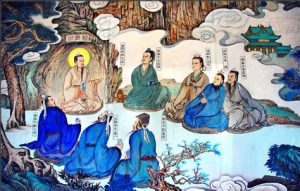
Note: In the Image posted yesterday of the Taoist Seven Masters of Quanzhen, Sun Bu Er was in the top right corner. Below in a clearer image of the same scene.
01/12/2022

Continuing the historical account of Master Sun Bu Er, compiled by Damo Mitchell from recorded history and lecture/notes, we look at Part 2:

Sun Bu Er is famous for her inner alchemy but she is also known to have been highly capable in various forms of esoteric medicine as well as in exorcisms and the performance of superhuman feats of survival and power. She was a master of the elements of fire and lightning as well as an expert in telepathic and psychic feats. Whilst none of these were the aim of her study, they are signs of her inner development that arose from her alchemical training under Wang Chong Yang.

After attaining mastery and establishing her own lineage of practice, Sun Bu Er headed West where she took her own students and lived out her life teaching and helping the needy with her healing abilities. It is said that in order to avoid the unwanted attentions of males on her journey to the West of China, she scarred her face badly with hot oil. With such extreme scars on her face, her beauty was destroyed and she was under less risk of being raped or assaulted on her journey. This is, most likely, metaphorical though as is the case with many stories of the Chinese masters. Sun Bu Er travelled ‘West’ which is often used as a metaphor for the attainment of spiritual awakening. India sits to the West of China and at this time India was heralded as a place of great spirituality to the Chinese people. To go ‘West’ meant that a person was walking the spiritual path and thus many teachers are said to have ‘gone West’ within their stories. Sun Bu Er’s beauty is used as a metaphor for attachment to the acquired mind and the egoistic side of existence. By destroying her beauty, Sun Bu Er shed the shackles of the acquired mind so that she could attain her spiritual awakening. This is particularly fitting as Sun Bu Er’s methods are very much based in cultivation of Qi along with dropping the attachments of the acquired mind; teachings in line with the Quan Zhen line within which she studied so hard.

Sun Bu Er died in her seventies (though there is some discrepancy around this age) where she entered into a meditative state in front of her key disciples and allowed her spirit to enter into the Heavenly realm; a sign of her mastery of all stages of Daoist practice. She left behind a whole series of alchemical instructions in the form of numerous short poems and two alchemical texts entitled:

The Sun Bu Er Yuan Jin Chuan Shu Dan Dao Mi Shu (孫不二元君傳述丹道秘書) ‘The Secret Book on the Alchemical Elixir Transmitted by Sun Bu Er’

Tomorrow in Part 3 we will look at some of Master Sin Bu Er’s teachings, especially her key stages of alchemical training for women. But for now, enjoy your practicing, people, and hope you stope back tomorrow.

01/11/2022

Today we begin an historical series on the development of Daoist Alchemical practices with an emphasis on the fairer sex. Master Sun Bun Er founded the Qing JIng lineage which was primarily a tradition for female practitioners of the Dao. The following account, which will be presented in several parts, was compiled and written by my teacher, Damo Mitchell, from a mix of recorded history & lectures/notes from a teacher.

Here is Part 1:

The Qing Jing (清静) lineage was founded by master Sun Bu Er (孫不二) and it was primarily a tradition for female practitioners of the Dao. Sun Bu Er was taken as one of the seven key disciples of Wang Chong Yang during the Jin (1115-1234) dynasty. She was originally married to Ma Yu who was also one of the seven key disciples of Wang Chong Yang but she was told to divorce from him once she attained expertise in the arts so that she and her husband could travel separately and help spread the teachings of the Quan Zhen line of Daoism to different regions of China.

Sun Bu Er was one of the most accomplished masters of Daoist alchemical practice as well as Daoist medicine and, as such, is often a source of inspiration for women entering into Daoist practice even to this day. She is said to have been an incredibly beautiful lady who was born into great wealth. She gave up her rich household life at the age of 51 when she met Wang Chong Yang and he inducted her as a spiritual practitioner and then teacher within his school. She studied in person with her master for 12 years in the ‘cave’ tradition, meaning that her practice was based largely on inner vision and exploration, until she attained immortality. At this stage of her spiritual journey she saw fit to found her own tradition which specialised in the teaching of female aspirants although she also took male disciples as well. The name of her tradition became the Qing Jing or ‘Pure and Tranquil’ lineage.

It was originally Sun’s husband Ma Yu (Ma Dan Yang) who started to follow the teachings of Wang Chong Yang and the Quan Zhen sect. He joined the tradition for a three-month long retreat and came back a transformed man due to his new teacher’s transmissions. Sun Bu Er was not pleased with the transformation that her husband had gone through; though she initially argued with Wang Chong Yang and wished ill of him, she came to understand his spiritual level after he performed several outlandish feats to prove himself to her. Recognising the importance of the teachings Wang Chong Yang was able to impart, she gave her blessing to Ma Yu and also joined the tradition herself.

In an uncharacteristic move for the time, Sun Bu Er left her role as a home-maker and mother to her three children; she left with the other disciples of Wang Chong Yang and chose the path of Daoism as her route through life.

– Compiled and written by Damo Mitchell from a mix of recorded history & lectures/notes from a teacher.

I will post Part 2 tomorrow. In the meantime, enjoy practicing, folks.

01/10/2022

Some truly great wisdom for today from Lao-tzu…

“Those who know don’t talk. Those who talk don’t know. Close your mouth, block off your senses, blunt your sharpness, untie your knots, soften your glare, settle your dust. This is the primal identity. Be like the Tao. It can’t be approached or withdrawn from, benefited or harmed, honored or brought into disgrace. It gives itself up continually. That is why it endures.”
― Tao Te Ching, Chapter 56

Taking an example from Lao-tzu and the Tao, we should continually give ourselves up to our practice. Enjoy, and thank for stopping by, folks

01/09/2022

“So it is said, for him who understands Heavenly joy, life is the working of Heaven; death is the transformation of things. In stillness, he and the yin share a single Virtue; in motion, he and the yang share a single flow.”
― Zhuangzi, The Complete Works of Chuang Tzu

A beautiful spring-like day in Los Angeles. I got together with some friends in the park for a little push-hands and to discuss Tai Chi. Hope your day has gone well. Get set for a week of practice.

01/08/2022

Today’s Daoist quote is a very practical reminder from Wayne Ng:

“Your Highness, were I to desire to change the world, I could not succeed. The world is shaped by the Way; the self cannot shape it. Trying to change it, you damage it; trying to possess it, you lose it.”
― Wayne Ng, Finding the Way: A Novel of Lao Tzu

Let’s see if we can follow that advice and remember what shapes the world and what cannot shape it. All we can do is enjoy practicing, folks. Thanks for stopping by.

01/07/2022

Yesterday’s quote, the Story of the Stonecutter, was a rather long one. Today’s quote it short and simple but very, very important, especially if you are an Internal Arts cultivator within the Daoist tradition. I’m sure you have heard various gurus and masters talk about heavenly spirits and angels being jealous of humans. Have you ever wondered why that is? Here’s my teacher, Damo Mitchell’s very brief take on it:

“Daoist practice is based upon the idea that primordial spirit may only be refined whilst we are living within the body. This is the meaning of life within the Daoist tradition.” – Damo Mitchell, Internal Arts Academy and Lotus Neigong.

So, this refining of the primordial spirit can only be refined here on Earth while we are alive, not in Heaven, Not in Purgatory or anywhere else. So, enjoy practicing, folks, this is the only place and the only time you can refine the Spirit.

01/06/2022

Ready for a long one? This is from the “Be careful what you wish for” file, the story of the Stonecutter, courtesy of Benjamin Huff.

“There was once a stonecutter, who was dissatisfied with himself and with his position in life. One day, he passed a wealthy merchant’s house, and through the open gateway, saw many fine possessions and important visitors. “How powerful that merchant must be!” thought the stonecutter. He became very envious, and wished that he could be like the merchant. Then he would no longer have to live the life of a mere stonecutter. To his great surprise, he suddenly became the merchant, enjoying more luxuries and power than he had ever dreamed of, envied and detested by those less wealthy than himself. But soon a high official passed by, carried in a sedan chair, accompanied by attendants, and escorted by soldiers beating gongs. Everyone, no matter how wealthy, had to bow low before the procession. “How powerful that official is!” he thought. “I wish that I could be a high official!” Then he became the high official, carried everywhere in his embroidered sedan chair, feared and hated by the people all around, who had to bow down before him as he passed. It was a hot summer day, and the official felt very uncomfortable in the sticky sedan chair. He looked up at the sun. It shone proudly in the sky, unaffected by his presence. “How powerful the sun is!” he thought “I wish that I could be the sun!” Then he became the sun, shining fiercely down on everyone, scorching the fields, cursed by the farmers and laborers. But a huge black cloud moved between him and the earth, so that his light could no longer shine on everything below. “How powerful that storm cloud is!” he thought. “I wish that I could be a cloud!” Then he became the cloud, flooding the fields and villages, shouted at by everyone. But soon he found that he was being pushed away by some great force, and realized that it was the wind. “How powerful it is!” he thought. “I wish that I could be the wind!” Then he became the wind, blowing tiles off the roofs of houses, uprooting trees, hated and feared by all below him. But after a while, he ran up against something that would not move, no matter how forcefully he blew against it–a huge, towering stone “How powerful that stone is”” he thought. I wish that I could be a stone!” Then he became the stone, more powerful than anything else on earth. But as he stood there, he heard the sound of a hammer pounding a chisel into the solid rock, and felt himself being changed. “What could be more powerful than I, the stone?” he thought. He looked down and saw far below him the fixture of a stonecutter.”
― Benjamin Hoff, The Tao of Pooh

So, be careful what you wish for and cultivate an attitude of Acceptance as you follow the Way. Enjoy practicing, folks. And thanks for stopping by.

01/05/2022

Do you Know what the “Te” alludes to in the Tao “Te” Ching? Today, in a short excerpt from her commentary on Hexagram #9 Xiao Chu/Small Restraint or Accumulation, Kari Hohne of CafeAuSoul.com will tell us what the idea of “Te” is. Although it is a short and simple quote, the actual practice is anything but simple.

“In Taoism, the idea of ‘Te’ is the inherent authenticity that you are born with. You need only peel away the layers of fear that keep you from expressing it. In either case, you will need to approach the object of your enquiry with gentle submissiveness to exercise, discover or release your power. Defensiveness ensures that the negative outcome is relentless. Submissiveness always opens new doors for success so simply surrender to the Way.” – Kari Hohne, commentary on Hexagram 9, Xiao Chu/Small Restraint.

Like I said, it sounds simple, but when you get right down to the practice, it can be rather daunting. But don’t let that hold you back. Go for it and practice diligently and joyfully, people.

01/04/2022

Are you practicing true benevolence? Or do you just think you are? Let’s find out from no better authority than Chuang-tzu…

“All attempts to create something admirable are the weapons of evil. You may think you are practicing benevolence and righteousness, but in effect you will be creating a kind of artificiality. Where a model exists, copies will be made of it; where success has been gained, boasting follows; where debate exists, there will be outbreaks of hostility.”
― Zhuangzi, The Complete Works of Chuang Tzu

Whether it’s benevolence or Internal Arts, let’s make it real and not artificial. Enjoy the cultivation, people!

01/03/2022

Who do you trust? Well, let’s check in with Stephen Russell and find out:

“You can trust everyone to be human, with all the quirks and inconsistencies we humans display, including disloyalty, dishonesty and downright treachery. We are all capable of the entire range of human behavior, given the circumstances, from absolute saintliness to abject depravity. Trusting someone to limit their sphere of action to one narrow band on the spectrum is idealistic and will inevitably lead to disappointment.

“On the other hand, you can decide to trust that everyone is doing their best according to their particular stage of development, and to give everyone their appropriate berth. For this to work, you have to trust yourself to make and have made the right choices that will lead you on the path to your healthy growth. You have to trust yourself to come through every experience safely and enriched. But don’t trust what I am saying. Listen and then decide for yourself. Does this information sit easily in your belly? You know when you trust yourself around someone because your belly feels settled and your heart feels warm.”
― Stephen Russell, Barefoot Doctor’s Guide to the Tao: A Spiritual Handbook for the Urban Warrior

And I trust you will enjoy practicing. So, get to it, folks.

01/02/2022

Today’s quote is from Laozi and the Tao Te Ching, Chapter 11, reminding us as we start of this new year of the “usefulness of what is not there,” in other words, emptiness.

“Thirty spokes share the wheel’s hub;
It is the center hole that makes it useful.
Shape clay into a vessel;
It is the space within that makes it useful.
Cut doors and windows for a room;
It is the holes which make it useful.
Therefore profit comes from what is there;
Usefulness from what is not there.”
– Laozi, Tao Te Ching, Ch. 11

So, empty out those things inside that aren’t useful to your cultivation, and enjoy your practicing, folks!

01/01/2022 – NEW YEAR’S DAY

We start off the 2022 with a quote from my teacher, Damo Mitchell, www.DamoMitchell.com, commenting on a line from the Tao Te Ching:

“Humanity follows the Earth, the Earth follows Heaven, Heaven follows the Dao, and the Dao follows what is natural.” (Ch. 25, Tao Te Ching)
Essentially translated as: your state of being will follow the conditions of the body which, in turn follow the condition of the mind. The mind is dictated by the unfolding path that originates from a place of non-conditioning.
It is a line that describes the nature of the tradition of Daoism and how, through internal training, the conditioned root of conscious distortion is eliminated and thus a person may experience a state of true being.
It has nothing to do with respecting the Earth, being spontaneous or being one with nature”
– Damo Mitchell, Internal Arts Academy and Lotus Neigong

So get ready for your best year of practice and cultivation ever. Enjoy, everyone!

Daoist Daily Diary

12/31/2021

On this last day of 2021, we give this year’s last selection to the I Ching, Hexagram #22, Bi/Grace, via two excerpts of a commentary by Kari Hohne, CafeAuSoul.com leaving us with a message of Hope and Grace for a bright and resilient 2022 after a very difficult 2021.

“The greatest lesson Bi teaches you is that no amount of outward adorning will ever conceal what is going on inside of you. If you want to attract others to you, begin within. Loving the self makes one loving. Accepting the Way makes one accepting. When you have no preconceived expectations you will open to the beauty of Grace. Brilliant inner beauty is like a magnet that others can’t resist. If circumstances are less than favorable, turn within and release the expectations that are making your outlook hardened. Take a breath and return to the moment…

“Do not fall prey to believing that the projections you place on others are real. Open yourself to life’s Grace and benevolence. Celebrate your inner Grace and allow it to rise to the surface. Unleash any expectations and flow in the dazzling river of life. The greatest makeover begins within. If you want to be attractive adorn yourself with the Grace that resonates from the sincerity of trusting the Way.”

Have a wonderful 2022 and a joyful road to Cultivation by following the Way.


12/30/2021

As we head into the last day of 2021, we have a final thought from Chuang-tzu:

“The fact is that those who do not see themselves but who see others, who fail to get a grasp of themselves but who grasp others, take possession of what others have but fail to possess themselves. They are attracted to what others enjoy but fail to find enjoyment in themselves.”
― Zhuangzi, The Book of Chuang Tzu

Very good advice, indeed, from this perspicacious Sage. See if you can adopt it in your daily life and with regular practice you may become a Sage, too. Enjoy the practice and thanks for stopping by.


12/29/2021

I usually don’t go in for artificial visualizations or structured imagings especially in meditation. However, with 2022 fast approaching and all of 2021’s disharmonies and turmoils, both natural and man-made, about to be handed off to the New Year in the midst of a transition from a Magnetic Age into an Electrical Age, I think we could all use this visualization presented by Stephen Russell:

“For a few moments, attune your mind to the idea of harmony and peaceful coexistence flowing among all peoples and nations.
The source of this idea is deep within your heart.
As you calmly breathe in and out, picture it radiating from you like a fine, colored vapor gradually covering the face of the earth.
See it enter the hearts of everyone, especially those stuck in the mad zones.
Feel it circulate everywhere until it comes all the way round and back to you.
This is love in action.
The source of this love is the Tao.
Savor this.”
― Stephen Russell, Barefoot Doctor’s Guide to the Tao: A Spiritual Handbook for the Urban Warrior

I hope you can enjoy these last couple of days of 2021 along with your last practices of the year. Best wishes and thanks for stopping by.


12/28/2021

As 2022 approaches, we can expect further divisiveness and radicalization as pitifully stupid minds pit their philosophy, their way of thinking, their beliefs against whomever they consider at best their counterparts and at worst their enemies. But way back in the Sixth Century, a Chinese philosopher wrote a poem describing what is causing this erratic behavior.

“Hsin Hsin Ming” aka “Xinxin Ming,” meaning “Faith in Mind”, is a poem attributed to the Third Chinese Chán Patriarch Jianzhi Sengcan. It is one of the earliest and most influential Zen writings, blending together Buddhist and Taoist teachings. Here is an excerpt:

“The Great Way is not difficult,
for those who have no preferences.
Let go of longing and aversion,
and it reveals itself.
Make the smallest distinction, however,
and you are as far from it as heaven is from earth.
If you want to realize the truth,
then hold no opinions for or against anything.
Like and dislike
is the disease of the mind.
When the deep meaning (of the Way) is not understood
the intrinsic peace of mind is disturbed”

Perhaps you can be aware of these thoughts as you move through your day and get ready for the new year. In any case, enjoy your practice, and thanks for stopping by.


12/27/2021

I received an email today from Stacey Abrams, who is campaigning to become the next Governor of Georgia in 2022. In that email, she told a personal anecdote that reminded me of this quote by Laozi in Chapter 77 of the Tao Te Ching:

“It is the way of Heaven to take away from those that have too much
And give to those that have not enough.
Not so with man’s way:
He takes from those that have not
And gives it as tribute to those that have too much.”

How true that is of many in government, who put their own self interests ahead of the true needs of all their people, especially those that have not. Here is Stacey Abrams’ anecdote from her email:

“I was my high school’s valedictorian and in Georgia, that meant being invited to a reception at the Governor’s Mansion.

My family didn’t have a car, so that morning, my parents and I took the bus from DeKalb to Buckhead. We arrived at the Governor’s Mansion and walked up the side of the driveway, next to the cars carrying valedictorians from across the state.

But when we reached the guard gate, a guard stepped out, looked at us and said, “You don’t belong here. This is a private event.”

He took one look at us walking up from the bus and assumed I couldn’t possibly be one of the valedictorians. My parents set him straight and we were eventually allowed in. But I don’t remember meeting the governor that day. What I remember is a man standing in front of the most powerful place in Georgia, telling me I didn’t belong.”

Ironically enough, now Stacey Abrams is campaigning for Governor. So, if you would like to contribute, I suggest you contact: StaceyAbrams.com

Enjoy your practicing, folks. Thanks for stopping by.


12/26/2021

During this holiday season many of us have traveled either near or far to be with family or friends. So, going back to that ancient Sage, Lieh-tzu we read his thoughts on travel as an experience. If you are stuck in an airport trying to return home but your flight has been cancelled due to the Omicron COVID-19 varient, I’m sure this is one experience you would rather forget.

“Travel is such a wonderful experience! Especially when you forget you are traveling. Then you will enjoy whatever you see and do. Those who look into themselves when they travel will not think about what they see. In fact, there is no distinction between the viewer and the seen. You experience everything with the totality of yourself, so that every blade of grass, every mountain, every lake is alive and is a part of you. When there is no division between you and what is other, this is the ultimate experience of traveling.”
― Liezi, Lieh-tzu: A Taoist Guide to Practical Living

12/25/2021 – Christmas Day

Christmas is a time for joy. We can all appreciate the joyful gatherings with friends and loved ones, the gifts and sumptuous meals. But Christmas is also about seeing the silver lining for those who are alone or facing less than favorable circumstances. But who truly knows what is good or bad, favorable or unfavorable? So, here is a Taoist story exactly about that, seeing the silver lining in unfortunate times as well as remembering that favorable circumstances don’t last forever.

“There was a farmer whose horse ran away. That evening the neighbors gathered to commiserate with him since this was such bad luck. He said, “May be.” The next day the horse returned, but brought with it six wild horses, and the neighbors came exclaiming at his good fortune. He said, “May be.” And then, the following day, his son tried to saddle and ride one of the wild horses, was thrown, and broke his leg.

Again the neighbors came to offer their sympathy for the misfortune. He said, “May be.” The day after that, conscription officers came to the village to seize young men for the army, but because of the broken leg the farmer’s son was rejected. When the neighbors came in to say how fortunately everything had turned out, he said, “May be.”

Source: Tao: The Watercourse Way, by Alan Watts, story attributed to Huainantse Liu An, c. 178-122 BC,

Merry Christmas and Happy Holidays, everyone!


12/24/2021 – Christmas Eve

On this Christmas Eve, honoring the birth of the Holy Infant, the words of Laozi comparing the qualities of a realized Sage with those of a newborn child seem appropriate. I offer them amid a confused and divisive world in the hope that all of its people can reacquire those qualities they had as newborn infants, and furthermore, I pray to end infant mortality throughout the world.

“He who is in harmony with the Tao
is like a newborn child.
Its bones are soft, its muscles are weak,
but its grip is powerful.
It doesn’t know about the union
of male and female,
yet its penis can stand erect,
so intense is its vital power.
It can scream its head off all day,
yet it never becomes hoarse,
so complete is its harmony.

The Master’s power is like this.
He lets all things come and go
effortlessly, without desire.
He never expects results;
thus he is never disappointed.
He is never disappointed;
thus his spirit never grows old.”
― Lao Tzu, Tao Te Ching, Ch. 55


12/23/2021

In keeping with Christmas week, instead of the usual short Daoist quotes, I am posting longer ones that keep to the spirit of this time of the year. Next up is an excerpt from the very popular book, “The Tao of Pooh”

“…you’d be surprised how many people violate this simple principle every day of their lives and try to fit square pegs into round holes, ignoring the clear reality that Things Are As They Are. We will let a selection from the writings of Chuang-tse illustrate: Hui-tse said to Chuang-tse, “I have a large tree which no carpenter can cut into lumber. Its branches and trunk are crooked and tough, covered with bumps and depressions. No builder would turn his head to look at it. Your teachings are the same – useless, without value. Therefore, no one pays attention to them.”

“You complain that your tree is not valuable as lumber. But you could make use of the shade it provides, rest under its sheltering branches, and stroll beneath it, admiring its character and appearance. Since it would not be endangered by an axe, what could threaten its existence? It is useless to you only because you want to make it into something else and do not use it in its proper way.”
― Benjamin Hoff, The Tao of Pooh

Enjoy this Holiday Season and keep practicing, everyone. Thanks for stopping by.

12/22/2021

In keeping with Christmas week, instead of the usual short Daoist quotes, I am posting longer ones that keep to the spirit of this time of the year. Next up is Stephen Russell, the Barefoot Doctor.

“Vulnerability is the only authentic state. Being vulnerable means being open, for wounding, but also for pleasure. Being open to the wounds of life means also being open to the bounty and beauty. Don’t mask or deny your vulnerability: it is your greatest asset. Be vulnerable: quake and shake in your boots with it. the new goodness that is coming to you, in the form of people, situations, and things can only come to you when you are vulnerable, i.e. open.”
― Stephen Russell, Barefoot Doctor’s Guide to the Tao: A Spiritual Handbook for the Urban Warrior

12/21/2021

Being that it is Christmas week, instead of the usual short Daoist quotes, I am posting longer ones that keep to the spirit of this time of the year. First up, is Liezi, an Ancient Daoist Sage and Adept from the 5th Century B.C.

“Some people think they can find satisfaction in good food, fine clothes, lively music, and sexual pleasure. However, when they have all these things, they are not satisfied. They realize happiness is not simply having their material needs met. Thus, society has set up a system of rewards that go beyond material goods. These include titles, social recognition, status, and political power, all wrapped up in a package called self-fulfillment. Attracted by these prizes and goaded on by social pressure, people spend their short lives tiring body and mind to chase after these goals. Perhaps this gives them the feeling that they have achieved something in their lives, but in reality they have sacrificed a lot in life. They can no longer see, hear, act, feel, or think from their hearts. Everything they do is dictated by whether it can get them social gains. In the end, they’ve spent their lives following other people’s demands and never lived a life of their own. How different is this from the life of a slave or a prisoner?”
― Liezi, Lieh-tzu: A Taoist Guide to Practical Living

Enjoy this Holiday Season and keep practicing, everyone. Thanks for stopping by.

12/20/2021

“Taoism has no rules. It`s a suggestion for perceiving life in its wholeness, without unnecessary categorization, yet enjoying the beauty of categorization.” – Frederick Lenz

Now that we have looked at “Song” in Tai Chi, we return to “Peng,” the next step in Tai Chi development. In today’s video from The Tai Chi Academy, we look at how utilizing ‘Peng’ in our structure can lead to the error of ‘forming up’ behind the point of contact. This is a very important point that corrects a common mistake that most tai chi practitioners make when pushing hands. (Click on link below.)

https://youtu.be/PwEfJsXh6nQ

12/18-19/2021

“You must let what happens happen. Everything must be equal in your eyes, good and evil, beautiful and ugly, foolish and wise.” – Michael Ende

Have a great weekend, everyone. Our exploration of “Song” and “Peng” in Tai Chi resumes on Monday. Meanwhile, enjoy your practice.


12/17/2021

“Taoism is simply the complete acceptance of yourself as you are right in this moment.” – Sheila M. Burke

Continuing our review of “Song,” the most important quality for Tai Chi practitioners to acquire, today we have a special exercise to enable the quality of “Song,” called “Song Gong,” designed by Grand Master Huang Xin Xian and presented by famous martial artist and tai chi master, Adam Mizner. This is one exercise you should put into your warmups whenever possible. Enjoy your practicing, folks, and thanks for stopping by.


12/16/2021

“Be Content with what you have; rejoice in the way things are. When you realize there is nothing lacking, the whole world belongs to you” – Lao Tzu

Continuing with the concept of “Song,” the most important quality for Tai Chi practitioners to acquire, today we Have Dan Kleiman explaining the difference between relaxation and true “Song,” where there is a balance between letting go and keeping a springy, buoyant structure.

If you haven’t already, you will definitely want to incorporate Dan’s focal points into your daily practice, which, by the way, I hope your are enjoying immensely, folks. Thanks for stopping by.


12/15/2021

“Great power is worry, and total power is boredom, such that even God renounces it and pretends, instead, that he is people and fish and insects and plants: the myth of the king who goes wandering among his subjects in disguise.” – Alan W. Watts

Currently, we are looking at the Number 1 quality for Tai Chi, namely, “Song.” Without being Song, your qi energy will not flow properly through your form. Without Song, you cannot expect to develop Peng Jin, which we looked at previously. Today, Tai Chi Instructor Susan Thompson teaches you how to “song” the joints during your Tai Chi movements, no matter which style you do. She also explains why it is important to song the joints and what it does for your Qi flow and physiology.

So, take a look. See if you can incorporate Susan’s points into your practice. And thanks for stopping by


12/14/2021

“But the basic Taoism that we are concerned with here is simply a particular way of appreciating, learning from, and working with whatever happens in everyday life.” – Benjamin Hoff

Today we continue with our exploration of the important Tai Chi quality of “Song,” presented by the Tai Chi Academy. In this 6-minute video, the diverse teachings on Song are broken down into a simple concept called ‘Relative Density.’ Take a look and see if this resonates with your practice. And, above all, enjoy practicing, folks.


12/13/2021

“Taoism is the way of water. The most frequent element or symbol referred to in Lao Tzu`s writings is the symbol of water.” – Frederick Lenz

Today we begin looking at one of the most important qualities in tai chi, namely “Song,” often mistranslated as “Relax.” Kieren Krygier, the Martial Man, returns again with Sifu Liang DeHua to discuss and demonstrate “Song.” This is really a quality you must develop not only tai chi but for your complete cultivation. So, enjoy, everyone, and keep practicing.


12/12/2021

“Embrace simplicity. Put others first. Desire little.” – Laozi

Chilly day in Los Angeles but sunny fortunately. I went to the park as usual for push hands. Not too many people at the first park. My former mentor showed up. We had an interesting discussion. Then I went to another park to meet with my training partner. We exchanged views on methods and exercises are teacher uses to condition our bodies for tai chi and neigong.

Don’t forget. We start our series on developing “Song” tomorrow, Monday; So, again, rest up and prepare for a full week of practice, everyone.


12/11/2021

“Taoism is the profoundest nonconformism that has ever been evolved anywhere in the world, at any time in history; essentially it is rebellion.” – Osho

Yesterday, Taoist Monk Yun Rou explained how Peng Jin and An Jin compliment one another. Today, he shows us how these two jins are used in partner work.

In Tai Chi, before one can develop Jin, one must have “Song,” often translated incorrectly as “relax.” We will begin a series abput the nature of “Song” and how to acquire it on Monday. Have a great weekend, and rest up for a full week of practicing, everyone.

12/10/2021

“Taoism means stretching your being, becoming both a man and a woman and joining within yourself, to be the heavens themselves, to stretch your awareness beyond the breaking point until all opposites are reconciled within yourself.” – Frederick Lenz

Daoist Monk Yun Rou is back again today continuing this series on Taiji Jin. In this short video Yun Rou adds An Jin to his demonstration of Peng Jin from yesterday thus completing a Vertical Energy Circle of Jin. Hope this material along with the other videos on Jin had added to your development. As always, enjoy practicing, everyone.


12/09/2021

“Some people think Taoism means not doing anything, just going on with your life. That has little or nothing to do with Taoism.” – Frederick Lenz

Today we are taking a look at the first quality of Jin, namely Peng Jin, with Daoist Monk Yun Rou. Unlike many, who believe Peng is simply a posture, Yun Rou points out the fact that Peng is actually a quality that encompasses a direction of movement. Hope you enjoy this short video, and, above all, enjoy your practicing. Thanks for stopping by, folks!


12/08/2021

“All of Chinese thinking – Confucianism, Taoism, as well as Buddhism – contains the idea that in the course of life, man will shape harmoniously those psychic and physical predispositions that he received as capital assets by unifying them and giving them form from within a center.” – Richard Wilhelm

Today Sifu Liang DeHua is back again with a discussion and demonstration of Nei Jin and Fa Jin. Tomorrow we will take a look at the most important Jin, namely Peng Jin. Thanks for watching, and enjoy your practice, people.


12/07/2021

“Taoists do not look upon meditation as `practice,` except in the sense that a doctor `practices` medicine. They have no design to subjugate or alter the universe by force or willpower, for their art is entirely to go along with the flow of things in an intelligent way.” – Alan W. Watts

Yesterday, we posted Part 1 of Sifu Liang De Hua’s explanation of Taiji Jin. Today, here is Part II, present by Kieren Krygier, the Martial Man. Enjoy. And keep practicing, folks.


12/06/2021

“Lao-tze`s Taoism is the exhibition of a way or method of living which men should cultivate as the highest and purest development of their nature.” – James Legge

There are many marvelous tai chi and qigong practitioners/instructors throughout Southeast Asia. So, continuing our series on Jin, today we have the first of will a two part video series on Jin with Sifu Liang De Hua presented by Kieren Krygier, the Martial Man. Hope you not only enjoy the video but learn something that you can practice. Tomorrow, we will have Part II. So, stay tuned and enjoy practicing, folks!


12/05/2021

“We may be floating on Tao, but there is nothing wrong with steering. If Tao is like a river, it is certainly good to know where the rocks are.” – Ming-Dao Deng

A cold mostly foggy Sunday in Los Angeles, at least in the morning. I went to the park to work with my friends on push hands and developing Jin. The sun popped out in the afternoon to warm things up a little. I was happy about that.

Although Zhan Zhuang is important, it is not as important to the early stages of developing jin as Wuji. So, I decided not to post Part 2 of Cain Yentzer’s Zhan Zhuang standing practice. Besides, there were a couple points that almost all Qigong and Tai Chi instructors teach, but they are not consistent with my practice of Nei Gong and Jin development for Taiji. Instead, Wuji standing should be done first to begin developing Jin. So, I will have a series on Wuji next.

However, continuing with this Jin series, I will have a two part video series on Jin with Sifu Liang De Hua starting tomorrow. Keep practicing and have a great week, everyone.


12/04/2021

“Man suffers only because he takes seriously what the gods made for fun.” – Alan W. Watts

Yesterday, we listened to Adam Mizner explaining “What is Taichi Jin Power Really Like?” Continuing our series on Jin, today we have Cain Yentzer from Inner Court Tai-ji with a 9-minute lecture on how Zhan Zhuang (Post Standing) is the key to developing Jin and understanding taiji. Tomorrow, we will have Cain Yentzer with Part II, the actual practice of Zhan Zhuang with instructions on its focal points. So, get ready to do some serious standing and make sure you add it into your practice if you haven’t already. Thanks for stopping by, everyone.


12/03/2021

“When a not-doing comes upon you, and there is no reflection of yourself to be found, many things can and will be related back to you as knowledge, yet you have no way of knowing how you assimilated that wisdom.” – Lujan Matus

Today we start a new series on Jin and Fajin as they related to taiji and its practitioners. We begin with Sifu Adam Mizner explaining “What is Taichi Jin Power Really Like?” Again, you can slow the playback speed if there is anything you don’t understand and replay it as often as you like. And then, guess what? Go out and practice with a partner. Good luck and thanks for stopping by. We’ll have more on Jin and Fajin tomorrow.

12/02/2021

“Taoism shows us how to deal with life and death by realizing everything here is transitory but its substance is eternal.” – Frederick Lenz

Today we will look at the fourth and final Dao Yin Dragon, Drunken Dragon, sort of. Unfortunately, I could not find an individual track with the Drunken Dragon online. One would have to enroll in either Lotus Neigong or the Internal Arts Academy at DamoMitchell.com to view Damo Mitchell’s instructional videos. However, I did find a compilation video by Kit Raven, performing all four dragons. The last one is the Drunken Dragon, which starts at 8:55 in the video. It’s not completely correct, but if you use it as a stretching and balance sequence, you should be fine. As aways, enjoy practicing, folks. And thanks for stopping by.


12/01/2021

“Taoism extols the virtue of flexibility. What survives on earth is what effortlessly adapts to the changing environment and changing circumstances.” – Ernie J Zelinski

Previously we have looked at the first two of the Four Dao Yin Dragons, Soaring Dragon and Swimming Dragon. Today we look at the third Dao Yin Dragon in our series Awakening Dragon. Again, you can stop or rewind this short video as often as you like and play it back at a slower speed if you wish. Follow along and then practice it in 10 or 15-minute bursts. Good luck with it and enjoy your practice. Thanks for stopping by.

THE DAOIST DAILY DIARY

11/30/2021

“To Taoism that which is absolutely still or absolutely perfect is absolutely dead, for without the possibility of growth and change there can be no Tao. In reality there is nothing in the universe which is completely perfect or completely still; it is only in the minds of men that such concepts exist.” – Alan W. Watts

Today we take a look at our second Dao Yin Dragon sequence, Swimming Dragon. This is the easiest of the Dragons to perform. You should have no problems following along with the video. The one note I will mention is that the feet are parallel and not angled as with yesterday’s Soaring or Arousing Dragon. In case you had trouble performing that one, you can scroll down to 11/24 and the Dao Yin Dragon Basic Stretches. In the video, look for the one titled “Coiling Snake.” That is the basic posture of the Soaring Dragon without stepping forward. Now just add the steps to it from yesterday’s video and have a great time practicing these two Dragons, folks!


11/29/2021

Welcome back, everyone! I hope no one got terminal indigestion from stuffing themselves on Thanksgiving, and I certainly hope no one was seriously injured from fighting through the hordes of shoppers on Black Friday. I’m glad that you are in one piece and can join me once again as we continue the series on the Dao Yin Dragons. Previously we viewed a podcast on Qigong vs Dao Yin and practice some Dao Yin preparatory stretches.

Today we look at the first exercise set in the Dao Yin Dragons called Soaring Dragon. If you have a difficult time following the movements then slow down the video to .75 or even .50. Since there are no audio instructions, you can slow this up as much as you would like and pause and replay it at any point.


11/28/2021

Another magnificent weekend in Los Angeles and the San Gabriel Valley. Temperature is in the 80s and the air is clean and fresh. A wonderful day to spend in the park doing tui shou with my tai chi brothers and sisters. Hope you have enjoyed your weekend and are ready to a full week of practicing. Thanks for stopping by. See you on Monday when we resume our series on the Dao Yin Dragons.

11/27/2021 Small Business Saturday

Today was Small Business Saturday. I hope you shopped at a small business like this one…

11/26/2021 Black Friday

Found an appropriate quote from Zhuangzi for today, Black Friday…

“The Kingly Man

My master said:
That which acts on all and meddles in none – is heaven . . .
The Kingly Man realizes this, hides it in his heart,
Grows boundless, wide-minded, draws all to himself.
And so he lets the gold lie hidden in the mountain,
Leaves the pearl lying in the deep.

Goods and possessions are no gain in his eyes,
He stays far from wealth and honour.
Long life is no ground for joy, nor early death for sorrow
Success is not for him to be proud of, failure is no shame.

Had he all the world’s power he would not hold it as his own,
If he conquered everything he would not take it to himself.
His glory is in knowing that all things come together in One
And life and death are equal.”
― Thomas Merton, The Way of Chuang Tzu

Happy Black Friday, everyone!

11/25/2021 Thanksgiving Day

“Be content with what you have;
rejoice in the way things are.
When you realize there is nothing lacking,
the whole world belongs to you.”
– Laozi

Happy Thanksgiving to Everyone! If you’re like me, I’m sure you have much to be thankful for. Just to be alive is plenty, and to appreciate life for what it is deepens our gratitude and adds an immense blessing to all we are and do. Have a wonderful day, celebrating Life by Giving Thanks. Bless you, one and all.

11/24/2021

“To a mind that is still the whole Universe surrenders.” – Lao Tzu

Continuing with our series on the Dao Yin Dragons. Here is a short video on Dao Yin Basic Warmup Stretches by Nikolas Benedikt of Mountain Pathways – an affiliate branch of Lotus Nei Gong International., a Damo Mitchell school. Watch the video several times and follow along until you feel proficient. You can slow the playback speed if necessary.

And in case you don’t stop by tomorrow, have a Happy and Safe Thanksgiving. Since many of you will be travelling and visiting family, we will resume the series on the Dragon Dao Yins on Monday. But the Holiday is no excuse not to practice, especially after gorging yourself with whatever Thanksgiving feast you are having.

11/23/2021

One of the more important aspects of Neigong training, especially in the beginning, are the Dao Yin Dragons. These are a series of choreographed stretches that open the fascia and the connective tissues that enable a more robust flow of Qi. There are four Dragons: Awakening Dragon, Swimming Dragon, Soaring Dragon and Drunken Dragon. Some liken them to Qigong and other actually classify them as Qigong exercises, but they are not. Because of the intensity of their stretches, they are in a class by themselves.

Today we start a short series on the Dao Yin Dragons with a podcast by Kong Jie, who discusses the basics of Dao Yin in general as well as how it differs from standard Qigong. He speaks rather quickly. So, if you cannot understand some of his points, adjust the playback speed from Normal to .75. And have a great practice, everyone.


11/22/2021

“Only when we can start with the simplest exercise of absorbing the awareness into the body and increasingly relaxing our mind will we enable the evolution of our breathing processes to lead towards a true state of Gong.” – Damo Mitchell

Today, we conclude our series on Taoist Breathwork not with another breathing exercise, but with a podcast on where the proper breathing takes us once we have developed true abdominal breathing. What happens then is that the breath becomes a major factor in building the dan tian and filling it with Qi. So, today we have Damo Mitchell of Lotus Neigong and the Internal Arts Academy explaining how the process works in a podcast entitled “Filling the Dantien Bucket.” Hopefully, this will clear up some misconceptions and put you on the correct path that leads to a true state of Gong. Enjoy your practicing, everyone! Thanks for stopping by.


11/21/2021

A magnificent day in Los Angeles and the San Gabriel Valley. Temperature is in the 80s and the air is clean and fresh. A wonderful day to spend in the park doing tui shou with my tai chi brothers and sisters. Hope you have enjoyed your weekend and are ready to a full week of practicing. Thanks for stopping by. See you on Monday.

11/20/2021

“There is nothing to try to do, for whatever comes up moment by moment is accepted, including non-acceptance.” – Bruce Lee

Today we look at another very specific breathing practice – Tu Gu Na Xin or Tu Na for short. This is not for everyday breathing or to be used in your Internal Arts Qigong, Neigong or Taiji exercises. This is a stand alone practice that one does in short 5-round or 10-round bursts before or directly after practice or as a breath refresher during the day.

Taoists directly relate ones quality of breath with their quality of life. Tu Gu Na Xin is a Daoist breathing method that cleans and clears the lungs. This allows for deeper, fuller breaths, contributing to a richer experience of life. This video teaches you to assess your breath capacity in addition to various methods for improving overall lung health and riding them of toxins.

It is presented by David Wei, a 16th generation lineage holder for the Wudang San Feng Life Nourishment Sect. He has over 20 years of experience in Taoist arts and culture, with a specialization in Tui Na acupressure. David is also the founder of Wudang West, an Oakland-based Heritage Center aimed to practice and preserve the cultural wellness arts of Wudang, China.


11/19/2021

“As you “observe the breath” for longer, you will naturally start to become aware of the nature of Qi moving within your system.” – Damo Mitchell

Today, we are going to look at another form of Taoist breathing techniques known as “Bone Breathing.” This is not the same as “Bone Marrow Washing” but is simply a breathing technique to soften the connective tissue around the bones and thus create a greater flow of Qi within your channel system. It is a simple technique to learn and even adapt to your Qigong exercises. It is presented here by Dr. David Clippinger of Still Mountain Tai Chi in a short six-minute video. Enjoy your practicing, folks, and thanks so much for stopping by.

11/18/2021

“We have to breath anyway. We might as well be breathing efficiently and with power.” – Lee Holden

Over the last two days we listened to Sifu Mark Rasmus explain and demonstrate Internal Breathing Methods, namely Vital Pore Breathing or Whole Body Breathing. Today Sifu Rasmus is back with us presenting a very specific type of breathing known as “Dragon Breathing.” This is particular method specializes in strengthening virility, increasing testosterone and also fast tracks an astral feeling of qi. So, get comfortable, listen to Sifu Rasmus’ instructions and follow along. Hopefully, you will find this method useful and effective. Enjoy your practicing, folks, and thanks for stopping by.


11/17/2021

“Every conscious breath is qigong” – Sebastian Wunches

Yesterday, we viewed a podcast by Sifu Mark Rasmus on Internal Breathing Methods with the focus on Pore or Vital Breathing also called Whole Body Breathing. Today, in a short 7-minute video Sifu Rasmus guides us through a Whole Body Breathing exercise. Follow along and see how Rasmus’ method resonates with you and your body. As always, have a great practice, everyone. And thanks for stopping by.

\11/16/2021

“Unwilling to face our deepest fears, we breathe our emotions; and our emotions in turn breathe us.”

Yesterday we heard from Armand at ChiSkills.com in Holland, a long-time desciple of Sifu Mark Rasmus. Today, we hear directly from Sifu Rasmus, himself, in this first part on Internal Breathing Methods, where he focuses on Pore or Vital Breathing also called Whole Body Breathing. Tomorrow, we will take a look at the second part and practice this method along with Sifu Rasmus. This is a short 5-minute talk today, so enjoy and see if you can work some of his points into your practice. And thanks for stopping by.


11/15/2021

“Extreme softness begets extreme hardness. Your ability to be lively lies in your ability to breathe.” From Understanding How to Practice the Thirteen Dynamics (of Zhang San Feng)

Our thanks to Damo Mitchell of Lotus Neigong and the Internal Arts Academy for starting off this series on Taoist Breathwork. If you missed his “Anchoring the Breath, Parts 1 & 2” podcast, just scroll down this page to 11/12 for Part1 and 11/13 for Part 2. Today we are going to learn about Pore Breathing or Vital Breathing from Armand at ChiSkills.com in Holland. Armand has been a long-time disciple of Sifu Mark Rasmus. We will hear from Sifu Rasmus starting tomorrow. But, in the meantime, Armand explains the basics of pore breathing and leads us in an exercise. I hope you enjoy this short video and gain enough practical information that you can put into practice right away. So enjoy and have a great practice, everyone. Thanks for stopping by.

11/14/2021

Another beautiful weekend in Los Angeles. Height of Summer weather here in the middle of November. I enjoyed a day at the park today doing tui shou with my friends. How about you? Hope your getting some rest tonight to prepare for a week of practice. As always, good practicing, folks!

11/13/2021

“Tension is stagnation, which causes blockages in the channels. A healthy flow of Qi serves to end emotional tension.”

Yesterday, we began to look at the Taoist methods of breathwork. Damo Mitchell, the Director of Lotus Neigong and the Internal Arts Academy, led us off with an explanation of the Taoist practice of “Anchoring the Breath, Part 1.” If you missed it, please scroll down to yesterday’s post 11/12 before going on to today’s video of “Anchoring the Breath, Part 2,” where you can follow along with Damo Mitchell as he shows us how to develop this practice. Enjoy, everyone. And have a great weekend. See you on Monday.

11/12/2021

“When we reach a high level of breathing practice, our breath can become a form of release from tension and stress.”

Breathing has a special place in Taoist Alchemy. It is where beginners start their practice and continues through all the levels of cultivation. It is responsible for breaking up stagnation and moving the different forms of Qi through the channels. So, over the next few days we will look at several form of breathing practices and exercises.

We begin today with an explanation a basic Taoist breathing practice called “Anchoring the Breath” by Damo Mitchell, Director of Lotus Neigong and the Internal Arts Academy.

11/11/2021

Perhaps the two most consistent themes or qualities running through the Tao Te Ching are Moderation and Modesty/Humility.

Chapter 9 is exclusively about Moderation:
“Stretch (a bow) to the very full,
And you will wish you had stopped in time.
Temper a (sword-edge) to its very sharpest,
And the edge will not last long.
When gold and jade fill your hall,
You will not be able to keep them safe.
To be proud with wealth and honor
Is to sow seeds of one’s own downfall.
Retire when your work is done,
Such is Heaven’s way.”

At the end of Chapter 15, Laozi sparkles with this gem:
“He who embraces this Tao
Guards against being over-full.
Because he guards against being over-full,
He is beyond wearing out and renewal.”

In Chapter 24, Laozi touches on both Moderation and Modesty by revealing what they are not. Then he concludes with a firm rebuke:
“He who stands on tiptoe does not stand (firm);
He who strains his strides does not walk (well);
He who reveals himself is not luminous;
He who justifies himself is not far-famed;
He who boasts of himself is not given credit;
He who prides himself is not chief among men.
These in the eyes of Tao
Are called “the dregs and tumors of Virtue,”
Which are things of disgust.
Therefore the man of Tao spurns them.”

In Chapter 29, Laozi warns us against interfering with the flow of Tao and the balance of Yin and Yang then concludes with this:
“Hence the Sage eschews excess, eschews extravagance,
Eschews pride.”

There are many more, too many to list here. However, I would like to include my favorite Laozi passage on Moderation entitled “Be Content.”
“Fame or one’s own self, which does one love more?
One’s own self or material goods, which has more worth?
Loss (of self) or possession (of goods), which is the greater evil?

“Therefore: he who loves most spends most,
He who hoards much loses much.
The contented man meets no disgrace;
Who know when to stop runs into no danger –
He can long endure.”

Now a quick few on Modesty/Humility.
In Chapter 2, Laozi concludes with another gem:
“He (the Sage) acts, but does not appropriate;
Accomplishes, but claims no credit.
It is because he lays claim to no credit
That the credit cannot be taken away from him.”

In Chapter 22, Laozi examines what the Sage does to become a model for the entire world to follow.
“Therefore the Sage embraces the One,
And becomes the model of the world.
He does not reveal himself,
And is therefore luminous.
He does not justify himself,
And is therefore far-famed.
He does not boast of himself,
And therefore people give him credit.
He does not pride himself,
And is therefore the chief among men.”

We have already looked at Chapter 24 above where Laozi reveals what both Moderation and Modesty are not. I want to conclude with Chapter 77, a wonderful verse, “Bending the Bow, another one of my favorites, that also combines both Moderation and Modesty.
“The Tao (way) of Heaven,
Is it not like the bending of a bow?
The top comes down and the bottom-end goes up,
The extra (length) is shortened, the insufficient (width) is expanded.
It is the way of Heaven to take away from those that have too much
And give to those that have not enough.
Not so with man’s way:
He takes from those that have not
And gives it as tribute to those that have too much.
Who can have enough and to spare to give to the entire world?
Only the man of Tao.
Therefore the Sage acts, but does not possess,
Accomplishes but lays claim to no credit,
Because he has no wish to seem superior.

So, let’s see if we can cultivate these two powerful, revealing qualities – Moderation and Modesty – into our daily lives. And enjoy practicing them, folks. That will seal or bind them to your consciousness.

11/10/2021

When it comes to consistency of themes and sought-after qualities perhaps the four most consistent are the feminine or female, child or infant, moderation or middle way, and humility or modesty. We will look at the last two, humility and moderation tomorrow. Today we will take a look at a few of Laozi’s quotes on the feminine and the infant.

One of his most famous quotes on the feminine is from Chapter 6:
“The Spirit of the Valley never dies.
It is called the Mystic Female.
The Door of the Mystic Female
Is the root of Heaven and Earth.

“Continuously, continuously,
It seems to remain.
Draw upon it
And it serves you with ease.”

Then in Chapter 10, Laozi stresses both the feminine and the infant:
“In controlling your vital force to achieve gentleness,
Can you become like the new-born child?…”

“In opening and shutting the Gate of Heaven,
Can you play the part of the Female?”

In Chapter 20, he mentions both the new-born child and the Mother (the feminine):
“The people of the world are merry-making,
As if partaking of the sacrificial feasts,
As if mounting the terrace in spring;
I alone am mild, like one unemployed,
Like a new-born babe that cannot yet smile…”

“The people of the world all have a purpose;
I alone appear stubborn and uncouth.
I alone differ from the other people,
And value drawing sustenance from the Mother.”

In Chapter 25, he likens the Tao to the Mother of All Things:
“Before the Heaven and Earth existed
There was something nebulous:
Silent, isolated,
Standing alone, changing not,
Eternally revolving without fail,
Worthy to be the Mother of All Things.
I do not know its name
And address it as Tao.”

In Chapter 28 he again stresses both the female and the child but also another consistent theme – the valley, ravine or lowly places:
“He who is aware of the Male
But keeps to the Female
Becomes the ravine of the world.
Being the ravine of the world,
He has the original character (teh) which is not cut up.
And returns again to the (innocence of the) babe.”

In Chapter 52, Laozi identifies the feminine as the Mother of the Universe:
“There was a beginning of the universe
Which may be regarded as the Mother of the Universe.
From the Mother, we may know her sons.
After knowing the sons, keep to the Mother.
Thus one’s whole life may be preserved from harm.”

In Chapter 55, Laozi’s most famous quote on the new-born child emphasizes qualities he considers most important:
“Who is rich in character
Is like a child.
No poisonous insects sting him,
No wild beasts attack him,
And no birds of prey pounce upon him.
His bones are soft, his sinews tender, yet his grip is strong.
Not knowing the union of male and female, yet his organs are complete,
Which means his vigor is unspoiled.
Crying the whole day, yet his voice never runs hoarse,
Which means his (natural) harmony is perfect.
To know harmony is to be in accord with the eternal,
(And) to know eternity is called discerning.”

And finally, in Chapter 61, he joins his theme of the feminine with that of the lowly places in describing a large country:
“A big country (should be like) the delta low-regions,
Being the concourse of the world,
(And) the Female of the world.
The Female overcomes the Male by quietude,
And achieves the lowly position by quietude.”

Tomorrow we will look at the other two major themes in the Tao Te Ching, moderation and modesty. Until then, keep Laozi’s consistent themes in mind while you enjoy your Internal Arts practicing. Thanks for stopping by, folks!

11/09/2021

Yesterday we looked at the consistency of Laozi’s teaching within the Tao Te Ching. Specifically, we focused on handling problems while they are small and the quality of consistency, itself, which Laozi highly recommends if we are to accomplish anything.

Today, we look at the consistency of his teachings on clarity

In Chapter 15, Laozi asks:
“Who can find repose in a muddy world?”
And then he immediately answers:
“By lying still, it becomes clear.”

Actually, the above quote contains three qualities that he consistently urges us to adopt – clarity, stillness, and water. Here he is implying that a muddy world is like muddy water. Leave it alone so the water remains still and the mud will eventually settle at the bottom.

In Chapter 52, Laozi has two references to clarity:
“He who can see the small is clear-sighted;
He who stays by gentility is strong,
Use the light and return to clear-sightedness.”

Another recurring quality or theme in the Tao Te Ching is lessening our attention that we place on the five senses. By doing so, Laozi implies that this brings about clarity.

In Chapter 12, he states:
“The five colors blind the eyes of man;
The five musical notes deafen the ears of man;
The five flavors dull the taste of man;
Horse-racing, hunting and chasing madden the minds of man;
Rare, valuable goods keep their owners awake at night.
Therefore the Sage:
Provides for the belly and not the eye.
Hence, he rejects the one and accepts the other.”

And again in Chapter 52
“Stop its apertures,
Close its doors,
And one’s whole life is without toil.

Open its apertures,
Be busy about its affairs,
And one’s whole life is beyond redemption.”

And in Chapter 56, there’s this…
“He who knows does not speak;
He who speaks does not know.
Fill up its apertures,
Close its doors,
Dull its edges,
Untie its tangles,
Soften its light,
Submerge its turmoil,
– This is the Mystic Unity.

“Then love and hatred cannot touch him.
Profit and loss cannot reach him.
Honor and disgrace cannot affect him.
Therefore is he always the honored one of the world.”

Thus to achieve true clarity and discernment, we want to perceive beyond the five senses and not dwell or get our desires tangled up in the turmoil of this muddy world but instead be still and see that turmoil for what it really is. Enjoy your practicing, people. Thanks for stopping by.

11/08/2021

One of the most essential qualities in developing character and advancing one’s cultivation in the Internal Arts is consistency. This is not a quality to be taken lightly but harkens back to Laozi and the Tao Te Ching. Here is a quote from none other than Osho on Laozi’s consistency:

“To understand Lao Tzu’s logic you will have to create eyes. It is very subtle, it is not the ordinary logic of the logicians — it is the logic of a hidden life, a very subtle life. Whatsoever he says is on the surface absurd; deep down there lives a very great consistency. One has to penetrate it; one has to change his own mind to understand Lao Tzu.” – Osho

One of the concepts in the Tao Te Ching, which Laozi stresses with consistency is handling problems while they are small.

In Chapter 63, Laozi says:
“Deal with the difficult while yet it is easy;
Deal wit the big while yet it is small.
The difficult (problems) of the world
Must be dealt with while they are yet easy;
The great (problems) of the world
Must be dealt with while they are yet small.
Therefore the Sage by never dealing with great (problems)
Accomplishes greatness.”

Then he comes right back in Chapter 64 and repeats the same admonition:
“That which lies still is easy to hold;
That which is not yet manifest is easy to forestall;
That which is brittle (like ice) easily melts;
That which is minute easily scatters.
Deal with a thing before it is there;
Check disorder before it is rife.
A tree with a full span’s girth begins from a tiny sprout;
A nine-storied terrace begins with a clod of earth.
A journey of a thousand li beings at one’s feet.”

Then in the very next verse in Chapter 64, Laozi deals with inconsistency, stating that the lack of consistency causes our affairs to fail especially when they are close to coming to fruition:
“The affairs of men are often spoiled within an ace of completion.
By being careful at the end as at the beginning
Failure is averted.”

So let’s see if we can put these two qualities of consistency and handling problems as soon as they emerge or even beforehand with preventive measures into our everyday lives as well as our Internal Arts practices. And have a great practice, everyone.

11/07/2021

A beautiful day in L.A. Great for going to your favorite and just chilling out or…doing some push hands and learning while doing. Now it’s time to rest up and get ready for a full week of practice. Enjoy it, folks!

11/06/2021

“Cessation of mind equals cessation of breath. Cessation of breath equals cessation of self…” -Damo Mitchell, Internal Arts Academy

In light of the Zhuangzi story, “Keng’s Disciple,” which we just concluded yesterday (Part 4, 11/05), I would like to post a podcast on Guan Yin by my Nei Gong and Alchemy teacher, Damo Mitchell. In this talk, he explains the concept of Guan Yin in terms of Daoist alchemy, which is basically a way for Internal Arts cultivators and other meditators to begin to realize how their awareness works in the context of our internal complexities. This lack of understanding was precisely what caused Keng’s disciple so much frustration and despair.


11/05/2021

Today we conclude “Keng’s Disciple” with Part 4 from Thomas Merton’s collection of Zhuangzi stories entitled “The Way of Chuang Tzu.” To review any of the previous parts of the story simply scroll down the page. For Part 1 scroll to 11/02, for Part 2 scroll to 11/03 and for Part 3 scroll to 11/04.

Have you guessed which chapter from his Tao Te Ching Lao Tzu quotes as advice to Keng’s overwrought disciple, who cannot seem to put the teachings into practice and cultivate desirable qualities while ridding himself of undesirable ones? Let’s find out.

KENG’S DISCIPLE Part 4

Lao Tzu replied:
“Can you embrace the One
And not lose it?
Can you foretell good things and bad
Without the tortoise shell
Or the straws?
Can you rest where there is rest?
Do you know when to stop?
Can you mind your own business
Without cares, without desiring reports
Of how others are progressing?
Can you stand on your own feet?
Can you duck?
Can you be like an infant
That cries all day
Without getting a sore throat
Or clenches his fist all day
Without getting a sore hand
Or gazes all day
Without eyestrain?
You want the first elements?
The infant has them.
Free from care, unaware of self,
He acts without reflection,
Stays where he is put, does not know why,
Does not figure things out,
Just goes along with them,
Is part of the current.
These are the first elements!”

The disciple asked:
“Is this perfection?”

Lao replied: “Not at all.
It is only the beginning.
This melts the ice.

“This enables you
To unlearn,
So that you can be led by Tao,
Be a child of Tao.

“If you persist in trying
To attain what is never attained
(It is Tao’s gift!)
If you persist in making effort
To obtain what effort cannot get;
If you persist in reasoning
About what cannot be understood,
You will be destroyed
By the very thing you seek.

“To know when to stop
To know when you can get no further
By your own action,
This is the right beginning!”

So, if you said Chapter 10 or Chapter 55 of the Tao Te Ching, you were correct. Parts of each are contained in Laozi’s advice to Keng’s Disciple. And as Zhuangzi would have it, good advice for all of us to follow. That is the reason he has developed principles from both chapters to give all of us advice on how to begin cultivating desirable qualities and ridding ourselves of undesirable ones. So for all Internal Arts practitioners, have a great weekend and enjoy practicing, folks.

11/04/2021

Today, we look at Part 3 of “Keng’s Disciple” from Thomas Merton’s collection of Zhuangzi stories entitled “The Way of Chuang Tzu.” Scroll down to 11/02/2021 to read Merton’s commentary and Part 1 with the disciple’s frustration of being unable to realize Keng’s teachings or put them into practice like the other disciples, and Keng advises him to present himself to Lao Tzu. Scroll down to 11/03/2021 to read Part 2 when Keng’s Disciple leaves his temple and journeys south to meet Lao Tzu. Meditating alone in a cell and trying to cultivate desirable qualities only led to further despair. And now Part 3

KENG’S DISCIPLE Part 3

“Miserable!” said Lao.
“All blocked up!
Tied in knots! Try
To get untied!
If your obstructions
Are on the outside,
Do not attempt
To grasp them one by one
And thrust them away.
Impossible! Learn
To ignore them.
If they are within yourself,
You cannot destroy them piecemeal,
But you can refuse
To let them take effect.
If they are both inside and outside,
Do not try
To hold on to Tao. Just hope that Tao
Will keep hold of you!”

The disciple groaned:
“When a farmer gets sick
And the other farmers come to see him,
If he can at least tell them
What is the matter
His sickness is not bad.
But as for me, in my search for Tao,
I am like a sick man who takes medicine
That makes him ten times worse.
Just tell me
The first elements.
I will be satisfied!”

Tomorrow we will conclude with Part 4 where Lao Tzu quotes one of his famous chapters from the Tao Te Ching as advice to Keng’s overwrought disciple. Can you guess which chapter that is? Which chapter would you quote to Keng’s disciple? And why? Contemplate on that tonight and join me tomorrow for the conclusion. And don’t forget to enjoy practicing and contemplating, everyone.

11/03/2021

Today, we look at Part 2 of “Keng’s Disciple” from Thomas Merton’s collectioj of Zhuangzi stories entitled “The Way of Chuang Tzu.” In Part 1 yesterday (scroll down to 11/02/2021), Keng’s Sang Chu’s disciple complained to his master that the other disciples get the Master Keng’s meaning and can put it into practice, but he cannot. No matter how hard he tries, it just does not ring any bells inside. Keng admits that his own capacity is too slight to help his student. Thus, he suggests that the student journey to see Lao Tzu. That’s where we begin today.

KENG’S DISCIPLE Part 2

The disciple got some supplies,
Travelled seven days and seven nights
Alone,
And came to Lao Tzu.
Lao asked: “Do you come from Keng?”
“Yes,” replied the student.
“Who are all those people you have brought with you?”
The disciple whirled around to look.
Nobody there. Panic!
Lao said: “Don’t you understand?”
The disciple hung his head. Confusion!
Then a sigh. “Alas, I have forgotten my answer.”
(More confusion!) “I have also forgotten my question.”
Lao said: “What are you trying to say?”
The disciple: “When I don’t know, people treat me like a
fool.
When I do know, the knowledge gets me into trouble.
When I fail to do good, I hurt others.
When I do good, I hurt myself.
If I avoid my duty, I am remiss,
But if I do it, I am ruined.
How can I get out of these contradictions?
That is what I came to ask you.”

Lao Tzu replied:
“A moment ago
I looked into your eyes.
I saw you were hemmed in
By contradictions. Your words
Confirm this.
You are scared to death,
Like a child who has lost
Father and mother.
You are trying to sound
The middle of the ocean
With a six-foot pole.
You have got lost, and are trying
To find your way back
To your own true self.
You find nothing
But illegible signposts
Pointing in all directions.
I pity you.”

The disciple asked for admittance,
Took a cell, and there
Meditated,
Trying to cultivate qualities
He thought desirable
And get rid of others
Which he disliked.
Ten days of that!
Despair!

Tomorrow we will get into Part 3 of “Keng’s Disciple” and his encounter with Lao Tzu. Until then, enjoy your practicing, folks.

11/02/2021

Today we begin Part 1 of “Keng’s Disciple,” the longest story in Thomas Merton’s Zhuangzi collection entitle “The Way of Chuang Tzu. We will start off with Merton’s commentary.

MERTON:
The “man of Tao” does not make the mistake of giving up self-conscious virtuousness in order to immerse himself in an even more self-conscious contemplative recollection. One cannot call Chuang Tzu a “contemplative” in the sense of one who adopts a systematic program of spiritual self-purification in order to attain to certain definite interior experiences, or even merely to “cultivate the interior life.” Chuang Tzu would condemn this just as roundly as the “cultivation” of anything else on an artificial basis. All deliberate, systematic, and reflexive “self-cultivation,” whether active or contemplative, personalistic or politically committed, cuts one off from the mysterious but indispensable contact with Tao, the hidden “Mother” of all life and truth. One of the things that causes the young disciple of Keng Sang Chu (Keng’s Disciple) to be so utterly frustrated is precisely that he shuts himself up in a cell and tries to cultivate qualities which he thinks desirable and get rid of others which he dislikes.

KENG’S DISCIPLE
A disciple complained to Keng:
“The eyes of all men seem to be alike,
I detect no difference in them;
Yet some men are blind;
Their eyes do not see.
The ears of all men seem to be alike,
I detect no difference in them;
Yet some men are deaf,
Their ears do not hear.
The minds of all men have the same nature,
I detect no difference between them;
But the mad cannot make
Another man’s mind their own.
Here am I, apparently like the other disciples,
But there is a difference:
They get your meaning and put it in practice;
I cannot.
You tell me: ‘Hold your being secure and quiet,
Keep your life collected
in its own center.
Do not allow your thoughts
To be disturbed.’
But however hard I try,
Tao is only a word in my ear.
It does not ring any bells inside.”
Keng San replied: “I have nothing more
To say.
Bantams do not hatch goose eggs,
Though the fowl of Lu can.
It is not so much a difference of nature
As a difference of capacity.
My capacity is too slight
To transform you.
Why not go south
And see Lao Tzu?”

Tomorrow we will learn what happens when the disciple meets Lao Tzu. Until then, enjoy your practicing, everyone. Thanks for stopping by.

11/01/2021

I will let Thomas Merton introduce our next Zhuangzi story from Merton’s collection entitled “The Way of Chuang Tzu.”

MERTON:
Meanwhile, though he (Chuang Tzu) consistently disagreed with his friend the dialectician, Hui Tzu, and though his disciples, who were not without “the need to win” always represented Chuang as beating Hui in debate, Chuang Tzu actually used many of Hui Tzu’s metaphysical ideas. He realized that, by the principle of complementarity, his own thought was notcomplete merely in itself, without the “opposition” of Hui Tzu.

One of the most famous of all Chuang Tzu’s “principles” is that called “three in the morning,” from the story of the
monkeys whose keeper planned to give them three measures of chestnuts in the morning and four in the evening but,
when they complained, changed his plan and gave them four in the morning and three in the evening.

When we wear out our minds, stubbornly clinging to one partial view of things, refusing to see a deeper agreement
between this and its complementary opposite, we have whati s called “three in the morning.”

What is this “three in the morning?”

THREE IN THE MORNING:

A monkey trainer went to his monkeys and told them:
“As regards to your chestnuts: you are going to have three
measures in the morning and four in the afternoon.”

At this they all became angry. So he said: “All right, in
that case I will give you four in the morning and three in the
afternoon.” This time they were satisfied.

MERTON:

The two arrangements were the same in that the number of chestnuts did not change. But in one case the animals were displeased, and in the other they were satisfied. The keeper had been willing to change his personal arrangement
in order to meet objective conditions. He lost nothing by it. The truly wise man, considering both sides of the question
without partiality, sees them both in the light of Tao. This is called following two courses at once.

What does this story mean? Simply that the monkeys were foolish and that the keeper cynically outsmarted them? Quite the contrary. The point is rather that the keeper had enough sense to recognize that the monkeys had irrational reasons of their own for wanting four measures of chestnuts in the morning, and did not stubbornly insist on his original arrangement. He was not totally indifferent, and yet he saw that an accidental difference did not affect the substance· of his arrangement. Nor did he waste time demanding that the monkeys try to be “more reasonable” about it when monkeys are not expected to be reasonable in the first place. It is when we insist most firmly on everyone else being “reasonable” that we become, ourselves, unreasonable. Chuang Tzu, firmly centered on Tao, could see these things in perspective. His teaching follows the principle of “three in the morning,” and it is at home on two levels: that of the divine and invisible Tao that has no name, and that of ordinary, simple, everyday existence.

There’s one more important story with Merton’s commentary, “Keng’s Disciple.” It’s one of Zhuangzi’s longest stories; thus, I will break it down into parts. Part 1 will be tomorrow. Don’t miss it. Meanwhile, enjoy your practicing, everyone. And thank you for starting off this month of Thanksgiving with me.

THE DAOIST DAILY DIARY

10/30/2021

Next in Thomas Merton’s collection of Zhuangzi stories from Merton’s book entitled “The Way of Chuang Tzu” is that asks the question: How should you treat a bird? As yourself or as a bird? That is the premise for “Symphony for a Sea Bird”

MERTON:
In the teaching of philosophy, Chuang Tzu is not in favor of putting on tight shoes that make the disciple intensely
conscious of the fact that he has feet-because they torment him! For that very reason Chuang is critical not only of Confucians who are too attached to method and system, but also of Taoists who try to impart knowledge of the unnameable Tao when it cannot be imparted, and when the hearer is not even ready to receive the first elements of instruction about it. “Symphony for a Sea Bird” is to be read in this light. Itdoes not apply merely to the deadening of spontaneity by an artificial insistence on Ju philosophy, but also to a wrongheaded and badly timed zeal in the communication of Tao. In fact, Tao cannot be communicated. Yet it communicates itself in its own way. When the right moment arrives, even one who seems incapable of any instruction whatever will· become mysteriously aware of Tao.

SYMPHONY FOR A SEA BIRD

You cannot put a big load in a small bag,
Nor can you, with a short rope,
Draw water from a deep well.
You cannot talk to a power politician
As if he were a wise man.
If he seeks to understand you,
If he looks inside himself
To find the truth you have told him,
He cannot find it there.
Not finding, he doubts.
When a man doubts,
He will kill.

Have you not heard how a bird from the sea
Was blown inshore and landed
Outside the capital of Lu?

The Prince ordered a solemn reception,
Offered the sea bird wine in the sacred precinct,
Called for musicians
To play the compositions of Shun,
Slaughtered cattle to nourish it:
Dazed with symphonies, the unhappy sea bird
Died of despair.

How should you treat a bird?
As yourself
Or as a bird?

Ought not a bird to nest in deep woodland
Or fly over meadow and marsh?
Ought it not to swim on river and pond,
Feed on eels and fish,
Fly in formation with other waterfowl,
And rest in the reeds?

Bad enough for a sea bird
To be surrounded by men
And frightened by their voices!
That was not enough!
They killed it with music!

Play all the symphonies you like
On the marshlands of Thung-Ting.
The birds will fly away
In all directions;
The animals will hide;
The fish will dive to the bottom;
But men
Will gather around to listen.

Water is for fish
And air for men.
Natures differ, and needs with them.

Hence the wise men of old
Did not lay down
One measure for all.

Tomorrow is Sunday, a good day to take a rest and get ready for a long week of practicing.

10/29/2021

Those of you who are invested in martial arts, what is your goal? Is it MMA? Getting into the UFC? Is it Tui Shou competition? Or just playing Tui Shou in the park? Whatever it might be, both Thomas Merton and Zhuangzi have advice for you in “The Fighting Cock,” a story from Thomas Merton’s collection of stories from the Zhuangzi in “The Way of Chuang Tzu.”

MERTON:
A contemplative and interior life which would simply make the subject more aware of himself and permit him to become obsessed with his own interior progress would, for Chuang Tzu, be no less an illusion than the active life of the
“benevolent” man who would try by his own efforts to impose his idea of the good on those who might oppose this idea and thus in his eyes, become “enemies of the good.” The true tranquillity sought by the “man of Tao” is Ying ning, tranquillity in the action of non-action, in other words, a tranquillity which transcends the division between activity and contemplation by entering into union with the nameless and invisible Tao. Chuang Tzu insists everywhere that this means abandoning the “need to win” (see “The Fighting Cock”).

THE FIGHTING COCK

Chi Hsing Tzu was a trainer of fighting cocks
For King Hsuan.
He was training a fine bird.
The King kept asking if the bird were
Ready for combat.
“Not yet,” said the trainer.
“He is full of fire.
He is ready to pick a fight
With every other bird. He is vain and confident
Of his own strength.”

After ten days, he answered again:
“Not yet. He flares up
When he hears another bird crow.”

After ten more days:
“Not yet. He still gets
That angry look
And ruffles his feathers.”

Again ten days:
The trainer said, “Now he is nearly ready.
When another bird crows, his eye
Does not even flicker.
He stands immobile
Like a cock of wood.
He is a mature fighter.
Other birds
Will take one look at him
And run.”

So, there’s your advice: Give up the need to win, and enjoy your practice, everyone. Thanks for stopping by.

10/28/2021

Today we look at “The Woodcarver” from a collection of Zhuangzi stories compiled by Thomas Merton in his book “The Way of Chuang Tzu.” Merton’s commentary follows the story.

THE WOODCARVER
Khing, the master carver, made a bell stand
Of precious wood. When it was finished,
All who saw it were astounded. They said it must be
The work of spirits.
The Prince of Lu said to the master carver:
“What is your secret?”

Khing replied: “I am only a workman:
I have no secret. There is only this:
When I began to think about the work you commanded
I guarded my spirit, did not expend it
On trifles, that were not to the point.
I fasted in order to set
My heart at rest.
After three days fasting,
I had forgotten gain and success.
After five days
I had forgotten praise or criticism.
After seven days
I had forgotten my body
With all its limbs.

“By this time all thought of your Highness
And of the court had faded away.
All that might distract me from the work
Had vanished.
I was collected in the single thought
Of the bell stand.

“Then I went to the forest
To see the trees in their own natural state.
When the right tree appeared before my eyes,
The bell stand also appeared in it, clearly, beyond doubt.
All I had to do was to put forth my hand
And begin.

“If I had not met this particular tree
There would have been
No bell stand at all.

“What happened?
My own collected thought
Encountered the hidden potential in the wood;
From this live encounter came the work
Which you ascribe to the spirits.”

MERTON:
In “The Woodcarver,” we see that the accomplished craftsman does not simply proceed according to certain fixed rules and external standards. To do so is, of course, perfectly all right for the mediocre artisan. But the superior work of art proceeds from a hidden and spiritual principle which, in fasting, detachment, forgetfulness of results, and abandonment of all hope of profit, discovers precisely the tree that is waiting to have this particular work carved from it. In such a case, the artist works as though passively, and it is Tao that works in and through him. This is a favorite theme of Chuang Tzu, and we find it often repeated. The “right way” of making things is beyond self-conscious reflection, for “when the shoe fits, the foot is forgotten.”

Let’s hope your shoes fit so you can enjoy practicing, everyone.

10/27/2021

Following on the heels or, I should say, the tail of “The Turtle, ” which we looked at yesterday is Zhuangzi’s story of the “Owl and Phoenix” from Thomas Merton’s collection of Zhuangzi stories entitled “The Way of Chuang Tzu.”

MERTON: In “The Turtle,” Chuang Tzu delivers a curt and definite refusal to those who come to tempt him away from
his fishing on the river bank in order to give him a job in the capital…He has an even more blunt response when his friend Hui Tzu suspects him of plotting to supplant him in his official job (in the “Owl and Phoenix”).

OWL AND PHOENIX

Hui Tzu was Prime Minister of Liang. He had what he believed to be inside information that Chuang Tzu coveted his post and was intriguing to supplant him. In fact, when Chuang Tzu came to visit Liang, the Prime Minister sent out
the police to apprehend him. The police searched for him three days and three nights, but meanwhile Chuang presented
himself before Hui Tzu of his own accord, and said:

“Have you heard about the bird
That lives in the south
The Phoenix that never grows old?

“This undying Phoenix
Rises out of the South Sea
And flies to the Sea of the North,
Never alighting
Except on certain sacred trees.
He will touch no food
But the most exquisite
Rare fruit,
Drinks only
From clearest springs.

“Once an owl
Chewing a dead rat
Already half-decayed,
Saw the Phoenix fly over,
Looked up,
And screeched with alarm,
Clutching the rat to himself
In fear and dismay.

“Why are you so frantic
Clinging to your ministry
And screeching at me
In dismay?”

Did Zhuangzi just call his friend, Hui Tzu, a rat? In a way he did, demeaning Hui Tzu’s ministry that he was clinging to. Did Hui Tzu deserve that? Of course, he did, believing the unproven, unverified speculations of a third party before even speaking with his friend. I certainly hope we do not do that. It’s called the benefit of the doubt. Always give that one special benefit to your close friends, and enjoy your practice, folks.

10/26/2021

Today, Thomas Merton comments on the story of “The Turtle” from his collection of stories from the “Zhuangzi,” entitled “The Way of Chuang Tzu.”

MERTON:
The “man of Tao” will prefer obscurity and solitude. He
will not seek public office, even though he may recognize that
the Tao which “inwardly forms the sage, outwardly forms the
King.” In “The Turtle,” Chuang Tzu delivers a curt and
definite refusal to those who come to tempt him away from
his fishing on the river bank in order to give him a job in the
capital.

THE TURTLE
Chuang Tzu with his bamboo pole
Was fishing in Pu river.
The Prince of Chu
Sent two vice-chancellors
With a formal document:
“We hereby appoint you
Prime Minister.”
Chuang Tzu held his bamboo pole.
Still watching Pu river,
He said:
“I am told there is a sacred tortoise,
Offered and canonized
Three thousand years ago,
Venerated by the prince,
Wrapped in silk,
In a precious shrine
On an altar
In the Temple.
“What do you think:
Is it better to give up one’s life
And leave a sacred shell
As an object of cult
In a cloud of incense
Three thousand years,

Or better to live
As a plain turtle
Dragging its tail in the mud?”
“For the turtle,” said the Vice-Chancellor,
“Better to live
And drag its tail in the mud!”
“Go home!” said Chuang Tzu.
“Leave me here
To drag my tail in the mud!”

Let’s not drag our tails in the mud tomorrow. Get out there and a great time practicing, people!

10/25/2021

We are still working with Zhuangzi stories from the Book of Zhuangzi, simply titled The “Zhuangzi.” But today, we have a guest commentator. Thomas Merton was a Trappist monk and a best selling author, who loved the stories of Zhuangzi. He complied a book of his favorite Chuang Tzu (Zhuangzi) stories along with commentaries. So, today we begin with “Monkey Mountain,” our first Thomas Merton excerpt from his book “The Way of Chuang Tzu.”

MONKEY MOUNTAIN
The Prince of Wu took a boat to Monkey Mountain. As soon as the monkeys saw him they all fled in panic and hid in the treetops. One monkey, however, remained, completely unconcerned, swinging from branch to branch-an extraordinary
display!

The Prince shot an arrow at the monkey, but the monkey dexterously caught the arrow in mid-flight. At this the Prince ordered his attendants to make a concerted attack. In an instant the monkey was shot full of arrows and fell dead.

Then the King turned to his companion Yen Pu’i: “You see what happened?” he said. “This animal advertised his cleverness. He trusted in his own skill. He thought no on
could touch him. Remember that! Do not rely on distinction
and talent when you deal with men.”

When they returned home, Yen Pu’i became the disciple
of a sage to get rid of everything that made him outstanding.
He renounced every pleasure. He learned to hide every “distinction.”
Soon no one in the Kingdom knew what to make of him.
Thus they held him in awe.

MERTON: In “Monkey Mountain,” he shows the peril of cleverness and virtuosity, and repeats one of his familiar themes that we might summarize as: No one is so wrong as the man who knows all the answers. Like Lao Tzu, Master Chuang preaches an essential humility: not the humility of virtuousness and conscious selfabasement, which in the end is never entirely free from the unctuousness of Uriah Heep, but the basic, one might say, “ontological,” or “cosmic” humility of the man who fully realizes his own nothingness and becomes totally forgetful of himself, “like a dry tree stump … like dead ashes.”

Stay tuned for more from Thomas Merton’s book, “The Way of Chuang Tzu,” tomorrow. Enjoy your practicing, folks!

10/24/2021

For most of you Sunday is a day to relax and take it easy. But for me it’s a day of teaching and training in Tui Shou, hardly relaxing. In the morning I work with another teacher to help a few of his students with their structure and techniques. Then later, I go to another park to work with a couple of experienced partners who can teach me a thing or two. So, as always, take it easy if you can, and get ready for a full week of enjoyable practicing, everyone. Adios!

10/23/2021

Today we have the Tale of “Yao and Xu You” from the “Zhuangzi,” translated by Burton Watson: “Yao ceded the empire to Xu You. “A small torch burning on after the sun is out finds making the day brighter a difficult task indeed. A man who keeps on irrigating fields after the seasonal rains have come finds making the crops richer tedious indeed. If you, sir, once took the throne, thereupon would the world be in order. Yet I like an imposter continue in charge, despite seeing my own inadequacy. I beg to turn the world over to you.”

Xu You said, “You rule the world and the world is already well ruled. Would I want to replace you for reputation’s sake? Reputation is merely the guest of reality – would I want to play the guest? When a wren builds its nest, although the woods may be deep it uses no more than one branch. When a mole goes to drink though it goes to a river it fills its belly and drinks no more. Go home and let the matter drop, my lord! I have no use for the world. Though the cook may not manage his job well, the sacrificial priest doesn’t leap over the altar wine and meats to take his place.”

It seems as though Xu You had to attend to things that were much weightier than simply ruling the world. What is the phrase that Jesus is quoted as saying in the New Testament: “For what shall it profit a man, if he shall gain the whole world, and lose his own soul?” (Mark 8:36). It seems like the above story is the Zhuangzi version of this quote and implies the importance of self cultivation, which, no doubt, was Xu You’s main interest in his life. And, yours as well, I hope. Keep practicing, folks, and you’ll get there eventually.

10/22/2021

Continuing with stories from The Zhuangzi, today’s excerpt is from Chapter 13. The story of Wheelwright Bian concerns a courageous wheelwright who challenges his ruler, Lord Huan, and would surely lose his head if he did not prove his point.

Lord Huan was reading a book in the hall.
Wheelwright Bian was chiseling a wheel before the hall. He laid
down his mallet and chisel, ascended the hall, and asked, “I venture
to ask Your Lordship whose words you are reading?”
The lord said, “The words of the sages.”
“Are those sages alive?” Bian said.
The lord said, “They are dead.”
“Then what you, my lord, are reading are merely the rubbish of the
ancients!”
Lord Huan said, “I am reading; how should a wheelwright be in any
position to comment? If you have an explanation, very well; if not,
you shall die.”
Wheelwright Bian said, “I, your servant, look at it from the perspective
of my occupation. In chiseling a wheel, if my actions are slow,
the wheel will be slippery and fragile; if my actions are quick, the
wheel will be uneven and not fit.
To be neither too slow nor too fast; this is acquired through one’s
hands and experienced through one’s heart.
One’s mouth cannot articulate it.
There is a knack in it.
I cannot teach the knack to my son,
nor can my son receive it from me.
Hence, I am seventy but still making wheels in my old age.
The ancients, as well as that which was impossible for them to
convey, are dead and gone.
This being so, then what you, my lord, are reading is but the rubbish
of the ancients!”

And so it is! The problem with the human condition is that we place too much credence on what we hear and read. We take it in as though our language conveys the full knowledge of what we speak. But it does not. As Wheelwright Bian explained, language can only convey partial knowledge. It cannot convey our feeling or experiential knowledge. You can talk all day about your cruise to Alaska, let’s say. But there is no way I can experience what you felt for language is not knowledge itself, pure and complete. Or, as Wheelwright Bian stated, “(True knowledge) is acquired through one’s hands and experienced through one’s heart. One’s mouth cannot articulate it.”

Happy practicing, folks. More from The Zhuangzi tomorrow.

10/21/2021

Today we continue with the story of “The Four Friends” from Chapter 6 of the “Zhuangzi.” In the first part of the story, Mast Yu fell ill to a crippling disease and was turning into a crooked hunchback. His friend, Master Si, went to visit Yu to check on his condition. Not only wasn’t Yu miserable and downtrodden, he was the complete opposite. Having accepted his fate willingly, he even made light of his situation. You might say that Master Yu was the perfect model for the adage: “When life gives you lemons, make lemonade.”

Today’s section is about the other two friends, Master Lo and Master Lai.

Before long Master Lai fell ill, and lay gasping at the point of death, while his wife and children stood around him wailing. Master Lо went to ask for him, and said to them, ‘Hush! Get out of the way! Do not disturb him as he is passing through his change.’ Then, leaning against the door, he said (to the dying man), ‘Great indeed is the Creator! What will He now make you to become? Where will He take you to? Will He make you the liver of a rat, or the arm of an insect? Master Lai replied, ‘Wherever a parent tells a son to go, east, west, south, or north, he simply follows the command. The Yin and Yang are more to a man than his parents are. If they are hastening my death, and I do not quietly submit to them, I shall be obstinate and rebellious. There is the great Mass (of nature);– I find the support of my body in it; my life is spent in toil on it; my old age seeks ease on it; at death I find rest on it:– what has made my life a good will make my death also a good.

‘Here now is a great founder, casting his metal. If the metal were to leap up (in the pot), and say, “I must be made into a (sword like the) Mo-yeh,” the great founder would be sure to regard it as uncanny. So, again, when a form is being fashioned in the mold of the womb, if it were to say, “I must become a man; I must become a man,” the Creator would be sure to regard it as uncanny. When we once understand that heaven and earth are a great melting-pot, and the Creator a great founder, where can we have to go to that shall not be right for us? We are born as from a quiet sleep, and we die to a calm awaking.’

Here, Zhuangzi is pointing out what one’s attitude should be regarding death. If we look at it as a calm awaking, then there is nothing to fear, nothing to be terrified of. It is by no means an absolute must to reincarnate as a human. We should accept whatever fate and our karma have in store for us. After all, whatever it is, we will not be conscious of it as we are not conscious of our last incarnation or the one before that.

I will have more from Zhuangzi tomorrow. Take care and have a great practice, folks.

10/20/2021

Today we start a brief series of stories by that master storyteller Zhuangzi from the “Book of Zhuang” (The Zhuangzi). This first one is called “The Four Friends,” from Chapter 6, translated by Burton Watson.

Master Si, Mater Yu, Master Lo, and Master Lai, these four men, were talking together, when some one said, ‘Who can suppose the head to be made from nothing, the spine from life, and the rump-bone from death? Who knows how death and birth, living on and disappearing, compose the one body?– I would be friends with him.’ The four men looked at one another and laughed, but no one seized with his mind the drift of the questions. All, however, were friends together.

Not long after Yu fell ill, and Si went to inquire for him. ‘How great,’ said (the sufferer), ‘is the Creator! That He should have made me the deformed object that I am!’ He was a crooked hunchback; his five viscera were squeezed into the upper part of his body; his chin bent over his navel; his shoulder was higher than his crown; on his crown was an ulcer pointing to the sky; his breath came and went in gasps:– yet he was easy in his mind, and made no trouble of his condition. He limped to a well, looked at himself in it, and said, ‘Alas that the Creator should have made me the deformed object that I am!’ Si asked, ‘Do you dislike your condition?’ Yu0 replied, ‘No, why should I dislike it? If He were to transform my left arm into a cock, I should be watching with it the time of the night; if He were to transform my right arm into a cross-bow, I should then be looking for a hsiвo to (bring down and) roast; if He were to transform my rump-bone into a wheel, and my spirit into a horse, I should then be mounting it, and would not change it for another steed. Moreover, when we have got (what we are to do), there is the time (of life) in which to do it; when we lose that (at death), submission (is what is required). When we rest in what the time requires, and manifest that submission, neither joy nor sorrow can find entrance (to the mind). This would be what the ancients called loosing the cord by which (the life) is suspended. But one hung up cannot loose himself;– he is held fast by his bonds. And that creatures cannot overcome Heaven (the inevitable) is a long-acknowledged fact;– why should I hate my condition?’

Why should any of us hate our condition? But we do. All the time – whenever we run into negative situations. Zhuangzi is teaching us the true nature ACCEPTANCE in this parable. Not only has Yu accepted his conditions, he even makes light of it.

So, we shall take a look at the next part of the story (yes, there’s more) tomorrow. Great practicing, enjoy, people!

10/19/2021

Today a final word from Song Shuming, who transmitted generations of the Song Family’s encounters with four of the ancient predecessors to modern Taijiquan:

The above descriptions of various schools of Taiji and their terminology are based on my own experience and on help from good friends who are not the type to show off their skills. I fear that a person within any of these styles will after a long period end up corrupting it, therefore I have written these things down to supply future generations with material to ponder and learn from. This art will last you for your entire life and you will never be able to use it up.
If there are any other Taiji styles with different names and different postures names, I am not aware of them, and I will leave it up to later generations to encounter and record them. No matter what names they may use for their techniques, the Taiji art itself cannot be considered to be more than one art. If some version is explained totally differently than the rest, then that is assuredly a different art altogether, but otherwise no matter what a person’s skill level might be, he should not proclaim his version to be a different art.
Tracing further back from the previous masters above, we encounter the likes of Dongfang Shuo [a Han Dynasty scholar who was subsequently placed in the ranks of Daoist immortals], then tracing back further still, there was Mengzi, who traveled from kingdom to kingdom to present his art of “accepting one’s destiny”. He said [Mengzi, chapter 2a]: “I am so good at nurturing my noble energy… that it fills up the world.”
The greater achievement is personal transformation, while the lesser achievement is martial skill. The Way of accepting destiny cannot be achieved without filling the body with energy. From accepting one’s destiny, there is then the fulfilling of one’s nature, and ultimately one’s spirit is transformed. From king to commoner, how could this process not initiate sincerity of intention, correctness of mind, and cultivation of the body?
Later generations must never pass down this material casually, for there are some kinds of people who should not be taught. After all, why did past masters pass the art down to us? It really had nothing to do with family relations, only with being worthy. We must respect the life’s work of past masters and not dare to teach their art rashly. When you later generations teach this art, you must try to get the work you put into it to live up to the efforts of the earlier masters.

TEN TYPES OF PEOPLE NOT TO BE TAUGHT

1. Do not teach those of different traditions.
2. Do not teach those without virtue.
3. Do not teach those who do not understand instructions.
4. Do not teach those who cannot endure.
5. Do not teach quitters.
6. Do not teach those who gain the treasure but forget the teacher.
7. Do not teach those who are ungrateful for what they receive.
8. Do not teach those who are prone to losing their temper.
9. Do not teach those who take excessive delight in worldly pleasures.
10. Do not teach those who cannot handle a great variety of tasks.

FOUR PROHIBITIONS

[1] Do not drink wine excessively.
[2] Do not be distracted by sex, for the ways of women will lead you to bad decisions.
[3] Do not be obsessed with wealth.
[4] Do not act in opposition to a balanced lifestyle, trying to get more for yourself than is reasonable.

THREE LITTLE PRACTICE PROHIBITIONS

[1] Don’t eat too much.
[2] Don’t drink too much.
[3] Don’t sleep too much.

Song Shuming’s final words will bring this series to an end. I certainly hope you enjoyed learning about ancient forms of Taiji Boxing that led to our modern practice of Taijiquan. Furthermore, I hope you will heed these final words of the author as translated by Paul Brennan. Take care, my friends, and enjoy practicing long and hard.

10/18/2021

Today we look at the last art in this series of ancient Taiji Boxing arts that laid the foundation for modern day Taijiquan. The art was called Acquired Nature Method.

“Hu Jingzi” was the name he called himself while in Yangzhou, but we do not know what his name actually was. He taught his art to Zhong Shu of the Song Dynasty. Zhong was from Anzhou [present-day Anlu in Hubei]. He once traveled to Gusu Tower, where he wrote this poem on a pillar [a poem which drew the attention of Su Dongpo, who Zhong then became friends with]:
Universe eternal, on and on forever,
you have no mind, so I likewise quiet mine.
I wander to the ends of the Earth, nobody paying me any attention [“people not piping” – a pun foreshadowing the next line],
but when spring breezes come, I blow my flute for them in taverns.

The Taiji Boxing that Zhong taught to Yin Liheng was called Acquired Nature Method. It too contained the techniques of warding off, rolling back, pressing, pushing, plucking, rending, elbowing, and bumping [although the list below focuses entirely on elbowing]. Although its posture names were different, its method of use was the same as before. If a practitioner of a system goes off on his own, he and the original system will each do things their own way, but the fundamentals in either case will remain the same.

後天法目
Contents of the Acquired Nature Method:

[1] ACTIVE ELBOW
[2] PASSIVE ELBOW
[3] GROIN-COVERING ELBOW
[4] INWARD-SPEARING ELBOW
[5] BLOSSOMING-FLOWER ELBOW
[6] EIGHT-DIRECTIONS PUNCH
[7] PASSIVE FIVE PALMS
[8] SINGLE LIFTING ELBOW
[9] DOUBLE-WHIP ELBOWS
[10] CROUCHING-TIGER ELBOW
[11] CLOUD-FLYING ELBOW
[12] GRINDING ELBOW
[13] MOUNTAIN THROUGH THE ELBOW
[14] ELBOW TO BOTH KNEES
[15] ELBOW TO ONE KNEE

Tomorrow we will end the series with some final words from Song Shuming, the Author, on Ten Types of People Not To Be Taught, Four Prohibitions, and Three Little Practice Prohibitions. Until then, happy practicing, everyone!

10/17/2021

Easy day today, enjoy some Tui Shou, then rest up and get ready for a full week of practicing, folks.

By the way, FYI for those interested in Tui Shou…

October 23, this Saturday, 3 1/2 hours dedicated to the depth of internal work of TC or other internal martial arts. There is a lot to cover:

Quick access of meditative state for practice Qi Gong or Tai Chi,
Push Hands and transformation of it into striking,
Unlocking hips for free movement in and out of the attack,
Maintaining postural alignment and Chi manipulation,
and many Q and A that you might have.

Amount of participants is limited to ensure proper exercises and techniques execution.

Details: <<<< MUST RSVP>>>>

When and where: Saturday, October 23th Reseda Park – 18411 Victory Blvd., Reseda CA 91335. Starting at 10am

Cost: $100 per person for one day

Email for PayPal payments: taichihollywood [at] gmail [dot] com

Reserve your spot now for the best Tai Chi hang out. Can’t wait to meet you and play Push Hands with you again!
Emil Rechester

(I know Emil personally, and he has some very good stuff to share.)

10/16/2021

Continuing our series on the ancient forerunners of modern day Taijiquan, today we look at the Taiji Boxing art of Han Gongyue, which was named “Small Highest Heaven.” And this one is really ancient from Sixth Century China. First a little background from the Song family history, recorded by Song Shuming and translated by Paul Brennan.

Cheng Lingxi, called Yuandi, was from Xiuning, Huizhou Prefecture, Jiangnan. He learned from Han Gongyue a Taiji skill that was highly practical. During the Houjing Rebellion [548–552], She County [in Anhui] was protected entirely due to Cheng. The first Liang emperor thus gave him command over the region. After Cheng died, he was given the posthumous name of Zhongzhuang [“loyal and mighty”].
The art was later passed down to Cheng Bi, who [in 1193] was a graduate of the court-level examinations in Shaoxing Prefecture. He was made Head of Records for Changhua County, as well as Minister of Personnel, was honored with a degree from the Hanlin Academy, served as an imperial courtier whose bearing inspired awe, and finally, given the title of Marquis of Xin’an Prefecture [modern day Huizhou in Anhui], as well as Scholar of the Hall of Clarity. While he ran his estate, he often sold grain for a much lower price to relieve people when there was less to go around, sincerely wanting to benefit the masses. He is the author of the Ming River Collection.
He changed the name of his Taiji Boxing art to Small Highest Heaven. Although he inherited the art, he recorded that it was Han Gongyue who taught it, never daring to forget the master who passed it down.

If Taiji is not based purely on the Book of Changes, you will not be able to succeed in it. To use the Book of Changes, you must at all times realize its ideas in your mind and manifest them within your body, transcending outward appearance and instead holding to what is in the center, thereby possessing the marvel of “the opponent does not understand me, only I understand him”. But if I had not personally received corrections from my teacher, I would not have been able to delight in these movements.

[Below are two pieces belonging to this art, with no specific authorship indicated.]

FIVE STUDY REMINDERS [These five terms are originally from the “Zhong Yong” – chapter 31 of the Book of Rites.]

[1] Learn abundantly. (Work on a great variety of skills.)
[2] Inquire meticulously. (This does not have to do with querying verbally, but with listening to energy.)
[3] Ponder wholeheartedly. (After a session of listening, contemplate the experience constantly.)
[4] Discriminate clearly. (New things will always continue to come at you [and you should keep yourself from being distracted by things that are not important].)
[5] Practice sincerely. (“Nature acts with vigor. [Likewise a gentleman ceaselessly improves himself.]” – Hexagram 1 of the Book of Changes)

SONG OF THE FOUR NATURES RETURNING TO ONE

Unless you understand your own nature,
how can you understand human nature?
The nature of things is similar to human nature,
and the nature of the universe is similar in turn to that nature.
We depend on the universe for existence,
but the universe depends on us for relevance.
If I can first seek to understand my own nature,
the universe will teach me and reveal my own unique talent.

This may be a little heavy for those who just practice Taiji for health or to learn Tui Shou, but for those who are true cultivators, all I can urge is take heed of the above…and enjoy your practicing, folks!

10/15/2021

Today we continue our review of legendary Zhang Sanfeng’s martial art, “The Thirteen Dynamics.” We begin this session with the “Thirteen Dynamics Song.” No, this is not a selection from the Top 100 Hits of the Tang or Ming Dynasties. In martial arts and especially Taijiquan, a Song was a poetic and often rhymed way of presenting instructions and even secrets attached to that particular form.

THIRTEEN DYNAMICS SONG

Do not neglect any of the thirteen dynamics,
their command coming from your lower back.
You must pay attention to the alternation of empty and full,
then energy will flow through your whole body without getting stuck anywhere.
In stillness, movement stirs, and then once in motion, seem yet to be in stillness,
for the magic lies in making adjustments based on being receptive to the opponent.
In every movement, very deliberately control it by the use of intention,
for once you achieve that, your technique will never be gummed up.
At every moment, pay attention to your waist,
for if there is relaxation and stillness within your belly, energy is primed.
Your tailbone is centered and spirit penetrates to your headtop,
thus your whole body will be aware and your headtop will be pulled up as if suspended.
Pay careful attention in your practice that you are letting bending and extending,
contracting and expanding, happen as the situation requires.
Beginning the training requires personal instruction,
but mastering the art depends on your own unceasing effort.
Whether we are discussing in terms of theory or function, what is the constant?
It is that mind is sovereign and body is subject.
If you think about it, what is emphasizing the use of intention going to lead you to?
To a longer life and a longer youth.
Repeatedly recite the words above,
all of which speak clearly and hence their ideas come through without confusion.
If you pay no heed to those ideas, you will go astray in your training,
and you will find you have wasted your time and be left with only sighs of regret.

Long Boxing: it is like a long river flowing into the wide ocean, on and on ceaselessly… The thirteen dynamics are: warding off, rolling back, pressing, pushing, plucking, rending, elbowing, and bumping – which relate to the eight trigrams:

☴☲☷ Sun, Li, Kun
☳ ☱ Chen, Tui
☶☵☰ Ken, Kan, Qian

… and advancing, retreating, stepping to the left, stepping to the right, and staying in the center – which relate to the five elements: metal, wood, water, fire, and earth. Combined [8+5], these are the Thirteen Dynamics, yet another name for Taiji Boxing. Warding off, rolling back, pressing, and pushing correspond to ☵, ☲, ☳, and ☱ in the four principle compass directions [meaning simply that these are the primary techniques]. Plucking, rending, elbowing, and bumping correspond to ☰, ☷, ☶, and ☴ in the four corner directions [i.e. are the secondary techniques]. Advancing, retreating, stepping to the left, stepping to the right, and staying in the center correspond to the five elements of water, fire, wood, metal, and earth.

We close out our study of Zhang Sanfeng’s “Thirteen Dynamics” with the “Playing Hands Song,” which relates to modern day “Push Hands” or “Tui Shou.”

PLAYING HANDS SONG

Ward-off, rollback, press, and push must be taken seriously.
With coordination between above and below, the opponent will hardly find a way in.
I will let him attack me with as much power as he likes,
for I will tug with four ounces of force to move his of a thousand pounds.
Guiding him in to land on nothing, I then close up and shoot him out.
I stick, connect, adhere, and follow, neither coming away nor crashing in.

It is also said:
If he takes no action, I take no action, but once he takes even the slightest action, I have already acted. The power seems relaxed but not relaxed, about to expand but not yet expanding. When my power finishes, my intent of it continues.

Next we look at the taiji boxing art of Han Gongyue called Small Highest Heaven. Until tomorrow then, Enjoy practicing, everyone!

10/14/2021

Today we continue with the story of the legendary ancestor of Taijiquan, Zhang Sanfeng, and his “Thirteen Dynamics” as recounted in the Song family history by Song Shuming and translated by Paul Brennan.

UNDERSTANDING HOW TO PRACTICE THE THIRTEEN DYNAMICS

Use mind to move the energy. You must get the energy to sink. It is then able to collect in the bones. Use energy to move your body. You must get the energy to be smooth. Your body can then easily obey your mind.
If you can raise your spirit, then you will be without worry of being slow or weighed down. Thus it is said [in the Thirteen Dynamics Song]: “Your whole body will be aware and your headtop will be pulled up as if suspended.”
Your mind must perform alternations nimbly, and then you will have the delight of being rounded and lively. Thus it is said [also in the Song]: “Pay attention to the alternation of empty and full.”
When issuing power, you must sink and relax, concentrating it in one direction. Your posture must be upright and comfortable, bracing in all directions.
Move energy as though through a winding-path pearl, penetrating even the smallest nook – meaning that the energy is everywhere in the body. Wield power like tempered steel, so strong there is nothing tough enough to stand up against it.
The shape is like a falcon capturing a rabbit. The spirit is like a cat pouncing on a mouse.
In stillness, be like a mountain, and in movement, be like a river.
Store power like drawing a bow. Issue power like loosing an arrow.
Within curving, seek to be straightening. Store and then issue.
Power comes from your spine. Step according to your body’s adjustments.
To gather is to release. Disconnect but stay connected.
In the back and forth [of the arms], there must be folding. In the advance and retreat [of the feet], there must be variation.
Extreme softness begets extreme hardness. Your ability to be lively lies in your ability to breathe.
By nurturing energy with integrity, it will not be corrupted. By storing power in crooked parts, it will be in abundant supply.
The mind makes the command, the energy is its flag, and the waist is its banner.
First strive to open up, then strive to close up, and from there you will be able to attain a refined subtlety.

It is also said:
First in your mind, then in your body. Your abdomen relaxes and then energy collects. Your spirit should be comfortable and your body should be calm – at every moment be mindful of this. Always remember: If one part moves, every part moves, and if one part is still, every part is still.
As the movement leads back and forth, energy sticks to and gathers in your spine.
Inwardly bolster spirit and outwardly show ease.
Step like a cat and move energy as if drawing silk.
Throughout your body, your mind should dwell on the spirit rather than on the energy, for if you are fixated on the energy, your movement will become sluggish. Whenever your mind is on the energy, there will be no power, and likewise whenever your mind is on the power, there will be no energy. But if you ignore the power and let it take care of itself, there will be pure strength.
To obtain the principle of “invigorating activity” from hexagram 1 of the Book of Changes [i.e. “Nature acts with vigor. Likewise a gentleman ceaselessly improves himself.”], let your energy be like a wheel and your waist be like an axle.

More on the “Thirteen Dynamics” of Zhang Sanfeng tomorrow. Until then, have joyful practicing, everyone.

10/13/2021

Two days ago we look at the Tang Dynasty 37 form, an ancient forerunner of modern Taijiquan, developed Xu Xuanping, a Taoist hermit. Then yesterday we looked at another ancient forerunner of Taijiquan developed by Li Daozi. Today we continue our journey into the ancient form of Taijiquan, according to the Song family history recorded by Song Shuming and translated by Paul Brennan and meet one of the most mysterious legendary figure of Taijiquan, Zhang Sanfeng.

Yesterday, we learned that Song Shuming’s distant ancestor, Song Yuanqiao together with Yu Lianzhou and five other close friends and martial artists went to find Master Li Daozi, who had taught Yu Lianzhou the “Song of Secrets,” which means Master Li taught Yu Lianzhou how to perform the martial secrets contained in the song. Today, we pick up with the Song family record from there with Song Shuming’s ancestor, Song Yuanqiao, detailing what happened next:

After the seven of us learned this song (SONG OF SECRETS – taught to Yu Lianzhou by Master Li), we all went together to Wudang to do obeisance to Master Li, but we could not find him there. At the Daoist “Jade Void Palace” on the heights of Mt. Taihe, we instead met Master Zhang Sanfeng, who had already been instructing Zhang Songxi and Zhang Cuishan. He was over seven feet tall, had a graceful beard that was like a halberd, wore the same bamboo hat regardless of winter or summer, and could travel three hundred miles in a single day. Long ago, in the first year of the reign of Emperor Hongwu [1368], he had practiced asceticism at Mt. Taihe.
The seven of us did obeisance to him, opening our minds to his wisdom for more than a month before returning, and from that point on have continued to make such pilgrimages. Master Zhang’s boxing art, which had so far been passed down only to Zhang Songxi and Zhang Cuishan, is called Thirteen Dynamics, another name for the Taiji art, and is also called Long Boxing.

The following are writings belonging to the Zhang Sanfeng’s art, Thirteen Dynamics [with no specific authorship indicated]:

Taiji [“grand polarity”] is born of wuji [“nonpolarity”] stillness and is the mother of yin and yang [the passive and active aspects]. When there is movement, passive and active become distinct from each other. When there is stillness, they return to being indistinguishable.
Neither going too far nor not far enough, comply and bend then engage and extend. He is hard while I am soft – this is yielding. My energy is smooth while his energy is coarse – this is sticking. If he moves fast, I quickly respond – this is connecting. If his movement is slow, I leisurely follow – this is following. Although there is an endless variety of possible scenarios, there is only this single principle [of yielding and sticking] throughout. Once you have ingrained these techniques, you will gradually come to identify energies, and then from there you will gradually progress toward something miraculous. But unless you practice a lot over a long time, you will never have a breakthrough.
Press up your headtop. Energy sinks to your elixir field. Stand centered and not leaning. Suddenly hide and suddenly appear. When there is pressure on the left, the left must become neutral. When there is pressure on the right, the right must become neutral. Emptiness and fullness manifest simultaneously. When looking up, it is still higher. When drilling in, it only becomes harder. When advancing, it is even farther. When retreating, it is even nearer. A feather cannot be added and a fly cannot land. The opponent does not understand me, only I understand him. A hero is one who encounters no opposition, and it is through this kind of method that such a condition is achieved.
There is a great variety of boxing arts besides this one. Although the postures are different between them, they generally do not go beyond the strong bullying the weak and the slow yielding to the fast. The strong beating the weak and the slow submitting to the fast are both a matter of inherent natural ability and bear no relation to skill that is learned. Examine the phrase “four ounces moves a thousand pounds”, which is clearly not a victory obtained through strength. Or consider the sight of an old man repelling a group, which could not come from an aggressive speed.
Stand like a scale. Move like a wheel. If you drop one side, you can move. If you have equal pressure on both sides, you will be stuck. We often see one who has practiced hard for many years yet is unable to perform any neutralizations and is always under the opponent’s control, and the issue here is that this error of double pressure has not yet been understood.
If you want to avoid this error, you must understand passive and active. In sticking there is yielding and in yielding there is sticking. The active does not depart from the passive and the passive does not depart from the active, for the passive and active exchange roles. Once you have this understanding, you will be identifying energies. Once you are identifying energies, then the more you practice, the more efficient your skill will be, and by absorbing through experience and by constantly contemplating, gradually you will reach the point that you can do whatever you want.
The basic of basics is to forget about your plans and simply respond to the opponent. We often make the mistake of ignoring what is right in front of us in favor of something that has nothing to do with our immediate circumstances. For such situations it is said: “Miss by an inch, lose by a mile.” You must understand all this clearly.

Once there is any movement, your entire body must be aware and alert. There especially needs to be connection from movement to movement. Energy should be roused and spirit should be collected within. Do not allow there to be cracks or gaps anywhere, pits or protrusions anywhere, breaks in the flow anywhere.
Starting from your foot, issue through your leg, directing it at your waist, and expressing it at your fingers. From foot through leg through waist, it must be a fully continuous process, and whether advancing or retreating, you will then catch the opportunity and gain the upper hand. If not and your body easily falls into disorder, the problem must be in your waist and legs, so look for it there. This is always so, regardless of the direction of the movement, be it up, down, forward, back, left, right. And in all of these cases, the problem is a matter of your intent and does not lie outside of you.
With an upward comes a downward, with a forward comes a backward, and with a left comes a right. If your intention wants to go upward, then harbor a downward intention, like when you reach down to lift up an object. You thereby add a setback to the opponent’s own intention, thus he cuts his own root and is defeated quickly and certainly.
Empty and full must be distinguished clearly. In each part there is a part that is empty and a part that is full. Everywhere it is always like this, an emptiness and a fullness. Throughout your body, as the movement goes from one section to another there has to be connection. Do not allow the slightest break in the connection.

Tomorrow, we shall study “Understanding How to Practice the Thirteen Dynamics.” Until then, Joyful Practicing, everyone!

10/12/2021

Continuing our discovery of ancient forms of Taiji, today we look at the art practice by Li Daozi known as Innate Nature Boxing through the Song family writings and oral traditions recorded by Song Shuming and translated by Paul Brennan. We start with a little about the history of Li Daozi and Innate Nature Boxing as recorded by Song Shuming:

The Yu family is from Jing County, Ningguo Prefecture, Jiangnan. Their Taiji art is called Innate Nature Boxing, also called Long Boxing. It was passed down by Li Daozi of the Tang Dynasty. Li was from Anqing in Jiangnan. During the Song Dynasty, he was a wanderer, making friends over wine. Then in the Ming Dynasty, he lived in the Wudang Mountains at the Southern Cliffs Temple. There he did not cook his food, instead snacking on wheat bran several times a day, and therefore he was known also as Master Li. When he met people, his catchphrase was “what a blessing”.

[Comment by Song Shuming:] (In order to find out if the Master Li of the Ming Dynasty was Li Daozi of the Tang Dynasty, my ancestor traveled to see the Yu family of Jing County, Jiangnan. He there discovered that Innate Nature Boxing was also, like our Thirty-Seven Postures, another name for Taiji. It was also confirmed to him that the Yu family’s art had been transmitted from Li Daozi of the Tang Dynasty and was then passed down in the family from generation to generation. Members of the Yu family went every year to Li’s cottage to honor him, continuing to do so into the Song Dynasty, though it is not known if they did this all the way into the Ming Dynasty.)

Yu Lianzhou and I traveled to the Wudang Mountains in Junzhou, Xiangyang Prefecture, Hebei. When Master Li saw us, he called out: “Hey, grandkid, where are you going?”
Yu looked up and saw that this man had a dirty face and matted hair, and he suspected the man would stink. Yu angrily said: “For such rude words, I’m warning you, with a slap you’ll be dead!”
Master Li said: “Sure, grandkid, show me your technique.”
Yu came forward to deliver a series of punches, but before he connected, he was lifted about a hundred feet into the air and then came down without getting any bones broken. He said: “Your skill surpasses everything to be able to throw me like that!”
Master Li said: “Do you not know of Yu Qinghui and Yu Yicheng?”
When Yu heard this, a shiver went up his spine. “Those are names of my distant ancestors.” Hurriedly kneeling down, he said: “You’re their teacher!”
Master Li said: “I’ve been here all these years without telling anyone. To see you now – what a blessing indeed. I will teach you this and that.”
Yu henceforth became not just invincible, but incredible.

[Comment by Song Shuming:] (My distant ancestor Song Yuanqiao, with Yu Lianzhou, Yu Daiyan, Zhang Songxi, Zhang Cuishan, Yin Liheng, and Mo Gusheng, all had long-term contact with each other around Jinling [Nanjing].)

SONG OF SECRETS – taught to Yu Lianzhou by Master Li

Be formless and shapeless.
Let your whole body be full of emptiness.
Respond to things naturally.
Be like chimes hung in the westerns hills [their sound resonating far].
Have the roar of a tiger and the cry of an ape.
The bubbling spring keeps fresh the calm stream.
Divert the river and turn back the sea.
Fulfill your nature and accept your destiny.

We will stop here for today and pick it up tomorrow with their meeting with the legendary Zhang Sanfeng. Good practicing, everyone.

10/11/2021

In the beginning of this month, October 2nd to be exact, I posted poems by Xu Xuanping, a Taoist hermit, who is believed to have passed down a martial art called “The Thirty Seven” because there were 37 postures. It is believed by many to have been the forerunner of modern Taijiquan and became known as the Tany Dynasty 37.

To recap from the Brennan Translations of an historical work by Song Shuming from his family record: “Xu Xuanping was from She County, Huizhou Prefecture, in the Jiangnan region. He lived as a hermit at Mt. Chengyang, dwelling in a thatched hut on the south-facing slope. He avoided eating grains. He was over seven feet tall. His beard reached his navel and his hair reached his feet. He walked like a galloping horse.”

Today, for you Internal Artists and Martial Artists alike, I would like to list the notes on how to practice this art of “The Thirty Seven,” which can be applied to almost all Taiji forms as follows:

These postures should each be trained one at a time until mastered before moving on to the next posture. Never be impatient for more. It does not matter which of the thirty-seven postures precedes or follows, only that they link together naturally, so that the postures all transform from one into another continuously. That is why it is called “Long Boxing”.
While your feet step according to the five elements, maintain awareness of the eight trigrams [in relation to the feet rather than the hands]. Standing at the central element of earth, you will then be able to stably step to Qian ☰ in the south, Kun ☷ in the north, Li ☲ in the east, or Kan ☵ in the west. The “four cardinal directions” [primary techniques] are warding off, rolling back, pressing, and pushing. The “four corner directions” [secondary techniques] are plucking, rending, elbowing, and bumping.

SONG OF THE EIGHT TECHNIQUES

The techniques of warding off, rolling back, pressing, and pushing are so unique
that out of ten skillful people there are ten who do not understand them.
But if you can perform them with both agility and solidity,
the qualities of sticking, connecting, adhering, and following will be sure to manifest.
The techniques of plucking, rending, elbowing, and bumping are yet more unusual,
and if you execute them unsuccessfully, they will just be wasted ideas.
But if you are capable with the qualities of sticking, adhering, connecting, and following,
you will occupy the central position and not be dislodged from it.

ON MENTALLY UNDERSTANDING IN THE THIRTY-SEVEN POSTURES ART

The lower back is first to command,
the throat second to command,
the solar plexus third to command.
The elixir field is first to obey,
the palms second to obey,
the soles of the feet third to obey.

ON FULLY USING THE BODY IN THE THIRTY-SEVEN POSTURES ART

First, when your emotions are stable and your mind is calm,
you will naturally be nimble and alert at every point.
Second, when energy flows through your whole body,
there is a continuousness that cannot be interrupted.
Third, as long as you never show your throat,
you will be able to handle yourself against the best in the world.
How can these things be achieved?
By way of total awareness, inside and out, in general and in detail.

THE SIXTEEN KEY POINTS

[1] Liveliness lies with your waist.
[2] Inspiration penetrates to your headtop.
[3] Spirit courses through your spine.
[4] Flowing is based upon energy, and on not forcing the energy.
[5] Movement lies with your legs.
[6] Pressing is felt at the foot.
[7] Wielding lies with your palms.
[8] Sufficiency reaches to the fingers.
[9] Gathering is a matter of your marrow.
[10] Arriving is a matter of your spirit.
[11] Concentration depends on your ears.
[12] Breathing occurs through your nose.
[13] Breath is expressed from your mouth.
[14] Springiness lies with your knees.
[15] Simplify things by using your whole body.
[16] The issuing of your whole body expresses with every hair.

SONG OF FUNCTION

Be nimble and lively, seeking to identify the opponent’s energies.
Passive and active are meant to exchange with each other, so do not make the error of getting stuck in either.
Once you have got the skill of “four ounces moves a thousand pounds”,
it will be determined by your expanding and contracting, and the rousing of your energy.

Tomorrow we will go over Part Two: Transmission from Li Daozi and his ancient Taiji art called “Innate Nature Boxing.” Until then, splendid practicing to all.

10/08/2021

Again, we are comparing the last two lines of the Tao Te Ching, Chapter 76 with “I Ching” hexagrams that correspond to Laozi’s admonition, which is:
“The big and strong belong underneath.
The gentle and weak belong at the top.”

So, yesterday we compared these this admonition with Hexagram #31, Hsien, Xian/Influence, Attraction, Compatibility, which turned out as Laozi had suggested to be very favorable. Today, we compare Laozi’s admonition with Hexagram #53, Jian, Chien/Development, Gradual Advancement or Progress.

Following Laozi’s dictates in Chapter 76, it is composed of SUN/THE GENTLE, WIND, WOOD above, replacing JOYOUS/Lake in Hexagram #31, but KEN or GEN/KEEPING STILL, MOUNTAIN remains on the bottom. According to an ancient commentator, Wang Bi, “Jian is concerned the hexagram concerned with gradual advance. Restrained and compliant, to advance as one should in this way…One should advance with restraint and compliance…If there is restraint and compliance, one’s actions will not founder.”

In the Wilhelm/Baynes commentary, it is stated: “A tree on a mountain develops slowly according to the law of its being and consequently stands firmly rooted. This gives the idea of a development that proceeds gradually, step by step. The attributes of the trigrams also point to this: within is tranquility, which guards against precipitate actions, and without is penetration, which makes development and progress possible.”

THE JUDGMENT

DEVELOPMENT. The maiden is given in marriage.
Good fortune. Perseverance furthers.

Again, in Wilhelm/Baynes: “The development of events that leads to a girl’s following a man to his home proceeds slowly. The various formalities must be disposed of before the marriage takes place. This principle of gradual development can be applied to other situations as well; it is always applicable where it is a matter of correct relationships of co-operation, as for instance in the appointment of an official. The development must be allowed to take its proper course. Hasty action would not be wise. This is also true, finally, of any effort to exert influence on others, for here too the essential factor is a correct way of development through cultivation of one’s own personality. No influence such as that exerted by agitators has a lasting effect. Within the personality too, development must follow the same course if lasting results are to be achieved. Gentleness that is adaptable, but at the same time penetrating, is the outer form that should proceed from inner calm. The very gradualness of the development makes it necessary to have perseverance, for perseverance alone prevents slow progress from dwindling to nothing.”

This is an essential point if we are to further our journey. Our personality must develop in the same way if we want to have lasting results. On the outside in our relations, we show a gentleness that is both adaptable and yet penetrating while inside we maintain an inner calm. It is also necessary to have perseverance which allows for slow progress without frustration or complete cessation

THE IMAGE
On the mountain, a tree:
The image of DEVELOPMENT.
Thus the superior man abides in dignity and virtue,
In order to improve the mores.

The tree that gradually grows on a mountaintop is the image of a gradual advance or development. Wang Bi states: “In the same way, the noble man finds a place for his worthiness and virtue to dwell and so manages to improve social mores.”

The Wilhelm/Baynes commentary elaborates on THE IMAGE. “The tree on the mountain is visible from afar, and its development influences the landscape of the entire region. It does not shoot up like a swamp plant; its growth proceeds gradually. Thus also the work of influencing people can be only gradual. No sudden influence or awakening is of lasting effect. Progress must be quite gradual, and in order to obtain such progress in public opinion and in the mores of the people, it is necessary for the personality to acquire influence and weight. This comes about through careful and constant work on one’s own moral development.”

Personal development seems to be a theme running through many of the Wilhelm/Baynes commentaries and, indeed, the I CHING (Yijing) itself. While not quite as auspicious as Hexagram #31, Xian/Influence, Jian or Chien, nevertheless, suggests progress along with a method of personal development that can have lasting results. So, why not see how this resonates with your own practice and personal cultivation?

10/07/2021

Yesterday, we looked at Chapter 76 of the Tao Te Ching. That chapter ends with these two lines:
“The big and strong belong underneath.
The gentle and weak belong at the top.”

So, I thought it would be a great idea to see what the “I Ching” thinks of Laozi’s suggestion. So, over the next few days, I’m going to review a few hexagrams that fit Laozi’s scenario and see if they are beneficial or not.

The first one is Hexagram #31, Hsien, Xian/Influence, Attraction, Compatibility, Stimulate. As Laozi suggested, Tui, the JOYOUS, LAKE, the weaker trigram is above Ken, KEEPING STILL, MOUNTAIN, the stronger, harder trigram. By its persistent, quiet influence, the lower, rigid trigram stimulates the upper, weak trigram, which responds to this stimulation cheerfully and joyously.

THE JUDGMENT
Influence. Success.
Perseverance furthers.

The weak element is above, the strong below; hence their powers attract each other, so that they unite. This brings about success, for all success depends on the effect of mutual attraction. By keeping still within while experiencing joy without, one can prevent the joy from going to excess and hold it within proper bounds. This is the meaning of the added admonition, “Perseverance furthers,” for it is perseverance that makes the difference between seduction and courtship; in the latter the strong man takes a position inferior to that of the weak girl and shows consideration for her. This attraction between affinities is a general law of nature. Heaven and earth attract each other and thus all creatures come into being. Through such attraction the sage influences men’s hearts, and thus the world attains peace. From the attractions they exert we can learn the nature of all beings in heaven and on earth.

THE IMAGE
A lake on the mountain:
The image of influence.
Thus the superior man encourages people to approach him
By his readiness to receive them.

A mountain with a lake on its summit is stimulated by the moisture from the lake. It has this advantage because its summit does not jut out as a peak but is sunken. The image counsels that the mind should be kept humble and free, so that it may remain receptive to good advice. People soon give up counseling a man who thinks that he knows everything better than anyone else.

To deal with a situation of influence or attraction one should find the best way to bring things that have been separated together. Use your influence to do this. Reach out join things and allow yourself to be moved. This will bring about success. In this case, the feminine and the yin are the keys to the situation. Understanding and acting through the yin will release tranformative energies.

No doubt, as far as Hexagram 31, Xian, is concerned, Laozi’s suggestion at the end of Chapter 76 was an ideal one. We will take a look at another hexagram of the same type tomorrow. In the meantime, wishing you great practicing.

10/06/2021

Today we contemplate a very familiar chapter of the Laozi, Tao Te Ching, to most taiji and internal arts practitioners, Chapter 72, which goes like this:

“When man is born, he is tender and weak;
At death, he is hard and stiff.
When the things and plants are alive, they are soft
and supple;
When they are dead, they are brittle and dry.
Therefore hardness and stiffness are the companions of death,
And softness and gentleness are the companions of life.

“Therefore when an army is headstrong, it will lose in a battle.
When a tree is hard, it will be cut down.
The big and strong belong underneath.
The gentle and weak belong at the top.”
Translation by Lin Yutang

And so, as Laozi tells us, the Sage as well as Internal Arts practitioners strive for softness and suppleness characterized by expansion. Whereas, the External Arts practitioners strive to emit force using tension and contraction. In everyday life, too, the Sage strives for gentleness in dealing with others while weakening one’s own egoic desires and selfish interests. Happy practicing to all, my friends.

10/04/2021

Another bit of wisdom from Zhuangzi. We all want to win – at something – whether it’s tai chi competition or tui shou (push hands), or sports competitions. And then there is competition in business, competition in politics, even competition within the family. You name it, and there is some form of competition in whatever it is. I’m sure all of us have experienced some form of competition many times in our lives. For some of us, it might even be daily.

Way back when, some 2200 years ago, Zhuangzi was well aware of this, and so, he gave us a parable about an Archer.

THE ARCHER

When an archer is shooting for fun
He has all his skill.
If he shoots for a brass buckle
He is already nervous.
If he shoots for a prize of gold
He goes blind
Or sees two targets –
He is out of his mind.

His skill has not changed,
But the prize divides him.
He cares
He thinks more of winning
Than of shooting –
And the need to win
Drains him of power.

Let that be a lesson to all of us. And happy practicing, everyone, hopefully without the need to win.

10/03/2021

Tao Te Ching, Chapter 40
Returning is the movement of the Way.
Yielding is the manner of the Way.

All things in the world are born out of being.
Being is born out of non-being.

Returning is the movement of the Way, therefore, the Dao is cyclic, its Yin and Yang are cyclic and rotate back and forth in a reciprocal manner, which in turn is yielding. So, the Day doesn’t class with the Night. They simply yield to one another. The Sun gives way to darkness, then in the morning the darkness slowly, gradually gives way to the light of day. Thus Nature follows the flow of the Tao by returning in a cyclic and yielding manner.

As for the Creation of the Universe, the Tao is pure non-being. But once Yin and Yang arose out of Wuji, stillness, the Tao’s mystic Te then manifested as Being. Some scientists may call this the Big Bang. But from that manifested Te me, you and everything else appeared to arise and dwell with that Te which is manifested as all of Nature including the Heavenly and Earthly realms and all their beings. Enjoy your practicing, everyone.

10/02/2021

A little change of pace for today as we look at the poems of the original founder of Taiji, Xu Xuanping. It is believed that the art of Taiji that was passed down from Master Xu Xuanping, called Yuhuan, of the Tang Dynasty and later became known as the Tang Dynasty 37.

Xu Xuanping was from She County, Huizhou Prefecture, in the Jiangnan region. He lived as a hermit at Mt. Chengyang, dwelling in a thatched hut on the south-facing slope. He avoided eating grains. He was over seven feet tall. His beard reached his navel and his hair reached his feet. He walked like a galloping horse. He often carried firewood to sell in the marketplace, chanting this to himself:

“At dawn I carry firewood to sell.
By dusk I have spent all my money on wine.
Passersby never ask where I am returning to.
I enter the white clouds to get to my verdant hillside.”

That was the first of Xu’s three surviving poems. Here is the second:

“Inscription on the Monastery Wall”
“I’ve lived as a hermit for thirty years
in a stone house on the southern slope atop this mountain.
In the dead of night, I play under the bright moon.
When the fresh morning comes, I drink from the azure fountain.
While woodcutters sing as they work on the ridge,
there are birds playing on the cliff face.
I am joyously unaware of old age,
always forgetting what year it is.”

The famous Tang Dynasty poet, Li Bai, went to visit Xu but did not meet him, then inscribed a poem [about not meeting him] at Gazing Immortal’s Bridge and went home.

“Inscription for Xu Xuanping on the Monastery Wall”
“Chanting away until my chanting went away,
I came to visit an authentic person.
The misty mountaintops obscure his footprints
in the foggy forest just this side of the great void.
I peeked into his courtyard and found nothing there but rustling of air,
so I leaned on my walking stick and waited in vain.
He probably transformed into some divine crane
and won’t return for a thousand years.”

Xu’s third poem is then a response to missing Li:
“There’s a pond of lotus leaves, completely covered by them.
There’s two acres of ripe golden grain, more than enough to eat.
But when I was visited by someone, seeking to make a connection,
he ended up having to stay the night in the monastery instead.”

Enjoy your practicing, my friends.

10/01/2021

Today I wanted to begin to revisit some of the more important hexagrams of the “I Ching,” not that some are not important but that I find some more important, at least, in my life. Since it is all relative anyway, I wanted to start with Hexagram 5, Xu, Waiting, Patience, something that I wish I had more of.

Xu has the trigram KAN THE ABYSMAL, WATER above while CHIEN THE CREATIVE, HEAVEN sits beneath it.

This hexagram shows the clouds in the sky, about to bring rain to refresh all that grows and provide mankind with vital nourishment. The rain will come in its own time. We cannot make it come; we have to wait for it. The idea of waiting is further suggested by the attributes of the two trigrams–strength within, danger from without. Strength in the face of danger does not plunge ahead but bides its time, whereas weakness in the face of danger grows agitated and has not the patience to wait.

Waiting is not mere empty hoping. It has the inner certainty of reaching the goal. Such certainty alone gives that light which leads to success. This leads to the perseverance that brings good fortune and bestows power to cross the great water. One is faced with a danger that has to be overcome. Weakness and impatience can do nothing. Only a strong person can stand up to his fate, for his inner security enables him to endure to the end. This strength shows itself in uncompromising truthfulness with oneself. It is only when we have the courage to face things exactly as they are, without any sort of self-deception or illusion, that a light will develop out of events, by which the path to success may be recognized. This recognition must be followed by resolute and persevering action.

The potential for change is contained within the water trigram. The nature of that change, whether it is an auspicious one, or a danger to you, depends upon your mindset. The generative energy of Heaven at the lower position, the position of your personal power, shows that it is your mindset that has the potential to receive either nourishment or a torrential downpour from the breaking clouds to come. Choose your intention wisely right now, your intention is more important than anything else. Govern the mind, bend your intention to your will and then simply wait – patiently. Great practicing, people. Carry on!

THE DAOIST DAILY DIARY

08/30-31/2021

As Autumn fast approaches, we are going to close out the month of August by moving from yesterday’s Decrease to today’s Increase as indicated by Hexagram #42, I or Yi. The strong lowest line of the upper trigram has sunk down and taken its place under the lower trigram. So now we have SUN/THE GENTLE, WIND above and ZHEN, THE AROUSING, THUNDER below.

Fundamental to both Daoism and the “I Ching” is the idea that to rule is to serve. Sacrifice on the part of those above for the increase of those below fills the people with a sense of joy and gratitude that is extremely valuable for the flowering of the entire community or country. This exemplifies the type of generosity and giving of one’s self that pleases the spirit and alone has power to heal the world. Develop this compassionate trait of giving of yourself to help others, especially those less advantaged, and you will have made an ethical change that increases the overall dynamics of your personality and moves you a giant step forward in Self Cultivation…Good Practicing, People.

08/29/2021

Returning the “I Ching” and the personal qualities and character traits contained in specific hexagrams, today we focus on Hexagram # 41, Sun/Decrease. The upper trigram is KEN, KEEPING STILL, MOUNTAIN with TUI or DUI, THE JOYOUS, LAKE below. Sun is marked by a decrease of the lower trigram in favor of the upper. However, not all decreases are detrimental and not all increases are positive as observed by none other than Laozi in his “Dao De Ching.” In Chapter 42, Laozi says, “Things may be diminished by being increased, increased by being diminished.” Then in Chapter 48, he discusses his view of knowledge:
“To learn,
One accumulates day by day.
To study Tao,
One reduces day by day.
Through reduction and further reduction
One reaches non-action,
And everything is acted upon.”

By the same token, regardless of scarcity or abundance, Laozi believes that a simple life rather than diminishing one’s strength actually increases one’s inner qualities, virtues and strength of conviction as stated in Chapter 48 of the “Dao De Ching.” .

“Therefore, the sage says:
I live a simple life,
and the people change themselves.
I love quiet,
and the people settle down in their regular jobs.
I look to effortlessness,
and the people grow rich.
I have no desires,
and the people return to Simplicity.”

In his commentary on the IMAGE of SUN, Richard Wilhelm explains how siplicity and decrease enrich our lives: “The lake at the foot of the mountain evaporates. In this way it decreases to the benefit of the mountain, which is enriched by its moisture. The mountain stands as the symbol of stubborn strength that can harden into anger. The lake is the symbol of unchecked gaiety that can develop into passionate drives at the expense of the life forces. Therefore decrease is necessary; anger must be decreased by keeping still, the instincts must be curbed by restriction. By this decrease of the lower powers of the psyche, the higher aspects of the soul are enriched.”

That’s an inspiring dictum, one that deserves repeating: “By this decrease of the lower powers of the psyche, the higher aspects of the soul are enriched.” Work these thoughts into your life and its cultivation. Good practicing, everyone.

08/28/2021

I thought I would give you a little something different today. Tomorrow I will continue with looking at the qualities exemplified in the various hexagrams of the “I Ching.” But for now, I came across an incredible “OM” chant and an even more incredible mountain image. If you are having trouble clearing your mind so you can fall asleep at night, this is the chant for you. Likewise, if you are having trouble in the morning waking up and starting your day, this is the chant that will clear your head and get you out of bed and stirring. And, most importantly, if you jnjeed something to calm your mind while you sit still and contemplate your sense of self, this is the chant that will lead to calm abiding. Wishing all of you good practices…

08/27/2021

Today is one my favorite hexagrams, not necessarily because of the outcome, although it is favorable, but for the actions of the Sage or superior person in the commentary on the image. This is Hexagaram #40 Jie or Hsieh/Deliverance. The upper trigram is ZHEN, THE AROUSING, THUNDER and the lower one K’AN THE ABYSMAL, WATER.

Here, we have averted the obstruction in Hexagram #39 Chien with movement that has gotten us out of the sphere of danger. Though deliverance is not yet complete, the difficulties are being resolved. The stressful pressures of the situation are starting to lessen. Thus it is important to return to our usual way of life as soon as possible and not linger.

And now for my favorite passage from Richard Wilhelm’s commentary on the Image

“Thunder and rain set in:
The image of DELIVERANCE.
Thus the superior man pardons mistakes
And forgives misdeeds.”

A thunderstorm has the effect of clearing the air; the superior person produces a similar effect when dealing with mistakes and sins of men that induced the condition of tension from the previous two hexagrams. (And Here’s the important part.) Through clarity he brings deliverance. However, when failings come to light, he does not dwell on them; he simply passes over mistakes, the unintentional transgressions, just as thunder dies away. He forgives misdeeds, the intentional transgressions, just as water washes everything clean.

So, in your own lives, if you want to make your cultivation as strong as possible, CLEAR THE AIR, like a Spring thunderstorm. Do not dwell on your failings. Pass over mistakes, the unintentional transgressions and forgive misdeeds, those intentional transgressions, just as the rain washes everything clean. Good practicing, people!

08/26/2021

Today we move from bad to worse or so it seems…from Opposition #38 Kuei to Hexagram #39 Chien/Obstruction. The upper trigram K’AN THE ABYSMAL, THE ABYSS/WATER while KêN KEEPING STILL, MOUNTAIN is below. So essential we are caught between a Rock and a Hard Place with a dangerous abyss lying before us and a steep, inaccessible mountain rising behind us. But, since the mountain has is still and, therefore, immobile, there is a possibility of extricate ourselves over time. Thus, in the present we retreat, fall back with the idea of finding a way to extricate ourselves throught introspection.

The solution, we discover, lies with the Image of this hexagram, water on the mountain. Difficulties and obstructions throw a man back upon himself. While the inferior man seeks to put the blame on other persons, bewailing his fate, the superior man seeks the error within himself, and through this introspection the external obstacle becomes for him an occasion for inner enrichment and education.

So, that is the key quality that one must develop in our to succeed in personal Cultivation, introspection or, in other words, contemplation of our innermost feelings with regard to this obstruction in our daily lives or practices.

08/25/2021

Today we have Hexagram #38, Kuei/Opposition with Li, the Flame or Fire over Tui, the Joyous Lake. Thus we have Fire ascending over Water which is descending. Therefore, they represent opposition as they are moving in different directions and pulling away from each other. Here, Opposition shows a situation where people are not seeing eye-to-eye but hold views are seriously opposed. This is the very situation that we see being played out daily in Washington with the Republicans versus the Democrats. We even see it within the Democratic caucus where like-minded people hold contrary views on certain measures.

However, this opposition cannot exist indefinitely because Nature never allows stagnation to endure. Eventually, there will be concessions made by one or both sides, usually small incremental changes until a reconciliation can occur.

To quote Kari Hohne from her “I Ching” commentary on Cafeausoul.com: “When we can accept that there are many expressions of the right way, polarity gives way to a condition where Clarity can illuminate Joy.”

08/24/2021

I am going to skip over the Judgment or Statement as it is known in some texts on the I Ching for Today’s Hexagram #37, Chia Jen, The Family or Clan. SUN THE GENTLE, WIND forms the upper trigram ove LI THE CLINGING, FIRE below. As you can no doubt surmise from the title of the hexagram, Chia Jen, The Family, based on a book created in the societal structure of ancient China will have very little relevance to a modern American family, in which both mates more than likely work and hold positions of equal or nearly equal stature and require outside help such as nursery school and preschool or babysitters (sometimes a retired relative) to look after the children, normally a duty of the wife and mother. Also, both will usually share housework and other duties both in and outside the home.

So, instead, I am going to use Richard Wilhelm’s commentary on the Image, which in today’s hexagram focuses on our words, the very source of our ability to think and communicate…

“Heat creates energy: this is signified by the wind stirred up by the fire and issuing forth from it. This represents influence working from within outward. The same thing is needed in the regulation of the family. Here too the influence on others must proceed form one’s own person. In order to be capable of producing such an influence, one’s words must have power, and this they can have only if they are based on something real, just as flame depends on its fuel Words have influence only when they are pertinent and clearly related to definite circumstances. General discourses and admonitions have no effect whatsoever. Furthermore, the words must be supported by one’s entire conduct, just as the wind is made effective by am impression on others that they can adapt and conform to it. If words and conduct are not in accord and consistent, they will have no effect.”

I would suggest that you read that paragraph through several times to get the gist of how you can make your words more powerful. Without power, your words will lake any influence. If they sound anything less then true, then you are lying to yourself and everyone else. Your words must be consistent with your conduct, and your conduct must be consistent with what is true and just. Keep up the good practices, folks.

08/23/2021

Today’s hexagram marks a time of caution and reservation. Hexagram #36 Ming I/Darkening of the light with K’UN THE RECEPTIVE, EARTH above and LI THE CLINGING, FIRE below. Here the sun has sunk under the earth and is therefore darkened. The name of the hexagram means literally “wounding of the bright”; hence the individual lines contain frequent references to wounding.

According to Richard Wilhelm: “One must not unresistingly let himself be swept along by unfavorable circumstances, nor permit his steadfastness to be shaken. He can avoid this by maintaining his inner light, while remaining outwardly yielding and tractable. With this attitude he can overcome even the greatest adversities. In some situations indeed a man must hide his light, in order to make his will prevail inspite of difficulties in his immediate environment. Perseverance must dwell in inmost consciousness and should not be discernible from without. Only thus is a man able to maintain his will in the face of difficulties…

“In a time of darkness it is essential to be cautious and reserved. One should not needlessly awaken overwhelming enmity by inconsiderate behavior. In such times one ought not to fall in with the practices of others; neither should one drag them censoriously into the light. In social intercourse one should not try to be all-knowing. One should let many things pass, without being duped.”

Recapping the personal qualities necessary in a darkened and possibly hostile situation, one needs to be cautious and reserved, not falling in with this type of crowd. One should also persevere in maintaining your innermost light while remaining outwardly yielding and tractable. Hopefully all of you and your practices are still in the light. If so, then carry on!

08/22/2021

A little break today from examining the character traits in the 64 hexagrams of the “I Ching.” Instead, here is a worthy item for you to contemplate, a Tang Dynasty poem entitled 32 Words the Essence and Doctrine of Tai Chi

No shape, no form, no likenesses
The body formless, empty, void
Naturally spontaneous
Like chimes that hang in Western Mountain

The tiger roars, the monkeys call
The spring is clear, the brook is still
The rivers roll, the oceans swell
Surrender “self” and life prevails

Created by Li Dao Zi
Tang Dynasty
English translated poem By
Master Ho Nan Jie
James Petersen
Vicki Tseng

08/21/2021

Today we encounter a familiar theme, clarity, in Hexagram #35, Chin or Jin/Progress, Flourishing. The upper trigram is LI THE CLINGING, FIRE and below is K’UN THE RECEPTIVE, EARTH. The hexagram represents the sun rising over the earth. It is therefore the symbol of rapid, easy progress, which at the same time means ever widening expansion and clarity.

The Image of the light of the sun rising over the earth is by nature clear. The higher the sun rises, the more it emerges from the dark mists, spreading the pristine purity of its rays over an ever widening area. The real nature of man is likewise originally good, but it becomes clouded by contact with earthly things and therefore needs purification before it can shine forth in its native clarity. This is very much the same kind of analogy often used in Daoism of allowing the mud or sediment to settle to clear a container or pool of water. Only with the sun rising, the direction is up and with the sediment sinking the direction is downward. Nevertheless, both achieve the same result – clarity. But how do we achieve clarity?

Ultimately through discernment. And how do we achieve discernment. Like the muddy water, we must let our minds settle by stilling them. But not that meditative Samadhi kind of stillness. We are not looking for the Great Void, just for clarity. So, it is only necessary to calm the mind by not being so reactive. We step back and allow situations and thoughts to arise but don’t react to them. Nor do we necessarily watch them come and go. That is awful vipassana advice. We are not traffic cops. Okay, that thought can go; now this one can come forth. No! What we do is FEEL! That’s right, do not react, do not watch the thought, but look inside and see how it makes you feel. What feeling does it evoke? And where did that feeling come from? What is its source? This will give you insight into a true sense of self. So, as you replace reacting with feeling, your inner nature with its natural clarity becomes like the Sun rising above the clouds of the acquired, conditioned mind. So, my good friends, allow your practice to gain some clarity.

08/20/2021

Hexagram #34, Da Zhuang, Invigorating Power, Great Strength indicated that the retreat has definitely ended and one’s power has returned. With Zhen, The Arousing, Thunder on top and Qian/Chien, The Creative, Heaven below, Da Zhuang is the image of Thunder -electrical energy – mounting upward with four strong yang lines moving up from the bottom of the hexagram. The direction of this movement is in harmony with the movement of heaven and therefore produces great power. However, in order to persevere it must also be in harmony with virtue, and one must not do anything that is unvirtuous or risk losing one’s power.

The way to deal with strength, drive and invigorating power is to focus one’s strength through a central creative task or function, such as Cultivation or Qi Building. But as any Taoist Sage would tell you, the best way to use your strength is to help others who are less fortunate. Focusing on helping others is definitely the best way to go.

08/19/2021

Yesterday Hexagram 32, Heng, Enduring, Persevering, marked the half-way point in the 64 hexagrams of the I Ching. Today, we start the second half with a not-so auspicious Hexagram #33, Tun/Retreat, Withdrawal. Chien/Qian, The Creative, Heaven is above and Ken, Keeping Still, Mountain is below. So, the power of the dark yin lines at the base of Mountain are ascending, causing the power of the light yang lines above to retreat so as to not exhaust its forces as the darkness encroaches.

Now there are two kinds of Retreat, passive and active. Passive is outright flight, a mindless, not well-conceived or organized retreat. Whereas an active one is mindfully constructed to keep its forces intact and oftentimes to obstruct the approaching forces as much as possible by destroying bridges, setting fires, planting land mines, etc.

A passive retreat can be seen in the U.S. military’s withdrawal from Vietnam, after the sudden collapse of Saigon, leaving hundreds of thousands of their Vietnamese allies behind, and the Russian withdrawal from Afghanistan. If you have been watching TV news, you are seeing what appears to be an Active withdrawal as the U.S. military is negotiating safe passage for tens of thousands of Afghan allies following the sudden collapse of the Afghan government after its military had lost the will to fight any longer and surrendered.

But as Cultivators, we do not look at retreat in the same way. In fact, we don’t even use the term. We call it “stepping back,” which usually refers to our intent. As you can well imagine, this is not a physical retreat but a mental, emotional one. Some of us get so wound up trying to advance our Cultivation that we actually create stress around the very aspect we are trying to improve. For example, in building the dantien, instead of just letting the mind casually soak into the dantien area or anchoring the breath there as well, we put too much of our intention into it. So, instead of the process being wu-wei or non-governing or non-controlling, it is just the opposite, extremely intense. If we don’t “step back” our intent, we are bound to fail.

So, my friends, look at areas of your practice where you may need to step back and let the mind calmly abide.

08/18/2021

Today’s hexagram is the inverse of the previous one, Xian. In Hexagram #32, Heng, the upper trigram is Zhen, The Arousing/Thunder and the lower one is Sun, The Gentle, Wind. Persevering, Enduring, Durable are its key qualities. All are excellent qualities for Internal Arts Cultivators to acquire. But although they are often regarded as synonymous, Persevering and Enduring are actually quite different. How so?

Endurance is the more Yin of the two and is a form of acceptance no matter how great the pain, suffering or hardship. An enduring person is one who accepts that pain or hardship as a fact of life and is more inclined to tolerate it rather than fight against it, trying to change it. In other words, enduarence is the quality of acceptance combined with stillness.

Perseverance, on the other hand, is definitely the more Yang of the two. Whereas endurance embraces acceptance with a quality of stillness, perseverance, like the Wind below the Storm that moves the thunder and lightning across the sky, is the quality of acceptance combined with movement rather than stillness.

The Internal Arts Cultivator needs both. Endurance for those long periods where there is pain and hardship but no apparent progress internally or externally. Without the quality of endurance, most people are inclined to give up if they don’t experience significant progress after a couple months. Perseverance is the acceptance of greater pain and difficulty as one advances through the arts, expecting that the road will get tougher and steeper as one moves up the mountain. Nevertheless, one continues to move on. And so, my good people, I hope each of you can move up in your practice.

08/16/2021

Today we have another favorable hexagram with the strong being respectful to the weak rather than trying to dominate it, with the male being submissive as well as protective of the female, and thus, the way of Nature is fulfilled. This is Hexagram 31, Xian or Hsien/Influence (Wooing), Stimulation. Here The upper trigram is Tui, the Joyous; Lake, the lower is Kên, Keeping still, Mountain. By its persistent, quiet influence, the lower, rigid trigram stimulates the upper, weak trigram, which responds to this stimulation cheerfully and joyously.

In Xian, the weak element, Tui, is above, the strong, Ken, is below; thus, their influences attract one another and enable them to unite. This brings about success, for all success depends on the effect of mutual attraction. By keeping still within while experiencing joy without, one can prevent that joy from becoming overly excessive and turning to mania This is the meaning of the added admonition in the Judgment, “Perseverance furthers,” for it is perseverance that makes the difference between seduction and courtship; in the latter the strong man takes a position inferior to that of the weak girl and shows consideration for her. This attraction between affinities is a general law of nature. Heaven and earth attract each other and thus all creatures come into being. Through such attraction the sage influences men’s hearts, and thus the world attains peace. From the attractions they exert we can learn the nature of all beings in heaven and on earth.

A lake on top of a mountain is the ery image of influence. A mountain with a lake on its summit is stimulated by the moisture from the lake. It has this advantage because its summit does not jut out as a peak but is sunken. The image counsels that the mind should be kept humble and free, so that it may remain receptive to good advice. People soon give up counseling a man who thinks that he knows everything better than anyone else.

All important points today. We know that by calming the mind, we can experience joy without becoming manic. By setting aside any form of male dominance and being respectful of all others and listening to their views, we can forge not only a pleasing relationship but a stimulating one as well that with “Perseverence furthers” our Cultivation. Finally, as the Image of this hexagram tells us, we should keep our minds humble and free in order to remain receptive not only to fruitful advice but also to inspiration from without and beyond. All very good advice and very good qualities to add to your character. May each and everyone of you have a stimulating practice!

08/15/2021

Today, we have another hexagram with doubled trigrams. Hexagram #30, Li, the Clinging/Fire, although doubled up like #29 Kan, is nowhere near as dire. In fact, it portends a rather bright future. In this case, Richard Wilhelm’s commentary seems to be a nice fit.

Wilhem states: “The trigram Li means “to cling to something,” and also “brightness.” A dark line clings to two light lines, one above and one below–the image of an empty space between two strong lines, whereby the two strong lines are made bright…As an image, it is fire. Fire has no definite form but clings to the burning object and thus is bright. As water pours down from heaven, so fire flames up from the earth. While K’an (#29) means the soul shut within the body, Li (#30) stands for nature in its radiance.”

Wilhelm continues: “What is dark clings to what is light and so enhances the brightness of the latter. A luminous thing giving out light must have within itself something that perseveres; otherwise it will in time burn itself out. Everything that gives light is dependent on something to which it clings, in order that it may continue to shine. Thus the sun and moon cling to heaven, and grain, grass, and trees cling to the earth. So too the twofold clarity of the dedicated man clings to what is right and thereby can shape the world. Human life on earth is conditioned and unfree, and when man recognizes this limitation and makes himself dependent upon the harmonious and beneficent forces of the cosmos, he achieves success. The cow is the symbol of extreme docility. By cultivating in himself an attitude of compliance and voluntary dependence, man acquires clarity without sharpness and finds his place in the world.”

Wilhem’s commentary brings out several very important qualities absolutely necessary for cultivation. The first two are perseverance and clinging. But I thought we have been cautioned not to cling to anything. Almost anything. It is absolutely essential for Internal Arts Cultivators that we cling to the idea of Cultivation and persevere in clinging to our processes of Cultivation. Next, we need to “cultivate” an attitude of compliance and voluntary dependence in order to acquire discernment and clarity as to who we are and what is our place in this world.

Wilhelm concludes his commentary on the Image of Li with this: “The great man continues the work of nature in the human world. Through the clarity of his nature he causes the light to spread farther and farther and to penetrate the nature of man ever more deeply.”

Good advice, no doubt. Hopefully we can assimilate it into our practice. Good cultivation, folks, onward and upward!

08/14/2021

In Hexagram #28, Da Guo, we discovered that Disaster lay directly ahead. Now in Hexagram #29, Kan, The Abyssmal, The Repeating Pit, we realize that the crisis is already here. Kan is one of eight trigrams throughout the “I Ching” that double up on their trigrams. Both top and bottom are the same trigram, in this case, water. It represent a plunging into the imminent danger that surrounds us. Here a yang line has plunged into two yin lines and is surrounded by them like water in a ravine. Also, since the trigrams are doubled up, the hexagram has the additional connotation of repeated danger.

Thus, whoever has cast this hexagram lives a life of constant danger, either consciously or unconsciously. They could have a profession that brings constant danger: a soldier, a police officer, a government operative, a spy. Or, unconsciously creating dangerous situations by lack of attentiveness and awareness. If they were more attentive in their everyday lives, they would have been able to see the danger that lay ahead and avert it or deal with it early on their own terms.

Unlike most of the commentators, who are advising readers to plunge right into the danger and face it since there is no way to avoid it, all I can say is simply plunging into danger time after time is not the way of Cultivators. So, if you are going to plunge into anything, let that be your practice, my friends, and this will keep you out of danger. Ciao!

08/13/2021

DANGER! Disaster lies directly ahead! That’s the message from today’s Hexagram #28, Da Guo, Great Traverses, Crisis, Great Transition. It is composed of Tui, the Joyous, Lake, above Sun, the Gentle, Wind, Tree. With the lake rising above the tree, it represents a great flood, a major catastrophe. While it does not indicate any character traits that one should acquire, it does indicate one that a person has failed to acquire, namely Laozi’s precept in Chapter 63 of the Dao De Jing, which I have mentioned before. That is to attend to problems while they are small, not when they have risen to flood-size proportions.

Hexagram 28 consists of four strong inside lines and two weak outside lines. The Image of this hexagram is that of a ridgepole buckling in the middle and collapsing due to weakness at each end. It is also the image of a great flood with water (Tui, the lake) rising above the trees (Sun, the Tree). Both images portend disaster. So, what is one to do?

There is one quality, if previously developed, that of contemplation. In times of crisis, one must not panic or act rashly. Instead, just the opposite is required. One must calm the mind and still the thoughts as much as possible. One’s ridgepole is warped and giving way. One’s life is about to collapse. But there is a creative force at work within even in the midst of this crisis. One needs to impose a direction and have a place to go. What does this mean?

The place to go is one’s deepest inner space (and preferably it should be in an external place where one can concentrate.). Once there, one must calm and still the mind and begin to contemplate a solution by looking inside the current crisis. This is how one imposes a direction on the current situation. By contemplating deeply oh all aspects of the crisis, one solution will stand out above all the others. Let that strong creative force gathering in the center penetrate and stimulate a plan of action.

However, the crisis may have grown to such proportions that one needs to reverse course entirely and get out of the house before it collapses. In other words, say good-bye to the community, group or organization with which one has been associated because their internals have worsened to the point of sheer corruption. We see this today with a major political party in America. Their internal politics have been so corrupted that long-time members who can see no way out have left the party and have joined other political groups to work against their former party.

Sorry to end on this political note but the situation is so representative of Hexagram 28 Da Guo.  May your practice be strong and meaningful, people.

08/12/2021

The two trigrams in today’s hexagram are inverses of one another. Hexagram #27 Yi/The Tiger’s Mouth, Nourishing and Being Nourished, with Ken, Keeping Still, Mountain above and Chen, The Arousing, Thunder below, they form the image of an open mouth. Above and Below are firm Yang lines that form the lips and in between are the broken Yin lines that show an open mouth, the symbol of nourishment. Starting with the mouth, through which we take food for nourishment, the thought leads to nourishment itself. Nourishment of oneself, specifically of the body, is represented in the three lower lines, while the three upper lines represent nourishment and care of others, in a higher, spiritual sense. Two excellent ideals for Internal Cultivators to aspire to attain.

In bestowing care and nourishment, it is important that the right people should be taken care of and that we should attend to our own nourishment in the right way. This is a great lessons for all Cultivators to learn. Nature nourishes all creatures. The Sage fosters and takes care of those who are established with extraordinary abilities that they, in turn, provide care for all. We can follow this model by setting aside part of our income to donate to worthy charities that provide nourishment and care for people around the world as a practice. The more well-rounded a total practice, the better. Keep your practices well-rounded, people.

08/11/2021

Today we will look at Hexagram #26 Ta Chu/The Taming Power of the Great, Accumuate, Concentrate, Nourish. The trigram Ken, Keeping Still or Mountain is above and Chien, the Creative, Heaven below. So, the Creative is tamed by Keeping Still. This produces great power.

The hexagram has a threefold meaning, expressing different aspects of the concept “Holding firm.” Heaven within the mountain gives the idea of holding firm in the sense of holding together; the trigram Kên which holds the trigram ch’ien still, gives the idea of holding firm in the sense of holding back; the third idea is that of holding firm in the sense of caring for and nourishing.

The trigram Ch’ein points to strong creative power; Kên indicates firmness and truth. Both point to light and clarity and to the daily renewal of character. Only through such daily self-renewal can a man continue at the height of his powers. Force of habit helps to keep order in quiet times; but in periods when there is a great storing up of energy, everything depends on the power of the personality.

As for the image, Heaven within the mountain points to hidden treasures. In the words and deeds of the past there lies hidden a treasure that men may use to strengthen and elevate their own characters. Thus, the noble one or Sage acquires much knowledge of things said and done in the past and so domesticates and garners his virtue. It is this capacity held in his bosom that allows the Sage to prevent virtue from becoming dispersed and lost.

So, in our practice we want to work on acquiring firmness and truth and discernment and clarity and renew them daily to strengthen our character. We should also look to the past and study the great deeds and the great persons from history whom we can emulate. Keep up your good habits and drop the negative ones.

08/09/2021

Continuing with Hexagram #25, Wu Wang, Disentangling, Becoming Spontaneous, Pure, Innocent, Free from Confusion, as I mentioned yesterday, although this is a womderful quality or character trait to acquire, it is nearly impossible to achieve in so many aspects of one’s life. Why is that?

For one thing, that which one is using, the acquired mind, to disentangle from the web of worldly influences is the very thing that is causing one’s life to become entangled in the first place. Attempting to use one’s conscious mind will only entangle one’s life all the more. Secondly, one cannot disentangle from one’s everyday world while living in that very world. There are too many distractions and way too many involvements. One needs to spend some time away from that world and retreat to a much quieter one. It’s the meaning of the Daoist term: “One foot in, and one foot out.”

Nevertheless, even though a quiet retreat may help one’s conscious mind to disentangle from worldly desires and influences, what about the subconcious mind and ultimately the tainted unconcious. Those perversions, insecurities and fears are still there. And so are the desires to consume as well as the fears that we won’t be able to consume enough. Consume, consume, consume, that’s what we humans do, whether we need what we consume or not.

Thus, to disentangle, you need to get away for awhile from those things that you are always consuming, whether it be money, food, sex, drugs, possessions. Just get away from it all and chill out. Calm your mind and calm your desires. Take a time-out from everyday living to just enjoy living without consuming. Good practice, everyone.

08/07/2021

Today we look at perhaps the most auspicious and beneficial trait an internal artists or cultivator can possibly have. Hexagram #25, Wu Wang, Disentangling, becoming spontaneous, pure, free from confusion. With Chien, Heaven above and Zhen the Arousing, Thunder below. we have the idea of being released from entanglements, perverse influences or worldly attachments. It enables you to act spontaneously and successfully deal with whatever comes your way and to attract and welcome the unexpected. Disentangling yourself from the influences of worldly gains and being sucked into various perversions is the best way to remain innocent and maintain that purity that is your inherent nature or Xing.

But there is one problem. Developing disentangling as a character trait is not easy to say the least. In fact, the way the world comes at us, it is next to impossible unless you are a total recluse. More on disentangling tomorrow. Good practice, everyone

08/06/2021

When all the light has been pushed out or split apart and filled by the dark as in yesterday’s hexagram #23 Po/Eliminating, Splitting Apart, then reversion or change is close to starting. That is the point of today’s hexagram,
#24, Fu, the Turning Point or Return.

With K’un, The Receptive, The Earth above and Zhen, The Arousing, Thunder below, Fu marks the return of the light, a Yang line in the first position while all five positions above it are filled with dark Yin lines. But this is not the Yang forcing its return. As with all situations in Nature and in our lives, this change is natural. After a time of decay whether a year, a decade, a century, or an eon, comes the turning point where what was eliminated or banished now returns. The old is discarded and the new is eventually established. It will remain in prominence until it too grows old, and the cycle of reversion completes another turn.

08/05/2021

With KêN KEEPING STILL, MOUNTAIN above and THE RECEPTIVE, EARTH below, today’s Hexagram #23, Po/Splitting Apart, Stripping Away, Eliminating is not a favorable one. Why not?

The dark lines are about to mount upward and overthrow the last firm, light line by exerting a disintegrating influence on it. The inferior, dark forces overcome what is superior and strong, not by direct means, but by undermining it gradually and imperceptibly, so that it finally collapses. The lines of the hexagram present the image of a house, the top line being the roof, and because the roof is being shattered the house collapses. The yin power pushes up ever more powerfully and is about to supplant the yang power altogether. This often happens within our psyche, our deep subconscious and, deeper still, our unconscious.

THE JUDGMENT or STATEMENT says: SPLITTING APART. IT does not further one to go anywhere.

This pictures a time when inferior people are pushing forward and are about to crowd out the few remaining strong and superior people. Under these circumstances, which are due to the time, it is not favorable for the Sage to undertake anything. The right behavior in such adverse times is to be deduced from the images and their attributes.0 The lower trigram stands for the earth, whose attributes are docility and devotion. The upper trigram stands for the mountain, whose attribute is stillness. This suggests that one should submit to the bad time and remain quiet. For it is a question not of man’s doing but of time conditions, which, according to the laws of heaven, show an alternation of increase and decrease, fullness and emptiness. It is impossible to counteract these conditions of the time. Hence it is not cowardice but wisdom to submit and avoid action.

And taking one’s cue from the IMAGE:
The mountain rests on the earth:
The image of SPLITTING APART.
Thus those above can ensure their position
Only by giving generously to those below.

that may be good advice for those to whom securing a position is all important. But for the Sage and Internal Cultivators, stripping away or eliminating is a a better interpretation. Now is the time to work on yourself. Strip away and eliminate old habits and ideas that are keeping you stagnated and weighing you down. Strip away everything that is not an ideal character trait and replace them with traits that are.

08/04/2021

Today we take a look at Bi or Pi/Elegance, Grace, Beautify, Embellish, Reflect inner awareness. The top trigram is Ken, Mountain or Keeping still. The bottom one is Li, Clinging, the Fire. Here, Elegance means prevalence, but it is fitting only for small matters, should one set out to do something. The soft provides the hard with pattern, and this is the reason for prevalence. Rising to the top, the hard provides the small with pattern, and this is why it is fitting only for small matters.

Adorning or embellishing describes your situation in terms of outward appearance. By decorating, embellishing or beautifying the way things are presented, this increases intrinsic value. Let the way you present yourself address the changes in your life. Be flexible and adapt to what present itself to be done. In that way, you are in step with the flow of Dao and not acting out of preconceived motivations and self-interest. Contemplate the overall pattern and the pattern of the people involved. But, above all, contemplate the changes that are taking place within you. Good practice, folks!

08/03/2021

Today’s hexagram is nothing that a Daoist cultivator need be concerned about. It is Hexagram #21, Shih Ho/Biting Through, Gnawing, Tenacious, Determined, Punishment. If those nouns seems like something you would want to cultivate, go right ahead. Be my guest. But I’m not buying it. Why not?

The upper trigram is LI THE CLINGING, FIRE and below Zhen THE AROUSING, THUNDER. This hexagram represents an open mouth with an obstruction (in the fourth place) between the teeth. As a result the lips cannot meet. To bring them together one must bite energetically through the obstacle.

The Judgment or Statement for Shih Ho suggests, when an obstacle to union arises, energetic biting through brings success. This is true in all situations. Whenever unity cannot be established, the obstruction is due to a talebearer and traitor who is interfering and blocking the way. To prevent permanent injury, vigorous measures must be taken at once. Deliberate obstruction of this sort does not vanish of its own accord. Judgment and punishment are required to deter or obviate it.

First of all, we are humans not rats. We do not need to gnaw our way through anything. Nor do we need to take vigorous measures if we are truly Daoist cultivators who practice ‘wu wei’ and who study the Dao De Jing, especially Chapter 63, where Laozi states:
“Whether it is big or small, many or few,
Requite hatred with virtue.”
Notice, he did not say Judgment and punishmebnt are required to deter or obviate it. Further on in Chapter 63…
” Deal with the difficult while yet it is easy;
Deal wit the big while yet it is small.
The difficult (problems) of the world
Must be dealt with while they are yet easy;
The great (problems) of the world
Must be dealt with while they are yet small.
Therefore the Sage by never dealing with great (problems)
Accomplishes greatness.”

So, forget the gnawing, forget punishing others and just be mindful. That way you can see or feel when a problem is about to arise and deal with it while it is still in the nascent stage. Continued cultivation within your practice, everyone.

08/02/2021

Today’s I Ching hexagram has a double meaning. Hexagram #20 Kuan or Guan/Conteplate, Viewing, Examine, Divining, the Tower. The Upper Trigram is SUN THE GENTLE, WIND while K’UN THE RECEPTIVE, EARTH is below. It means both contemplating and being seen, in the sense of being an example. These ideas are suggested by the fact that the hexagram can be understood as picturing a type of tower characteristic of ancient China.

Richard Wilhelm goes on to comment that a tower of this kind commanded a wide view of the country and at the same time, when situated on a mountain, it became a landmark that could be seen for miles around. He then applies these two qualities to a ruler who contemplates the law of heaven above him and the ways of the people below, and who, by means of good government, sets a lofty example to the masses. So good so far. We want to develop the quality of contemplating the law of heaven or the Dao which is far above us. Also, we want to contemplate Nature in general as well as human nature. This will tell us a lot about ourselves and our fellow beings.

Then Wilhelm comments on the Image of Kuan, the Wind above the Earth. “When the wind blows over the earth it goes far and wide, and the grass must bend to its power.” He considers both of these qualities as beneficial and states: “The two images are used to symbolize a practice of the kings of old; in making regular journeys the ruler could, in the first place, survey his realm and make certain that none of the existing usages of the people escaped notice; in the second, he could exert influence through which such customs as were unsuitable could be changed. All of this points to the power possessed by a superior personality.” While true contemplation of the Dao or Heaven is a much desired quality, to use that quality to gain power or change customs and interfere with the Way (Dao) and its natural processes is not only non-Daoist, it is corrupt. It is not one of our precepts of to, as Wilhelm states, “impress the people so profoundly, by his mere existence and by the impact of his personality, that they will be swayed by him as the grass by the wind.”

The thing to remember here is the two main precepts of Daoism as stated by both Laozi and Zhuangzi are humility and being lowly like the flow of water. The two go hand-in-hand in Daoism. As my teacher says: “Liberation from ideas of becoming ‘special’ is the first step on the way to moving towards union with the Dao.” Being in the background rather than the limelight or towering over the world with a prominant personality should have prevalence in our lives. Again my teacher states: “Humility is an extremely Yin state of being. To be able to place yourself behind others is a difficult thing but important in Daoism.”

Therefore, don’t think of humility and being behind others or appearing lowly as detrimental but rather as something very special to attain, more so than prominence or fame.

.

08/01/2021

We start the month of August with Hexagram #19, Lin/Approach, Nearing, New Arrival. It is composed of the upper trigram K’UN THE RECEPTIVE, EARTH and below TUI, THE JOYOUS, LAKE

The Chinese word “Lin” has a several meanings. The ancient explanations in the Book of Changes give as its first meaning, “becoming great.” What becomes great are the two strong lines growing into the hexagram from the base of Tui, position 1 and 2; the light-giving power expands with them. The meaning is then further extended to include the concept of approach from below.

THE JUDGMENT then states that APPROACH has supreme success, and Perseverance furthers.
But When the eighth month comes, There will be misfortune.

The hexagram as a whole points to a time of joyous, hopeful progress. Spring is approaching. Joy and forbearance bring high and low nearer together. Success is certain. But we must work with determination and perseverance to make full use of the propitiousness of the time. But one thing more: spring does not last forever. In the eighth month the aspects are reversed. Then only two strong, light lines are left; these do not advance but are in retreat. We must take heed of this change in good time. If we meet evil before it becomes reality-before it has even begun to stir-we can master it.

THE IMAGE of the earth above the lake:
The image of APPROACH.
Thus the Sage/Ruler is inexhaustible in his will to teach,
And without limits in his tolerance and protection of the people.

The earth borders upon the lake from above. This symbolizes the approach and condescension of the Sage in a higher position to those beneath him. The two parts of the image indicate what his attitude toward these people will be as well as the qualities we should try to acquire: Just as the lake is inexhaustible in depth, so the sage is inexhaustible in his readiness to teach mankind, and just as the earth is boundlessly wide, sustaining and caring for all creatures on it, so the sage sustains and cares for all people and excludes no part of humanity. Thus, be inexhaustible in your readiness to teach those in your charge, and be boundlessly sustaining and caring for all living creatures, both human and otherwise, and exclude no part of humanity like we see today in governments around the world and even in many states here in America.

THE DAOIST DAILY DIARY

07/30/2021

Today is an unfortunate day should you ask the “I Ching’ about your present situation, and the ‘I Ching” answers with Hexagram #18, Ku or Gu, Decay, Perversion, Corruption, Pestilence. The upper trigram is Kên KEEPING STILL, MOUNTAIN and the lower one, Sun THE GENTLE, WIND

The Chinese character Ku or Gu represents a bowl in whose contents worms are breeding. This means decay. IT is come about because the gentle indifference in the lower trigram has come together with the rigid inertia of the upper, and the result is stagnation. So, definitely not a qualities any of us want to acquire. Also, since this implies guilt, the causes that brought about the condition of stagnation and decay, namely indifference and inertia, must be removed. Thus, the hexagram not only embodies what has been decayed, but demands that one “works on what has been decayed,” in other words “Self-Improvement.”

07/29/2021

Yesterday, we looked at Hexagram #16 Yu, Contentment or Enthusiasm. As the saying goes, where there is Enthusiasn, there is certain to be Following, which is today’s hexagram, #17, Sui, Following. While Following, per se, is not a virtue, it can require certain qualities that are virtuous like Yielding. Yield to that path that fate has set out before you. Be guided by the way things are moving. Realize that all these events that you are going through are not disjointed or incongruous but are firmly connected. Have the restraint not to fight it and the courage to go with it. In other words, Follow the path wherever it may lead. But what is it that is guiding you?

To that, we must look to the Image of Sui for the answer. Sui is complosed of Zhen, thunder at the base and Dui, the Lake or Joy above. Here it is the thunder in the middle of the lake that serves as the image–thunder in its winter rest, not thunder in motion. The idea of following in the sense of adaptation to the demands of the time grows out of this image. Thunder in the middle of the lake indicates times of darkness and rest. Similarly, a superior man, after being tirelessly active all day, allows himself rest and recuperation at night. No situation can become favorable until one is able to adapt to it and does not wear himself out with mistaken resistance.

Good advice, no doubt, for all of us. Good luck with your practice.

07/28/2021

As we saw earlier with Hexagram #10, Lu, Treading, where the soft treads on the hard but avoids retaliation due to an attituide of “cheerfulness,” and this cheerfulness led to Hexagram #11 T’ai, Peace. So, to yesterday’s Hexagram #15, Ch’ien or Qian, Modesty, brings about today’s hexagram, #16, Yu, Contentment.

With Zhen, Quake or Thunder, above, and K’un, the Receptive, Earth, below, Yu symbolizes when action occurs out of compliance. Heaven and Earth act only out of compliance. Thus, the sun and moon never err, and the seasons never vary. The Sage acts only out of compliance. To prepare and gather what is needed to live fully within your means and yet be capable of modesty means that one must be content.

So, prepare and gather those qualities needed to extend your practice and rest in contentment.

07/27/2021

Today we look at one quality that hopefully all internal artists can aquire and one of the most important, so much so that it is stressed in all the major works of Daoism including the Dao De Ching and the Zhuangzi. This is Hexagram #15 Ch’ien or Qian, Modesty. It is made up of the trigrams Kên, Keeping Still, Mountain, below and K’un, the Receptive, Earth, above. Ken, the Mountain, dispenses the blessings of heaven, the clouds and rain that gather round its summit, and thereafter shines forth radiant with heavenly light. This shows what modesty is and how it functions in those who are great and strong. Lowliness, on the other hand, is a quality of K’un, the Earth: this is the very reason that it appears in this hexagram as exalted, by being placed above the mountain. As the Dao De Ching has stated: the Dao of Heaven is to make the full empty and to fill or bring increase to that which is modest. The Dao of the Earth is to transform what is full and to make what is modest flow and spread.

As stated in the Judgement to Ch’ien: MODESTY creates success; The superior person carries things through (without boasting of what one has achieved). Need I say more? Good luck with your training, and no matter how much you accomplish, don’t get full of yourself.

07/26/2021

Today we have another inverted hexagram, the reverse of the preceding one. It’s Hexagram #14, DaYou (Great Holdings/Great Possessions). With Li, Fire/Flame on top and Ch’ien, Heaven below, it is the inverse of #13, Tongren, Fellowship. DaYou is even more auspicious than Tongren. Why is that?

In Tongren, the ruler of the entire hexagram is the Yin line in the weak second position, the middle of the lower trigram, Li. However, in DaYou, the Yin line, which remains the ruler of the hexagram, is in a position of strength now that its trigram Li is on top. Thus, Great Holdings/Possessions is expressed by the way its ruler, the Yin line in the fifth place, obtains this noble position by its yielding nature and abiding in the Mean (commonality) and enjoys greatness as those above and those below all respond to it.

The Virtues of Great Holdings as expressed by the Yin line in the fifth place include hardness and strength but also civility and enlightenment or, as I mentioned yesterday, clarity based on discernment of the Mean. It is by resonating with Heaven’s Will that one achieves timely action, and this is how fundamental prevalence comes about. As the Virtues of Great Holdings work in response to Heaven’s will, one’s actions are timely and correct. One’s hardness and internal strength allow one to stay free of impediments while one’s civility and clarity keep one free of wrongdoing. Since one’s actions are also timely, they will not be in conflict with Nature.

So, work on trying to acquire the Virtues of DaYou by combining your practice with calm abiding throughout the day. Best of luck to you.

07/25/2021

Today we look at a positive trait, Fellowship, which is Hexagram # 13, Tongren. The hexagram consists of Qian, the Creative, Heaven, Yang in the upper trigram and Li, Fire or Flame and sometimes referred to as Radiance. So, it is Heaven over Fire, which has the flames of the fire burning up to heaven. Thus, in the same way, the weak Yin line in the second position reaches up to the strong Yang line in the fifth position, the middle of the upper trigram, Heaven. Thanks to its achievements of the Mean, the weak Yin line finds itself in resonance with the ruler of the upper trigram, the strong Yang in the fifth line. Such a situation is referred to as Fellowship.

Exercising strength through the practice of civility and enlightenment, the Second Yin and the Fifth Yang each respond to the other with their adherence to the Mean. Here the “Mean” refers to commonality while “enlightenment” does not refer to Nirvana but rather to clarity that is derived through the discernment of that commonality you have with other persons despite differences in status and social position. The exercising of strength should not be done with external force but instead with the internal qualities of civility and discernment.

In this hexagram, the lower weak Yin line and its opposite the higher strong Yang line respond to each other not out of dissent or conflict but out of adherence to that commonality they have as the rulers or central figures of their respective trigrams. So, the traits for us to aquire are civility and discernment. By finding places of agreement where common goals can be shared, we can develop a bond of common understanding and thus build Fellowship with an individual or within a group.

07/24/2021

Moving along to Hexagram #12, Pi/ Standstill (Stagnation). This is certainly not a quality an Internal Artist or Cultivator would want to aquire. In fact, it is the complete opposite. Speaking of opposistes, Pi is the very opposite of Hexagram 11, T’ai, Peace which had K’un the Receptive, Earth, above and Ch’ien, the Creative, Heaven below. But in Pi, Ch’ien is above and K’un is below. So, what is the problem with that? Plenty.

In his commentary, Richard Wilhelm points out that “Heaven is above, drawing farther and farther away, while the earth below sinks farther into the depths. The creative powers are not in relation. It is a time of standstill and decline.”

Heaven and earth are not on the same page. Their communication is way off and that has everything in a stagnant state of numbness. Again, Wilhem comments: “What is above has no relation to what is below, and on earth confusion and disorder prevail. The dark power is within, the light power is without. Weakness is within, harshness without. Within are the inferior, and without are the superior. The way of inferior people is in ascent; the way of superior people is on the decline.”

But even in the midst of all this stagnantion and meanness, there is a much needed quality that arises – Restraint. Wilhelm goes on to explain: “But superior people do not allow themselves to be turned from their principles. If the possibility of exerting influence is closed to them, they nevertheless remain faithful to their principles and withdraw into seclusion.”

From the image of Pi, Stagnation or Standstill, we get the idea of Heaven and Earth being unable to unite and drawing further away from each other. Then the I Ching tells us if we want to be superior, we must fall back on our principles, our inner values and act with restraint.

“Thus the superior man falls back upon his inner worth
In order to escape the difficulties.
He does not permit himself to be honored with revenue.”

Wilhem adds: “When, owing to the influence of inferior men, mutual mistrust prevails in public life, fruitful activity is rendered impossible, because the fundaments are wrong. Therefore the superior man knows what he must do under such circumstances; he does not allow himself to be tempted by dazzling offers to take part in public activities. This would only expose him to danger, since he cannot assent to the meanness of the others. He therefore hides his worth and withdraws into seclusion.”

From this reading, we learn there are three things that must be done to avoid stagnation. First, always keep your inner principles in mind and never compromise them. Secondly, try your best to avoid people with inferior morals and values. Finally, restrain from accepting money and other favors that would compromise your principles.

07/23/2021

Before moving on I would like to go over the last two qualities from Hexagram 11, T’ai/Peace and Hexagram 10, Lu/Treading. As I mentioned yesterday, Lu, Treading, carries the quality of “Cheerfulness,” and that, in turn, leads to the quality of Peace or Calm Abiding that we have in the internal Arts. I cannot emphasize enough how important both of these qualities are. If you can remain cheerful in the face of failure, mistakes and blunders, and other negative situations, not only will you attract the spirit of heaven as we said yesterday but also the hearts of other people. No one likes a sour puss or a cry baby. While some may empathize with this person, they certainly don’t want to remain around them for too long. All that sobbing and complaining gets old very quickly. But a cheerful person not only attracts good spirits from the Heavenly realm but good-hearted people as well. People want to be around a cheerful person, who feels so blessed just to be alive and appreciative of everything that life has to offer, even if some of it is negative. So, even if they do accidentally tread on the tiger’s tail, they know it may growl somewhat but it certainly won’t take a bite out of them.

This attitude, as we said yesterday, leads to a “Peaceful” inner nature, which is most important for advancing within the cultivation arts. In fact, you cannot advance at all if you are not at peace with yourself and comfortable with who you are and your situation in life. While cheerfulness is not the only route to a peaceful inner nature, it is perhaps the smoothest and most direct one. It may not guarantee bliss or nirvana, but being at peace with yourself, your circumstances and your environment and the world all around you makes each step along the road so much easier and fruitful.

07/22/2021

Next up is Hexagram #11 T’ai (Peace) above K’UN THE RECEPTIVE, EARTH and below CH’IEN THE CREATIVE, HEAVEN. Here, the Receptive, which moves downward, stands above; the Creative, which moves upward, is below. Hence their influences meet and are in harmony, so that all living things bloom and prosper.

This hexagram denotes a time in nature when heaven seems to be on earth. Heaven has placed itself beneath the earth, and so their powers unite in deep harmony. Then peace and blessing descend upon all living things. In the world of man it is a time of social harmony; those in high places show favor to the lowly, and the lowly and inferior put an end to all feuds. Inside, at the center, in the key position, is the light principle; the dark principle is outside. Thus the light has a powerful influence, while the dark is submissive. In this way each receives its due. When the good elements of society occupy a central position and are in control, the evil elements come under their influence and change for the better. When the spirit of heaven rules in man, his animal nature also comes under its influence and takes its appropriate place.

So, you can see how our last quality “cheerfulness,” implicit in #10, Lu, Treading, has led to T’ai, Peace. Cheerfulness naturally elevates one’s spirit by attracting the light with its powerful influence, which, in turn, diminishes the dark. One’s “cheerfulness” attracts the spirit of heaven, which reins in your animal nature and your peaceful inner nature will prevail.

07/21/2021

Hexagram #10, Lu, Treading. Although “Treading” is the name of the Hexagram, that is not the quality we are after. Instead, the real quality is implicit in the design and nature of its two trigrams – Qian (Heaven) above and Dui (Lake, sometimes translated as Joyous, Cheerful) below. Here, the treading is a matter of the soft (yin) treading on the hard (yang). It is because Dui responds to Qian with Cheerfulness that even if one treads on a tiger’s tail, one will not be bitten.

The third Yin line is the master of this Hexagram, Lu. Here it walks with a Yin’s softness and treads on the hardness of the Second Yang, and this is to tread on danger. That it treads on the Tiger’s tail and yet is not bitten is due to the way Dui responds to Qian with cheerfulness. And that is the quality that we want to consider acquiring. Being cheerful even when you make a mistake and accidently tread on the tail of fate. It will not turn around and bite you. Your very own cheerfulness will ease the sting of your mistakes.

07/20/2021

Hexagram #9 Xiao Xu is often translated as Small Accumulating, Lesser Domestication (Garnering), Taming Power of the Small. Here it could mean the force of the small that restrains, impedes or tame. The Image of Xiao Xu is that of the Wind crossing the Skies. Though merely empty air, the wind can restrain the clouds and make them grow dense. That in itself will not bring rain. Without a solid body, the wind does not produce great or lasting effects. So also an individual, in times when one can produce no great effect in the outer world, one can do nothing except refine the expression of one’s nature in small ways. Or, as Wang Bi, an ancient commentator on the I Ching, had put it: one can seek out “the accumulation of resources that lead to prosperity.”

Just as we saw yesterday in Hexagram 8, Pi, Grouping or Gathering, Xiao Xu doesn’t have a specific personality trait to acquire but allows us to examine our nature and search for inner qualities that will lead to prosperity. In our case, prosperity doesn’t refer to a wealth of money or external possession but rather internal possessions and resources. Best wishes for a successful cultivation.

07/19/2021

Hexagram #8, Pi or Bi, Holding Together, Grouping, Gathering is the inverse of the previous hexagram, Shih, the Army. In Pi, K’an Water is the upper trigram and K’un, Earth, is the lower trigram. Thus, instead of being ground water, the water becomes river and streams flowing upon the Earth to join together in the ocean. Then, just as streams flow into rivers and rivers flow into the oceans, so, too, humans gather in various groups of like-minded people be they political, religious, or social groupings. How does grouping effect your personality and allow you to be successful in your practice?

Grouping, itself, is not necessarily a personality trait. However, psychologists look at things like introverted and extroverted. If one is extroverted, that person will have a personality that is attracted to being a part of a group, while an introvert will tend to shy away from groups, especially large ones usually do to insecurity and feelings of inadequacy. What is helpful about Hexagram #8 and grouping is the way you look at who you group yourself with. What kind of people are they? This will tell you a great deal about your personality, especially the subconscious part that lies beneath the surface. This is true of things as well. How do you categorize your ideas? According to your work? Your family? Your friends? How do you categorize the objects that you use everyday. Taking a long look at these various groupings that you have put together over the years will tell you a great deal about yourself and especially the latent part of your personality.

07/18/2021

Some may think of Hexagram #7, Shih, the Army, as being too aggressive or forceful. We can see this by some of its other translations: soldiers, legions, martial artists, military forces, militants. But actually this is quite an auspicious hexagram on which to model our behavior and personality. Why is that?

Basically, there are two very important qualities an Army must have: discipline and organization. If we think of ourselves as generals in charge of our minds, bodies and lifestyles, these two qualities are essential for us to develop in order to have any kind of success, not only in the Internal Arts but in most of life’s endeavors. They are especially necessary when we are being attacked by outside influences: media, money matters, business and family demands. Think about it. Does a day ever go by when you are not besieged with a deluge of responsibilities? To wade through this flood of pressures and stress, one needs strict discipline and organization.

This is most interesting when you think of the Image of this hexagram. It is comprised of K’an, a muddy pool of water at the bottom, and K’un, the Earth at the top. Thus it symbolizes ground water stored up in the earth, which is very much symbolic of the situation I just described: worldly pressures and demands flooding our lives everyday.

A third quality also must emerge in our Inner General: obedience. An actual general of an army requires obedience as well as discipline in order to organize the troops. But in the case of our lives we cannot “force” this obedience upon bodies and minds. This is especially true of Daoism and the Daoist Internal Arts. Instead this is done by putting our hearts into those areas that our most important to us; eg., our practice, our diets, our mindfulness, and to warm our hearts with enthusiasm for them. This is how our inner discipline is built.

Hopefully, this has given you further insight into a dynamic and fruitful ways to enhance and strengthen your personality.

07/17/2021

The next hexagram is one that we definitely do not want to acquire. Or, if we have it, we should definitely work on eliminating it or at lease reduce its effect. That would be Hexagram #6, Sung, Conflict. Some other translations are quarrelsome, argumentative, contentious. Conflict here is comprised of two negative qualities: a deep cunning and a fixed determination on reaching an outward goal.

Both of these go firmly against the Way of the Dao. Neither the Dao nor those who are aligned with it are at all cunning. instead, they are completely opposite in that they do not think or plan ways to achieve a goal but instead let their inner nature attune to whatever life brings. Secondly, they have no outward determination. Whatever determination they might harbor, you can rest assured that it is certainly not fixed, but always moving, constantly changing with the conditions.

Thus, it would lead to greater Internal Arts success if we can allow our bodies and minds to nullify these two qualities by watching for and studying their effects.

07/16/2021

Next up is Hexagram #5 Xu, Waiting, Nourishment, Attending to What is needed, waiting for the right moment, Patience. That last one, Patience, is my own personal translation. However, Richard Wilhelm in his commentary on Hexagram 5 implies the idea of patience in waiting rather than giving in to the fight or flight reaction. Here’s what Wilhelm has to say…

“Waiting is not mere empty hoping. It has the inner certainty of reaching the goal. Such certainty alone gives that light which leads to success. This leads to the perseverance that brings good fortune and bestows power to cross the great water. One is faced with a danger that has to be overcome. Weakness and impatience can do nothing. Only a strong man can stand up to his fate, for his inner security enables him to endure to the end. This strength shows itself in uncompromising truthfulness [with himself]. It is only when we have the courage to face things exactly as they are, without any sort of self-deception or illusion, that a light will develop out of events, by which the path to success may be recognized. This recognition must be followed by resolute and persevering action. For only the man who goes to meet his fate resolutely is equipped to deal with it adequately. Then he will be able to cross the great water–that is to say, he will be capable of making the necessary decision and of surmounting the danger.”

He goes on to comment on the Image of Xu – clouds mounting in the skies: “When clouds rise in the sky, it is a sign that it will rain. There is nothing to do but to wait until after the rain falls. It is the same in life when destiny is at work. We should not worry and seek to shape the future by interfering in things before the time is ripe. We should quietly fortify the body with food and drink and the mind with gladness and good cheer. Fate comes when it will, and thus we are ready.”

So, all in all, Xu, Waiting with Patience for the right moment and course of action, should be another trait you can enfold within your personality.

07/15/2021

Today we look to Hexagram #4, Meng, Youthful Folly to see if we can find a personality trait that may be helpful to us. Some other terms used by translators and commentators of the I Ching for Meng are Juvenile Ignorance, Immaturity, Foolishness.

It is not at all unusual for youth to act foolishly out of confusion or immaturity. Young persons simply lack the wisdom that age and experience bring. However, once a person has gone beyond their teenage years and early twenties, foolishness and an ignorance of how life works is something one should want to shed and not develop. The psychological term, the Peter Pan complex, applies to that person who is now in their thirties and forties but have never actually grown up or matured. They keep making the same foolish mistakes over and over. Or, in some cases, they simply refuse to mature but want to retain the aura of youth as long as they can. So, unless they go into some form of entertainment like music or movies, most of their ventures are doomed to failure.

07/14/2021

Today we look at Hexagram #3, Zhun or Chun. It’s title has been translated many ways: Birth Throes, Sprouting, Difficulty at the Beginning, Begin to Grow, Constancy. So, how does this fit in with the concept of chosing character traits that can eventually lead to success in the Internal Arts as well as integrating a personal sense of self within the higher levels of your practice.

The image most often associated with Zhun is that of a tree on a mountain. It shows what can transpire from constantly applying oneself. That huge tree began as tiny seed that turned into a sprout that had to constantly push against the hard, crusty soil at the top of a mountain before finally pushing through. This is an example of the difficulties at the beginning of almost any worthwhile endeavor. While it may look easy for some, we know it really isn’t. It requires that constancy of applying one’s talents and skills until one finally reaches a breakthrough and then carrying on from there. So, while there are many difficulties at the beginning, the costancy of continuous resolve despite setbacks can not only engender ultimate success but increase your sense of self-worth and confidence.

Hopefully, you can see how valuable a character trait Zhun is accomplishing whatever it is that you set out to do.

Tomorrow we will look at Hexagram #4 Meng, Youthful Folly. What do you think that is all about?

07/13/2021

Yesterday we looked at Hexagram #1, the Creative. Today it’s Hexagram #2, Kun, The Receptive, the Earth.

Just like the Earth is receptive, welcoming sunlight and rain from Heaven, we can all afford to be a little more Receptive, and some of us perhaps a lot more receptive. When people are interacting with us, do we give them our full attention? Good listening skills are definitely a vital part of being receptive. Some other words that are synonymous include nourish, welcoming, open, yield, enfolding to name a few.

However, we should also look at one important antonym – reactive. When you hear or learn something disturbing, do you immediately react? Or can you be receptive to problems and situations that befall you, realizing they are just as much a part of life as pleasures and enjoyment? Can you put some space between the initial event and your immediate reaction? Receptivity rather than reactivity is a most valuable personality trait to acquire, especially for higher cultivation of the Internal Arts.

Good luck with your practice. Tomorrow we will look at Hexagram #3 Chun or Zhun, Sprouting.

07/12/2021

Last week I attended an online Internal Arts workshop, where we looked at many aspects of orienting a sense of self into the higher levels of our practice. One of the essential qualities necessary for success in doing this is having the right personality traits. Your personal qualities can make a massive difference between success and failure. So, just what is a proper personality for advancing wthin the Internal Arts? What traits mark that personality which can attain the higher levels of cultivation?

I thought I would let the I Ching answer that question. So, what I will do is look at each hexagram individually to see which ones seem fitting to be woven into our personalities and which ones should be stricken if we unfortunately have acquired them. Then you can contemplate each quality as we go and see how that can be integrated or removed from our sense of self. Here goes then with the first one…

Hexagram #1 Chien, The Creative, Heaven. Obviously creativity is great personality trait to possess or acquire. No, it doesn’t mean you need to paint or sculpt a masterpiece or write a best-selling novel. Creativity can be about simple, everyday things that get your creative juices flowing. You can start with your environment and the space you dwell in by getting rid of the clutter in a particular part of the spece and finding something colorful or uplifting to put there instead. It could be something you made or something you might buy in a shop that feels just right for that space. You can also develop more creativity in the kitchen with the way you prepare your food. Try blending the colors of the various vegetables and fruits that you have at a meal. Try adding different spices or the way your prepare and serve a meal. You can paint a room in a different color, hang curtains, buy a throw rug. Try changing the clothes you wear or the way you comb your hair. There are so many little touches that will revive and strengthen your creativity. Go for a walk in a park or some other natural area and open the camera on your cell phone then start snapping. The many small ways you find of being creative will eventually make creativity a mainstay of your personality.

Tomorrow we will look at Hexagram #2, Kun, the Earth, the Receptive.

07/01/2021

Attending Internal Arts Workshop – No Diary for a few days. Return 07/12.

06/30/2021

Summer Reading from the Zhuangzi, Chapter 18

“Zhuangzi’s wife died. When Huizu went to convey his condolences, he found Zhuangzi sitting with his legs sprawled out, pounding on a tub and singing. “You lived with her, she brought up your children and grew old,” said Huizu. “It should be enough simply not to weep at her death. But pounding on a tub and singing – this is going too far, isn’t it?”

Zhuangzi said, “You’re wrong. When she first died, do you think I didn’t grieve like anyone else? But I looked back to her beginning and the time before she was born. Not only the time before she was born, but the time before she had a body. Not only the time before she had a body, but the time before she had a spirit. In the midst of the jumble of wonder and mystery a change took place and she had a spirit. Another change and she had a body. Another change and she was born. Now there’s been another change and she’s dead. It’s just like the progression of the four seasons, spring, summer, fall, winter.

“Now she’s going to lie down peacefully in a vast room. If I were to follow after her bawling and sobbing, it would show that I don’t understand anything about fate. So I stopped.”

To honor the progression of the four seasons, on this last day of June here is the Daoism view of Summer…


06/29/2021

“The student of knowledge acquires day by day.
The student of Tao loses day by day.
Less and less, until nothing is done.
Do nothing, and everything is done.
The world is ruled by letting things take their course.
It cannot be ruled by interfering.”
– Translated by Ned Ludd, Chapter 48, Tao Te Ching

I think I have actually lost much more knowledge with my current teacher than I have gained. But that’s not a bad thing. In fact it is very Taoist. As Laozi reminds us in Chapter 48: “The student of knowledge gains day by day, but the student of Tao loses day by day” until one reaches wu wei, the action of no action. In other words, no premeditated action based on acquired knowledge which is hampered by emotional tinting that renders it confusing or ineffective. Yet, there is nothing left undone. This is due to the spontaneous action of one who is aligned with the Dao and the discernment and clarity it brings to one’s awareness.

What my teacher has been able to do is strip away so much of my biased acquired knowledge that has filled my head over the years especially in regards to the internal arts as well as to life in general. No easy task to say the least. Where has all faulty acquired knowledge come from? It is everywhere – on your smart phone, your laptop or tablet, your TV, the various social media outlets. It’s in lecture halls, online lectures, seminars and workshops, and in books. It exists wherever egoic minds are. Usually it is nothing more than biased opinion labelled as fact. Remember, in ancient times, it was preached that the sun and stars rotated around the stationary Earth and that very same Earth was considered flat not round. It would be quite difficult to land a man on the moon or send a spacecraft to Mars if that same ancient knowledge had not bee debunked.

Even worse today, educators in all fields are being coerced to publish and give that priority over educating their students. The world is becoming cluttered with one tome after another filled with unproven opinions. It is no different in the Internal Arts. With discernment comes clarity. This means keeping an open mind if not a dissatisfied one that refuses to accept someone’s biased opinion as fact. If you are trying to search for Truth, you won’t find it. It isn’t about acquiring the Truth; it’s about eliminating the incorrect and the false. This will lead you to the Truth. This then is the discernment that brings about clarity.

Here’s an error you can eliminate right now. It’s one that many internal artists and meditators often make…


06/28/2021

“Life is the companion of death, death is the beginning of life. Who understands their workings?”
– The Zhuangzi, Ch 22, “Knowledge Wandered North” – Translated by Burton Watson

Zhuangzi continues the conversation between Knowledge, who has wandered north, and Huang-Ti, the Yellow Emperor, who continues his answer to Knowledge’s questions00 about the Way (Tao)…

“Man’s life is a coming-together of breath. If it comes together, there is life; if it scatters, there is death. And if life and death are companions to each other, then what is there for us to be anxious about?

“The ten thousand things are really one. We look on some as beautiful because they are rare or unearthly; we look on others as ugly because they are foul and rotten. But the foul and rotten may turn into the rare and unearthly, and the rare and unearthly may turn into the foul and rotten. So it is said, You have only to comprehend the one breath that is the world. The sage never ceases to value oneness.”

Knowledge said to the Yellow Emperor (Huang Ti), “I asked Do-Nothing-Say-Nothing and he didn’t reply to me. It wasn’t that he merely didn’t reply to me – he didn’t know how to reply to me. I asked Wild-and-Witless and he was about to explain to me, though he didn’t explain anything. It wasn’t that he wouldn’t explain to me – but when he was about to explain, he forgot what it was. Now I have asked you and you know the answer. Why then do you say that you are nowhere near being right?”

The Yellow Emperor said, “Do-Nothing-Say-Nothing is the one who is truly right – because he doesn’t know. Wild-and-Witless appears to be so – because he forgets. But you and I in the end are nowhere near it – because we know.”

Wild-and-Witless heard of the incident and concluded that the Yellow Emperor knew what he was talking about.


06/27/2021

“The marks of great Character (Te or Virtue)
Follow alone from the Tao.”
– Laozi, Tao Te Ching, Ch 21, Lin Yutang translation

Why is that? Why can someone achieve great Character only by following the Tao and its manifestation as Te. Read the rest of Chapter 21 and see if you can discover why that is.

“The thing that is called Tao
Is elusive, evasive.
Evasive, elusive,
Yet latent in it are forms.
Elusive, evasive,
Yet latent in it are objects.
Dark and dim,
Yet latent in it is the life-force.
The life-force being very true,
Latent in it are evidences.

“From the days of old till now
Its Named (manifested forms) have never ceased,
By which we may view the Father of All Things.
How do I know the shape of the Father of All Things?
Through these (manifested forms)!”

Laozi is making several vastly important points about the Tao but, more importantly, about ourselves. First, great Character can only be achieved by following the Tao because the Tao is all there is. But if it is evasive and elusive as well as intangible, invisible, and inaudible, how can we follow it? Because latent in it is the life-force, and the life-force being very true or real, latent in it are the evidences we need to follow.

Now, here are the vital points about ourselves. We are the forms that are latent in it. We and all the objects around us (the 10,000 things) are latent in it. Thus, we are not who and what we think we are. We are not people, humans, walking around on the Earth as we know it or driving around in cars or watching birds fly through the air or cattle grazing on hillsides. We are appearances – the animate forms and inanimate objects that are latent in the Tao. The Tao and, more specifically, its Te, the life-force, is that invisible source in which we and all the myriad things, including Nature and all the realms of Heaven and Earth, have arisen and in which we appear to dwell. As Laozi is reminding us in the last paragraph, we are the Tao’s manifested forms. Not really flesh and blood, but, through the Tao’s manifestation as Te, the life-force, we are instead appearances (spiritual rather than physical in nature) of that same life-force and, by extension, the Tao manifested.

So, the question becomes: if we are truly spiritual and not flesh and blood, should we ignore what appears to be the physical/material side of ourselves? No, not at all. Care for it as best you can like you would a valuable artwork or exquisite antique. Not to do so would be to discredit the Te and thereby the Father of All Things, the Tao.

06/26/2021

“Thunder comes resounding out of the earth:
The image of ENTHUSIASM.”
– I Ching, Hexagram 16, Yu (Enthusiasm) – Commentary by Richard Wilhelm

above CHêN THE AROUSING, THUNDER
below K’UN THE RECEPTIVE, EARTH

The strong line in the fourth place, that of the leading official, meets with response and obedience from all the other lines, which are all weak. The attribute of the upper trigram, Chên, is movement; the attributes of K’un, the lower, are obedience and devotion. This begins a movement that meets with devotion and therefore inspires enthusiasm, carrying all with it. Of great importance, furthermore, is the law of movement along the line of least resistance, which in this hexagram is enunciated as the law for natural events and for human life.

ENTHUSIASM. It furthers one to install helpers
And to set armies marching…

(Have you ever wondered how some people have gotten to become presidents, prime ministers, governors, etc.? It’s their Enthusiasm, which is aligned with the spirit of the people.)

The Wilhelm commentary continues…

The time of ENTHUSIASM derives from the fact that there is at hand an eminent man who is in sympathy with the spirit of the people and acts in accord with it. Hence he finds universal and willing obedience. To arouse enthusiasm it is necessary for a man to adjust himself and his ordinances to the character of those whom he has to lead. The inviolability of natural laws rests on this principle of movement along the line of least resistance. Theses laws are not forces external to things but represent the harmony of movement immanent in them. That is why the celestial bodies do not deviate from their orbits and why all events in nature occur with fixed regularity. It is the same with human society: only such laws are rooted in popular sentiment can be enforced, while laws violating this sentiment merely arouse resentment. Again, it is enthusiasm that enables us to install helpers for the completion of an undertaking without fear of secret opposition. It is enthusiasm too that can unify mass movements, as in war, so that they achieve victory.

(Not only in war but in politics as well. One only has to look at the January 6th assault on the Capitol in Washington to understand how Former President Trump’s “enthusiasm” ignited the fire in his followers. Again, “Thunder comes resounding out of the earth.”)


06/25/2021

“Since (the Sage) doesn’t have the feelings of a man, right and wrong cannot get at him. Puny and small, he sticks with the rest of men. Massive and great, he perfects his Heaven alone.” – Zhuangzi, Ch. 5 THE SIGN OF VIRTUE COMPLETE

The past two days, we looked at Laozi’s personal philosophy, both his likes (Yang) and dislikes (Yin). Today we switch back to Zhuangzi and his concepts regarding feelings in relation to likes and dislikes.

Hui Tzu said to Chuang Tzu, “Can a man really be without feelings?”

Chuang Tzu: “Yes.”

Hui Tzu: “But a man who has no feelings-how can you call him a man?”

Chuang Tzu: “The Way gave him a face; Heaven gave him a form – why can’t you call him a man?”

Hui Tzu: “But if you’ve already called him a man, how can he be without feelings?”

Chuang Tzu: “That’s not what I mean by feelings. When I talk about having no feelings, I mean that a man doesn’t allow likes or dislikes to get in and do him harm. He just lets things be the way they are and doesn’t try to help life along.”

Hui Tzu: “If he doesn’t try to help life along, then how can he keep himself alive?”

Chuang Tzu: “The Way gave him a face; Heaven gave him a form. He doesn’t let likes or dislikes get in and do him harm. You, now – you treat your spirit like an outsider. You wear out your energy, leaning on a tree and moaning or slumping at your desk and dozing – Heaven picked out a body for you and you use it to gibber about `hard’ and `white’!”

Zhuangzi is telling Hui Tzu and us as well that life does not need to be helped along. It is what it is. Just accept what comes. If you have no feelings toward the external world, then likes and dislikes cannot get to you and make you angry, sad, or frustrated by a situation that has come up. Don’t waste the good energy Heaven has given you by ‘gibbering about’ in the external world of the ‘hard’ and ‘white'” Enjoy the world with its vast beauty, abundance and fascinating creatures. But don’t get caught up in it. In other words, be in the world but not of it.


06/24/2021

“He who stands on tiptoe does not stand (firm);
He who strains his strides does not walk (well)”
Ch. 24, Tao Te Ching, Laozi

Yesterday, in Chapter 8, we looked at the Yang (positive) side of Laozi’s personal philosophy, based on the qualities he loved. Today, in the remainder of Chapter 24, we will look at the darker (Yin) side of his personal philosophy – the qualities he greatly dislikes.

“He who reveals himself is not luminous;
He who justifies himself is not far-famed;
He who boasts of himself is not given credit;
He who prides himself is not chief among men.
These in the eyes of Tao
Are called “the dregs and tumors of Virtue,”
Which are things of disgust.
Therefore the man of Tao spurns them.”

For those of us who may be trying to follow the Way or the Path of the Tao, Laozi gives us a clear picture of the qualities we need to develop in Chapter 8 and the ones we need to dispel in Chapter 24 above. Good luck on your cultivation, and keep practicing, keep meditating.


06/23/2021

“The best of men is like water;
Water benefits all things
And does not compete with them.
It dwells in (the lowly) places that all disdain –
Wherein it comes near to the Tao.”
– Ch. 8, Laozi, Tao Te Ching, Translated by Lin Yutang

This is perhaps the easiest chapter in the Tao Te Ching to decipher. There can be no doubt as to Laozi’s comparison of the best of men (the Sage) to water. By so doing, he perfectly describes his own personal philosophy. One side note as to his use of the term “the lowly” is the translator’s (Lin Yutang’s) term, not Laozi’s. Other translators use words like disdain, shun, loathed. It doesn’t mean that the Sage lives in a low river valley. In fact many of the ancient Sages dwelled in the mountains of China. However, the places that they picked for shelter were caves and dugouts that most persons would definitely disdain. The point is they did not select a place based on comfort or exterior style and richness. Their shelters were more or less an extension of their own natures. Being closed to the earth meant they were close to the Tao.

So, let’s go on and look at the rest of Laozi’s personal philosophy as exemplified in Chapter 8.

“In his dwelling, (the Sage) loves the (lowly) earth;
In his heart, he loves what is profound;
In his relations with others, he loves kindness;
In his words, he loves sincerity;
In government, he loves peace;
In business affairs, he loves ability;
In hi actions, he loves choosing the right time.
It is because he does not contend
That he is without reproach.”

From that, it’s easy to see that Laozi believes people should try to emulate the Sage. Not only are these Laozi’s personal beliefs and philosophy, he expressed them in the hopes that all those who follow his teachings would do well to emulate the Sage or Laozi himself.

06/22/2021

“These postures should each be trained one at a time until mastered before moving on to the next posture. Never be impatient for more. It does not matter which of the thirty-seven postures precedes or follows, only that they link together naturally, so that the postures all transform from one into another continuously. That is why it is called “Long Boxing.” – TEACHINGS OF SONG SHUMING – Translated by Paul Brennan

While teaching the Yang 37 short form, my teacher from time to time slips in a posture from the Tang Dynasty 37. The Tang Dynasty preceded the Song Dynasty, when Zhang Sanfeng was said to have developed the art of Tai Chi while watching a fight between a Crane and a Snake. However, the Tang Dynasty 37 already existed at that time. In fact, according to documents in the archives of the Yang and Wu families, it was Xu Xuanping, a Tang Dynasty poet and founder of the “37,” who taught his art to Zhang Sanfeng. Xu Xuanping’s “37” was also known as Chang Quan or Long Boxing as a reference to the flowing power of the Yangtze River (which is also known as the Chang Jiang or Long River). He had a disciple called Song Yuanqiao who passed the Song Family T’ai chi ch’uan system down through the generations to Song Shuming.

So, I thought it would be interesting to take a look at Song Shuming’s Song family version of the history of taijiquan. Here is the link to the Paul Brennan translation. Good Reading. Enjoy.

The Teachings of Song Shuming

06/21/2021

“If virtue is preeminent, the body will be forgotten. But when men do not forget what can be forgotten, but forget what cannot be forgotten – that may be called true forgetting.” – Zhuangzi, Ch. 5, THE SIGN OF VIRTUE COMPLETE

I’m always forgetting things. A sign of Alzheimer’s? Maybe. At least, that’s what doctors and Big Pharma would like us to believe. But it may not be a disease at all. It could just be that I simply forget what can be forgotten. You know, all the mundane things that we think about all day or give a few moments attention to before we move on to thinking about some other mundane thing. For me, it’s usually about food. What should I make for lunch? What about dinner? What do I need to get from the markets? Should I go to Trader Joe’s or Ralph’s? What about Sprouts or Bristol Farms? But maybe instead of the Food of Man, I should be thinking about the Food of Heaven. Then perhaps I won’t forget.

Zhuangzi tells us that the Sage instead sets his spirit free. “For him, knowledge is an offshoot, promises are glue, favors are a patching up, and skill is a peddler. The sage hatches no schemes, so what use has he for knowledge? He does no carving, so what use has he for glue? He suffers no loss, so what use has he for favors? He hawks no goods, so what use has he for peddling? These four are called Heavenly Gruel. Heavenly Gruel is the food of Heaven, and if he’s already gotten food from Heaven, what use does he have for men? He has the form of a man but not the feelings of a man. Since he has the form of a man, he bands together with other men. Since he doesn’t have the feelings of a man, right and wrong cannot get at him. Puny and small, he sticks with the rest of men. Massive and great, he perfects his Heaven alone.”

Zhuangzi is reminding us that, because the Sage doesn’t have human passions, the feelings of man – the questions of right and wrong – do not touch him. Small and puny, in other words infinitesimal are the things that men think about and attach themselves to. On the other hand, infinitely great is that of Heaven.

So, we have a choice. Stick with man, simply because one has a human body, or join with Heaven and the Way of the Tao.


06/20/2021 (FATHER’S DAY)

“Thanks to my parents, I can come to this world, to know myself in this body. My parents went through all the hardships in bringing me up, but they never complained. Now I start to grow old, start to convert back to “nothingness”. I am grateful for this body, this life.” – Grandmaster Wang Liping, 18th Lineage holder, Longmen Pai branch of Quanzhen Northern Daoism

Yes, that’s right, another Longmen Pai (Dragon Gate) lineage holder. No doubt there are more Dragon Gate branches of Quanzhen Daoism than there are official Yi Jin Jing exercise sets. In any case, I thought Grandmaster Wang’s quote would be appropriate on this Father’s Day. It comes from his introduction to a Taoist exercise called “Listen and Memorize Parents.”

Grandmaster Wang continues in his introduction: “When I practice the Taoist exercise ‘Listen and Memorize Parents’, I discovered their miseries and suffering, and also realized just how deep their love is.”

Wang wishes he had supernatural power so he could become a child and live with his parents once more. Then he says, “If I have magical power, I would turn back to pre-birth, and go to my parents’ wedding as wind. How wonderful it would be to see my parents joining hands to start a happy family, and pass life down generation by generation. All I want to say to them is “Thank you, and I love you.”

According to Wang, here is how the “Listen and Memorize Parents” exercise is performed:

“Everyone should use one day a month to do this exercise. Also in the three days before Chinese new year, pick one day to do this exercise. This is the best way to truly benefit our parents. Even if our parents already passed away, this exercise can still benefit them.

“During sitting exercise, when your celestial eyes opened, think about your parents’ images with your eyes closed(Only do one at a time, pick father or mother). Think carefully and in as much detail as possible. Then slowly merge the space where your parents are with the space where you are. Pull this image into your body with the celestial eye, and slowly pass it down to your lower Dantian. Then breath slowly using lower Dantian, and your energy in the lower Dantian will nurture your parents. When you do this right, your parents’ images will become bright and clear in front of you, and you will also truly able to feel how they feel.”

And to all you fathers out there, Have a Happy Father’s Day and keep practicing.


06/19/2021

“Through hardness and selfishness the heart grows rigid, and this rigidity leads to separation from all others. Egotism and cupidity isolate men. Therefore the hearts of men must be seized by a devout emotion. They must be shaken by a religious awe in the face of eternity” – Commentary by Richard Wilhelm on Hexagram 59, Huan, Dispersion/Dissolution

We looked at attachment yesterday. Attachment is the early stage. In the later stages attachment leads to alienation and isolation. Though we may go freely from place to place, internally we cannot get away from ourselves. In this case as Wilhelm points out, it is the result of egotism and cupidity, which is the excessive desire for wealth or power, that deep pocket of greed and avarice that alienates us from others. So, I wholeheartedly agree with the first part of Wilhelm’s statement but not the second. The hearts of men must be seized not by a devout emotion, but by a fervent devotion, and not one shaken by a religious awe in the face of eternity. That trapped individual who cannot let go of his/her greed and avarice is already filled with a sense of religious awe for whatever it is that they crave so deeply.

Letting go of that religious awe for power or wealth will be impossible. If they let go of one form of power, another one will pop up in its place and take hold of their ego. They need instead to turn that religious awe on its head with nothing short of a devotion to and for a cause, one that will benefit humanity in general. They must turn away from always honoring their selfish cravings to generating a deep concern for a selfless cause. The greater their concern for that cause the more their alienation and isolation weakens and eventually falls away. As always, until next time, good luck with your practice.

06/18/2021

“Therefore the Sage:
Manages affairs without action;
Preaches the doctrine without words;
All things take their rise, but he does not turn away from them;
He gives them life, but does not take possession of them;
He acts, but does not appropriate;
Accomplishes, but claims no credit.
It is because he lays claim to no credit
That the credit cannot be taken away from him.” – Laozi, Ch. 2

What Laozi is teaching Chapter 2 is the Daoist concept of Non-Attachment. The Sage gives life to all in the form of his/her teachings or examples, just as Laozi has given us the spirit to live a righteous and purposeful life in accordance with the doctrine of the Tao. Yet he did not take possession of that doctrine or claim it as his own. He simply said, here it is and road off on his ox into the West never to be heard from again. Nevertheless because he did not lay claim to the Tao Te Ching, credit cannot be taken away from him although many scholars have tried. So, it’s not just what they preach, but it is what Sages like Laozi and Zhuangzi do and how they have lived their lives that puts makes their “doctrine without words” come alive for us.

Then in Chapter 9 Laozi looks at this concept from the other side, namely Attachment:
“When gold and jade fill your hall,
You will not be able to keep them safe.
To be proud with wealth and honor
Is to sow seeds of one’s own downfall.
Retire when your work is done,
Such is Heaven’s way.”

Here a person is so attached to gold and jade that they must live nearly every waking hour worrying over how to protect it from would-be thieves. Another person takes so much pride in their wealth and honor that their attachment will lead to their downfall. Others are so attached to their work in a prideful way that they spend every moment they can putting up photos of their latest achievement on Instagram and Facebook.

We, too, in our internal arts training get so attached to our successes that we want everyone to know about it. That motivation becomes a goal in itself, and we lose sight of the simple act of dispassionate, quiet progress, a progress stripped of all the bells ‘n whistles. On the other hand, sometimes we get completely attached to our failures or seeming inability (one of the serious problems that I had) that we come to believe it is permanent and impossible to overcome.

So, what’s the antidote. Simply letting go. Let go of your attachments to the positives as well as the negatives.

06/17/2021

“If there is not inner repose, then the mind will be galloping about though you are sitting still. Let your ears and eyes communicate within but shut out all knowledge from the mind. Then the spirits will come to dwell therein, not to mention man. This is the method for the transformation (influencing) of all Creation.” – Zhuangzi, Ch. 4, This Human World

Another quote from the Zhuangzi, Ch. 4, This Human World, this one is very similar to the quote used yesterday from Laozi, Chapter 52, “Block the passages, shut the doors…” Both of these much respected and often quoted ancient masters are giving us the same advice. Calm yourself and sit quietly in repose. It’s okay to have thoughts in your mind as long as they are focused on what is going on inside, not outside in this present moment, not in the future or the past. And there should be a lot going on within in this present moment.

We should bring our mind to the lower abdomen and focus on our dispersed dantian, trying to consolidate the yin qi of which it was comprised. Once the mind is positioned in the field of the dantian, next we must focus on guiding the breath to where our mind is. Once mind and breath are in position, then the work of consolidating the yin qi can begin. There’s no place for external thoughts or interruptions or worldly interjections in this kind of work. It’s purely internal. So, get to work and Good luck with it.


06/16/2021

“Concentrate your will! Hear not with your ears, but with your mind, not with your mind, but with your spirit. Let your listening stop with the ears, and let your mind stop with its images. Let your spirit, however, be empty- passively responsive to externals. In such open receptivity only can Tao abide. And that open receptivity – that emptiness – is the fasting of the heart.” – The Fasting of the Heart, from Zhuangzi, Ch. 4, This Human World

When you were a child every experience was new. This newness made Life so full, so vibrant and zestful. New pleasures, new food, new tastes, new toys, new games, new places to go and things to do. But as you grew into adulthood and experienced more and more, Life began to lose some of its luster. By the time you are forty, new experiences and pleasures are few and far in between. Our heart-mind – the emotional mind – has learned that pleasure isn’t so easy to come by anymore. It really has to work at it and becomes more willing to make an effort to obtain it. Thus, one becomes addicted to alcohol, drugs, sex or greed. When you finally open up to the fact that your addiction is the only thing that can stimulate your senses, and even that is starting to decline.

Life at this point has not only become dull but quite problematic. Your brain is overwhelmed from all the judging, analyzing, criticizing and fantasizing that it has been forced to do, trying desperately to find new experiences so one can enjoy Life once again. When the body has become overwhelmed from eating too many high-caloric, super-rich foods, there’s only one thing to do. Detox! Detoxifying the body usually entails some form of fasting to bring the body back to ground zero, where it can once again find pleasure in normal everyday foods.

It is no different for the heart-mind. It needs to come back to ground zero as well, which means it needs to reset. And it can only do that by detoxifying. This is where “Fasting of the Heart” comes in. As Laozi advises in Chapter 52 of the Tao Te Ching:
“Block the passages, shut the doors,
And till the end your strength shall not fail.
Open up the passages, increase your doings,
And till your last day no help shall come to you.”

This does not have to be a long-term commitment. Abstaining for even a short period can weaken the grip our addictions have on our emotions, which are the motivations that drive us. Detoxing our mind from these external influences and the whirlwind of pressures we put on ourselves trying to revitalize our lives with TV, movies, video games, sweets, sodas, binge eating, alcohol, drugs, etc., can be mind expanding as well as restorative. Just like our bodies, it is vital to let our minds rest. As Laozi points out, silencing our senses and mental faculties for a period will not only replenishes our energy, but brings us closer to being aligned with the Tao.


06/15/2021

“The Sun rises over the Earth:
The image of PROGRESS.
Thus the superior man himself
Brightens his bright future.”
– I Ching, Image of Hexagram 35, Chin/Progress

Here’s an exercise for cultivators and non-cultivators alike to help you make progress in your mental training and brighten your future as Hexagram 35 suggests. I like the fact that this exercise develops several much-needed mental qualities. First, it develops discernment and clarity. Secondly, it also develops and strengthens your awareness. Thirdly, it helps you make adjustments and add variety to your lifestyle. And finally, it just may strengthen your mind against Alzheimer’s as you age.

This is what you do. Simply recall any 15-minute segment of your day. You can start out with this morning and recall the things you did once you got out of bed. Maybe you stretched a little or a lot. Maybe you went to the bathroom and brushed your teeth and took a shower. Or maybe you skipped the shower and combed your hair or shaved. You may instead want to recall what you made for breakfast over a 15-minute time span. Or maybe you delayed breakfast and exercised instead. Whatever it was, just sit comfortably and recall as much as possible.

That’s it. Easy, no? No! Here’s the catch. You do not simply recall what you did but recollect it in real time along with all the “physical” sensations – temperature, smells, tastes, tightness or openness in the joints or muscles. You are recalling in realtime a somatic experience linked to the physical “body” mind. You are not recalling an intellectual or emotional experience linked to our everyday heart/mind which has the emotional subconscious mind attached. So, you don’t think about or attach emotional feelings – likes and dislikes, satisfaction and dissatisfaction.

So, you do this every day for a week. Pick the same segment every day. You will notice by the end of the week how much more aware you are during that segment because your body knows it will need to recall the total somatic experience. You will not do everything the same exact way each day. Fine, that’s to be expected. Now the following week go back to the previous week and pick out the next to last day. So, let’s say today is Monday. So, the last day of the previous week was yesterday, Sunday. Then Saturday was the next to last day. You are now recalling the segment of a day that was two days ago. Keep doing this, picking the day before yesterday, and try to recall everything in that 15-minute segment. Do this for about a week. Then go out a week. What did you do that first morning a week ago? Recall as much as you can in real time.

Do you see how this challenges your physical awareness as well as your memory and how much better your memory functions with those interfering emotions stripped away. This is a major step in developing the discernment and clarity of an ordered mind. Also, seeing how your body automatically adjustments to what it does on each successive day will help you break routines and maybe even some old habits that you can do without. More about this in another lesson. So, give it a try, but don’t beat yourself up over it. Remember, have fun!


06/14/2021

“Deal with the difficult while yet it is easy;
Deal with the big while yet it is small.” Laozi, Ch. 63

Again I am using a Laozi quote from the Tao Te Ching to conclude my thoughts on stress. Always try to deal with stressful problems before they become stressful. This means you must add discernment and clarity to your awareness so you can recognize that a situation is about to become problematic. Usually, you can tell when someone is about to dump a load on you by the way they carry themselves as they approach you. This is the time to excuse yourself, “I’m sorry, Bob or Susan, but I can’t talk right now. Got to run. I need to…(Fill in the blank). In the case of a spouse, you can usually discern a problem by the look in their eyes as he/she approaches with a… “Honey, I can use your help for a second.”

If you analyze that request, what he/she is really saying is: “Honey, I would like you to deal with this problem I have, so I can relax for a while and then do something easier.” But it’s not only the problems that others put on you; it’s the problems you put on yourself. The solution, however, is the same. Use your discernment and clarity to see that you are about to make a problem for yourself or find an easy solution before this minor problem grows into something larger.

Tomorrow, I will take a look at a method for developing your discernment  and clarity.

06/13/2021

“Life arises from Death and vice versa,
Possibility arises from Impossibility and vice versa.”
– Zhuangzi, Ch. 2, Leveling All Things

Receiving force as we do in the tui shou (push hands) aspect of tai chi has been misinterpreted over the years by both teachers and students alike. In some forms of tai chi, it has been taught that the “receiving” of force is sent down through the body to the feet. Then the pressure on the feet releases and the force that was received now moves upward through the connective tissue and issues back through the contact points into your partner. While this is true for practicing with willing partners or actually pushing with inexperienced beginners and unskillful partners.

But when pushing with an advanced practitioner, “receiving” becomes “spreading.” We need to spread that incoming force in two directions. First, we spread it throughout our body not just down to the feet. Secondly, we spread it through the contact point and into our opponent’s body, locking it in the opponent’s lower abdomen (dan tian area) and into the hips, locking the opponent, who will be unable to move away. As always, keep practicing and above all have fun, enjoy!

06/12/2921

“Stretch a bow to its fullest,
and you will wish you had stopped in time.
Temper a sword to its very sharpest,
and the edge will not last long.”
– Laozi, Ch. 9

One of the worse things we as internal arts practitioners can do is to take on too much stress. Avoiding stress altogether is impossible. There’s plenty of it all around, much more than enough for every man, woman and child. There’s stress from our environment: tornadoes, hurricanes, wild fires, earthquakes, floods and the like. There’s stress from mechanical breakdowns: vehicles, washers and dryers, air conditioners, and a host more. Then there’s stress from the people around us: significant others, bosses, fellow employees, neighbors, relatives, even friends. Like any good tui shou (push hands) proponent knows, these are the ones you need too neutralize. You need to limit how much and how deeply you let them get into you. This is where setting limits comes in, which leads to the most important stressor of all.

That stressor is exactly what Laozi’s quote is referring to. This is the stress we put on ourselves by not setting limits on the people around us, especially the ones we interact with the most, and allowing them to stretch our bow to its fullest. Don’t wait until it reaches that point. Actually, you are not neutralizing them but instead you are neutralizing the pressure or stress they are putting on you. So realize “it’s no big deal.” That’s true, it isn’t. Most people are usually in the fight or flight mode and tend to blow situations up way out of proportions. So, they take the stress they have put on themselves and are trying to force it on you. Don’t fall for it. Use the discernment and clarity that you have gained from mindful awareness and meditation and kindly show them how illogical their reasoning is. But always be cordial and non-combative as you decline to take on their stress. If they are still being unreasonable, then have an escape route planned and use a viable escape line to make your exit.

Most importantly, you can use the above methods on the greatest stressor of them all – yourself – your egoic mind whenever you find it trapped in that same flight or fight mode, demand that you keep going. Take a few deep breaths and relax into the parasympathetic nervous system. Then see the illogic in your need to keep going trying to do too much. Remember, “there’s always tomorrow”…unless you kill yourself today with the stressful demands you are putting on your body. Enjoy life and have fun. What the world most definitely doesn’t need is one more workaholic.

06/11/2021

“Attain the utmost in Passivity,
Hold firm to the basis of Quietude.” – Laozi, Ch. 16

It is extremely hard to attain passivity or hold firm to quietude when workmen are banging away right above your head. But that’s what I was faced with this week, and today I am grateful. I guess you could call me a jumpy person. I am usually startled by loud sounds. All week workman have been putting in a new roof on our building, and my condo unit is on the third floor, the top one, with the roof just overhead. So, all week I have been dealing with this extremely loud and abrupt banging, grinding, chiseling. The suddenness of the noise had me flinching and jumping as I tried to work on Daoist mental training and meditation. Needless to say, I was extremely agitated and angered by the constant disturbances.

However, by today, I was getting used to the noisy interruptions, and at one point my angered subsided and I gave thanks for those interruptions. Without them, I would not have learned to control my nerves and realize the deep meaning of Laozi’s words: “Hold firm to the basis of Quietude.”

Here’s hoping that all of you can go through life holding firm to the basis of Quietude. Have a great weekend, and keep up your practice.


06/10/2021

“Conduct free from the ambition of being distinguished above others is what is called being Generous” – Zhungzi, Chapter 12

Here Zhuangzi is pointing out that the superior person remains free of arrogance and self-pride, no matter how great his/her accomplishments. Instead, the superior person is quite generous in praising others for their roles and support in those accomplishments. Of course, I’m sure many of us know practitioners and even so-called masters steeped in the pride and glory of accumulating honors and trophies, that project just the opposite. But instead of being truly distinguished they have fallen away from the Tao and by doing so have actually dishonored themselves.

So, as we continue our practice in the internal arts, let us recall Zhuangzi’s words and not assume a false sense of pride in our accomplishments or criticize others for theirs.  Remember, there’s a fine line between confidence and arrogance.


06/09/2021

“Mountains standing close together,
The Image of Keeping Still.
Thus the superior man (the Sage/Master)
Does not permit his thoughts
To go beyond his situation.”
– I Ching, Hexagram 52, Ken, Mountain, Keeping Still

Yesterday, we looked at the first part of the quote from the Image of Hexagram 52, Mountains standing close together, the Image of Keeping Still, which is also the Image of Wuji, standing still like a mountain. I mentioned how important standing in Wuji is for internal arts practitioners. Wuji conditions the body via the Huang or connective tissues. Thus the body becomes dynamic, elongated and uses qi rather than muscle force, so that the qi moves through the stretched connective tissue as jin.

Today, I want to mention the second part of the above quote: “Thus the superior man (the Sage/Master)does not permit his thoughts to go beyond his situation.” The keyword here is ‘situation.’ Richard Wilhelm in his commentary states: “The heart thinks constantly. This cannot be changed, but the movements of the heart-that is, a man’s thoughts-should restrict themselves to the immediate situation. All thinking that goes beyond this only makes the heart sore.”

Wilhelm is referring to the Daoist practice of Mental Training. It is not meditation where a practitioner will try to slow the mind and even eliminate thoughts, but it could lead to deeper meditation and certainly keener awareness. Here’s how it works. Sit straight up on the floor or in a chair but do not use the back rest. Instead, move to the front of the chair and straighten. Close your eyes and listen internally to your body and externally to the world outside for anything that is “immediate.” Now, unlike meditation, you are going to think rather than trying to stop thinking. So, you hear a car passing and think “What direction is it going, to my right or to my left?” “Does it sound large, like a van or SUV?” Then, “I’d like to get a newer car. Mine’s getting old…STOP! Not immediate! Discard and go back to listening. You feel a twitch in your spine and think “My body’s making an adjustment. I need to sit up straighter. There’s a twitch in my shoulder near the collarbone. Relax, let go.” Then another car passes and you think “Car passing…to the left…sounds like it’s moving pretty fast.” Then your stomach gurgles. “Ah, there goes my stomach. I’m getting hungry. Wonder what I should make for lunch. Or maybe I should go out for lunch…STOP! Not Immediate! Discard and go back to listening. “I hear a bird chirping. Do I know what kind of bird makes that sound? It’s not raspy like a crow. Maybe it’s a robin or blue jay. I used to date a girl named Robin, she was…STOP! Not Immediate! Discard and go back to listening.

That’s it, the Daoist Mental Training method to build awareness. It doesn’t have to be very long, ten or fifteen minutes. You can even do it while driving or standing in a checkout line. So, add it to your practice and see if it improves your overall awareness.

06/08/2021

“Mountains standing close together,
The Image of Keeping Still.
Thus the superior man (the Sage/Master)
Does not permit his thoughts
To go beyond his situation.”
– I Ching, Hexagram 52, Ken, Mountain, Keeping Still

Today, I want to touch on the first part of the I Ching quotation – standing and keeping still – as it relates to the Daoist internal arts. We can take a look at that second part which focuses on the superior man and his thoughts tomorrow.

Most tai chi, baguazhang and qigong practitioners have heard of “Zhan Zhuang,” standing like a tree. It’s a form of qigong where one encircles the arms outward as though hugging a tree and remains standing as still as possible. But the practice I want to look at is standing in Wuji, the primal posture. In my particular Nei Gong and internal arts practice, we don’t stand in Zhan Zhuang but rather in Wuji. Why?

Both postures require stillness over a certain period of time, and both condition the body if practiced diligently. However, Zhan Zhuang conditions the body via the muscles. But Wuji conditions the body via the Huang or connective tissues.
So, in turn, we get two different shaped bodies. The Zhan Zhuang body is muscular and able to generate power by contracting the muscles. The Wuji body is dynamic, elongated and uses qi rather than muscle force, so that the qi moves through the stretched connective tissue as jin, is issued outward through various parts of the body.

Standing in Wuji, a practitioner’s body is only still externally. Internally, there is a lot of very subtle movement occurring as the body makes its own internal adjustments to eventually condition itself into the most efficient shape for conducting qi. The practitioner actually releases or separates the large action muscle groups from the bones. We call this “hanging the muscles from the bones.” We do this to get the muscles out of the way. When contracted, as in Zhan Zhuang, the muscles actually compress the Huang, preventing it from opening up and stretching. Ideally, with the large action muscles out of the way, the body’s mass will drop through the connective tissues, stretching and opening them as it descends to the feet. Then a very unique thing happens in the feet.

When the body’s mass drops into the forward section of the feet, the metatarsal bones around the Yong Quan (the Kidney 1 point in acupuncture) spread out from the pressure, opening the whole area around the Yong Quan. This allows the Yin Qi from the Earth’s Qi Field to enter the feet and move up through the Huang in the legs and into the lower Dan Tian area where it joins with the dispersed Yin Qi from childhood and adolescence to rebuild the Dan Tian. Once this happens, a practitioner is in position to begin filling the Dan Tian with Yang Qi, the first step in becoming proficient in Daoist internal arts.

Hopefully, you can now see why it is so important to stand in Wuji often in your weekly practice sessions.  Good luck with your training.

06/07/2021

“Flow with whatever may happen, and let your mind be free: Stay centered by accepting whatever you are doing. This is the ultimate.” – Zhuangzi

Yesterday I met my partner at a park where our former group & master meets. One of the groups most accomplished tai chi exponents came back. Now an out-of-towner, he hadn’t come for over a year due to the pandemic. With no tai chi people around, he spent over a year at his park working with external martial artists (systema, jiujitsu, etc) and got trounced at first. Once he got hit so hard that his childhood and early life flashed before him. Not about to back down, he kept going to the park and continued sparring. Determined to make his tai chi work against his opponents, he contemplated it a lot in his spare time and was finally able to hold his own against these external martial artists.

As we worked together yesterday, he kept “swallowing” me like the last gulp of Key lime pie. During the past year, he realized the problem most tai chi masters have sparring with external fighters is that they are double-weighted and don’t know it. They don’t move their center, their zhong ding. It gets caught, and they get “swallowed.” They’re too used to moving slowly. But the external exponents move quickly, and we need to move our center as quickly as they move or our tai chi skills are useless. And, above all, you can’t tense up or you will be double-weighted. In other words, we must get into the same flow as our opponent, keeping the Zhong Ding flowing with each move he makes. But as he pointed out, before you can flow, you must “Fang Song.” The same with throwing a punch. Your fist can’t be tightly closed or your muscles will tense. Basically, he used the laogong to stretch his palm but left his fingers lose enough to wiggle so he could close his hand into a relaxed fist.

Before leaving, he said the same exact thing that my teacher said in one of his instructional videos. You can’t have any anger or maliciousness toward your opponent even when you are losing. He did have anger, but it was toward himself because he couldn’t figure out how to solve the problem. But when he eventually did, he became calm and “Song,” no matter how intense the sparring, whether he was winning or losing.

Hope this helps with your training and advancement. Good luck with your practice.


06/06/2021

We have fears because we have a self (body and mind).
When we do not regard that self as self, what have we to fear?” – Laozi, Chapter 13

Continuing our thoughts from yesterday, we go deeper into finding those fears and insecurities that have driven us to take up martial arts in the first place, whether internal or external. So, ask yourself: Is your training tackling those fears and insecurities. If the answer is no, then your training is not working. First, you must identify those insecurities. What are they? Like Laozi suggests, the fears center around your body. Feeling that is your real self, you are fearful of injury, pain or even death. Are there insecurities surrounding your abilities to protect your body, to avoid pain or any kind of suffering? Can you find them? No? Then look deeper because everyone has them. There are no exceptions, not for kings, presidents, movie and recording stars, sports heroes, multi-billionaires. They are the root for what you do and especially for those things you have done that make you feel ashamed or guilty.

If your training is improving your confidence at facing these insecurities, then it’s working. If you see these fears disappearing, then it’s working. If, when you face a confrontational or stressful situation, no matter what it is – a lost job, an unfaithful lover or spouse, a failing business, or a heated argument, can you remain calm and settled? Then your training is working. If those kinds of situations are becoming less and less stressful and you feel more and more confident with them, then your training is working.

Do you manage to remain true to yourself when faced with temptation or difficulty? No? Then your training isn’t working and neither is your introspection. You must go deeper in both. Go deeper into your xin (the heart/mind) into your emotions and find what is not letting you remain true to yourself when faced with difficulty. And go deeper into your practice to become as efficient as you possibly can. Then you must realize that all techniques will lose their efficiency when fueled by anger or other emotions. Can you spar with someone and have no maliciousness, spite or anger aimed at that person, especially if your are losing? Then both your training and personal cultivation are going very well. And I wish you continued success

06/05/2021

“What does this mean: What we value and what we fear are within our Self?”
We have fears because we have a self (body and mind).
When we do not regard that self as self, what have we to fear?” – Laozi, Chapter 13

What are you afraid of? You know the answer. It is right there, lurking under layers of suppression. But no matter how hard you have tried, it is still there. It won’t go away – not if you keep letting it dictate your life. In all of your big decisions and even many small ones, it is there. You might not recognize it, but your mind can sense it.

The reason I ask is the fact that many of us, no actually, most of us who have become involved in some form of martial arts have done so out of this fear that is driving us. In my case, I’m an abject coward and came to martial arts hoping to change that. I wasn’t always a coward. When I was young, I got into a few fights basically to prove to myself that I wasn’t a coward and could handle myself. But after a few major defeats and getting hit hard, it was time to own up to the fact that I just couldn’t handle myself or just about anyone else my size or larger. And so I entered into martial arts, thinking I could make myself into something I really wasn’t – a fighter.

So, that’s my greatest fear, and I will ask again: What’s yours? And can martial arts, and especially the internal arts help in any way, shape or form? I will have more on this tomorrow when we will go deeper.

06/04/2021

“If there is still something where one has to go,
Hastening brings good fortune.” from Hexagram 40, I Ching, Hsieh/Deliverance

This quote from the I Ching is about something that we all need to do – tie up the loose ends. When we make a decision to take action, and it turns out to be in harmony with our fate, we should not press on any further. According to Hexagram 40, returning to but our “regular order of life as soon as the task is achieved bring good fortune. However Deliverance also points out that, if there are any residual matter that ought to be attended to, it should be done as quickly as possible. In that way a clean sweep is made and no relapses occur.

So, if there are no loose end, then there is no need to press on. Simply return to your normal order of life, which should be as Daoist sages would recommend, peaceful introspection. But if there are some loose ends, don’t let them dangle; they will only grow larger and more difficult to handle. Take care of them as quickly as possible, so they cannot come back to hurt you. Then return to your “regular order of life.” Good advice from the I Ching.

06/03/2021

“To stop leaving tracks is easy. Not to walk upon the ground is hard.” – Zhuangzi

When I contracted prostate cancer some 26 years ago, I shed about 25 pounds with various diets. Ten years later when I had recovered from the cancer, I was well into my tai chi practice. But I found it was impossible for me to put on the lost weight. Refusing to do anything drastic, I resigned myself to the fact that I would be forever thin and frail. But during the COVID-19 pandemic, I decided it might be best to return to resistance training to build up my strength, which I would definitely need should I become infected with the virus. With my gym closed due to the pandemic, I did the best I could at home with some dumbbells, hand weights, a weight vest, and one-gallon water bottles. While I didn’t put on any weight, I did feel stronger and perhaps a bit more muscular.

Then I decide to return to internal arts training, joining an online academy with an absolutely incredible teacher. Needless to say, I gave up the weight training to focus on tai chi, nei gong, baguazhang and meditation six days a week anywhere from 2 to 4 hours daily. It’s usually not a good idea when you are first building your dantian and working with your qi. My teacher advised against it until the jin was more available and the connective tissues were mostly open. However, a few weeks ago, I was diagnosed with osteoporosis (severe bone loss). My doctor and many experts recommended resistance training to build the bones. So, now I was faced with a decision: qi or bones. But I decided I would do qi and bones.

Here’s what I did. Our teacher is a proponent of classic tai chi and nei gong where one hangs the muscles from the bones and drops the flesh while holding the bones up. If one follows the “bones up and flesh down” method, sinking the weight mass through the connective tissue and down to the floor, it is very much like resistance training. So, I do this with slow moving Ba Men exercises and in the form, pausing at key postures to really sink the flesh, and the resistance becomes intensive.

As for actual resistance training, I keep that separate from my internal arts practice. I takes breaks during the day where I put on my 20-pound weight vest, a pair of hand weights and some fast shuffle music to combine aerobics with resistance. I will do this while cooking in the kitchen or cleaning up, and especially when jumping and shuffling on my mini trampoline.
Either before or after my internal arts practice, I work with dumbbells, hand weights, water bottles and resistance bands keeping tai chi and the yi jing jin principles in mind. How?

First I stand in Wuji opening my kua and my joints, aware of hanging my muscles from the bones like well-cooked meat hanging on a spit and sinking my flesh through the connective tissue. Next I listen to my limbs making sure there is no weight in the joints. I lift my head as though held by a meat hook and alternate raising the head and dragging the kua and pelvis; then lowering the pelvis and dragging the head and shoulder. After a few of these, and my weight mass has sunk through my connective tissue and landed on my feet, I let my mind soak through my body like a sponge. Then I feel the resistance of the weight before slowly lifting or pulling as you move from the kua, keeping my shoulders in line and head straight. Making sure my mind and body are completely connected, I slowly initiate the movement.

06/02/2021

“When I let go of what I am, I become what I might be” – Laozi

In the above quote, Laozi is talking about “release.” Release or letting go is such an important concept in everyday life as well as our internal arts practice. In taiji, for example, when you work on the form, you send your body mass downward through all the connective tissue stretching them as your mass drops. Then when your mass presses into your foot, you simply release the pressure in the foot and then send the energy of the weight mass upward through the stretched tissue. When working with a partner, you do the same thing. The only difference here is that instead of releasing the weight of your body mass, you are sending your partner’s force downward through the connective tissue, then releasing that force by relaxing your foot, thus effectively sending that force upward, returning it into your partner.

In life, it is much the same. When you feel that pressure, which we often call stress, you need to release it. You don’t need it, and you certainly don’t need to keep it. So, release it. Let it go. Simply tell your Mind that you want to breathe it away. Then relax, take a couple of deep breaths and then sit comfortably, let your breathing return to normal and just observe the breath for a short while. It’s not magic; it’s just body-mind conditioning or what I like to call re-positioning.

Today, I was doing tui shou (push hands) with my training partner and noticed that I could not release his pressure if it was into my heel. So, what did I do? The next time he position, I re-positioned myself to make sure his pressure would fall on either the center or the forward part of my foot, where I could easily manage to release it. This was not only a good lesson for tai chi; it was a great lesson for everyday life.

Remember yesterday, I wrote about limitation. Not only are there the limits that life in general poses for us, but there are limits we unconsciously place on ourselves. Now, just as I would not have noticed the pressure on my heel and being unable to release it in the push hands drill unless I was observant of my whole body and not just the spot where my partner was pushing. So too, with limitations in life. You first need to be observant, aware. Don’t be so anxious to break through those limits or find a way around them. It’s more important to calmly look at what they are and where they come from. The ‘How?’ will arise on its own accord from what you have discovered. Then re-position and make your adjustment.

Here’s wishing you a stress-free, pressure-free day.

06/01/2021

“Limitation. Success.
Galling limitation must not be persevered in” – I Ching #60, Chieh, Limitation

Do you know your limits? Why do the I Ching and Daoist sages and masters consider limitation indispensable? Why does the I Ching seem to imply that it will lead to success. Basically, limits are necessary. I won’t say that they are a necessary evil. Instead, perhaps, I can say they are a necessary benefit. They tell us so much about ourselves and our world. They let us know how much we can spend and help us to live frugally within our budget as most Daoist sages will attest to They let us know when we have gone too far physically through exhaustion or physical pain like that of an overworked muscle. They let us know when we have eaten too much or, for that matter, drank too much. They let us know when we need more sleep. They even help us to learn what we much avoid. Knowing your limits is possibly the first step on the path to success. It is certainly the first step on the Path of the Dao. After all limitation is basically a synonym for the reciprocal action of Yin and Yang, which, when followed, tells us when conditions are about to change, whether in our personal life or in the physical world around us. So, be thankful that you have limitations and accept them rather than trying to avoid or defeat them. Work with them rather than against them. By persevering, the conditions that set those limitations will eventually change. So be patient and let wisdom be your guide.


05/31/2021

“He who knows does not speak,
He who speaks does not know.” Laozi

Have you spoken to your mind recently? All day long our minds chatter away, speaking to us whether we care to listen or not. The fact that we are usually listening is the problem Rather than trying to quiet the mind or worse yet, trying to silence it completely, why not butt in and tell your mind what you want it to do. No, I don’t mean telling it to shut up or be quiet. Look, various parts of the mind via the nervous system control 99 percent of the body if not more. The mind controls our breathing, our blood flow, our hormones, digestion, elimination, lymph fluids and much more. The mind regulates all of these. It even tells the limbs how much strength and pressure to use when walking or jogging and lifting or pulling objects. Why not talk to your mind and tell it what you would like it to do with regard to whatever physical needs you might have? Have trouble falling asleep? Talk to your mind about it. What about that high blood pressure? Talk to your mind about improving blood circulation. Every morning when you first wake up, you need to talk to your mind and tell it what physical adjustments need to be made. At night before going to be, go over the things your mind did that were conducive and those that were not.

But here is the most important aspect of talking to your mind and working with it – your personality and overall mental wellbeing. It is the heart mind (in Chinese, the Xin) and its subconscious nature that rules over the mental state of your being. When you pop off in anger at someone or at something unexpected that happened, when you criticize or try to control a situation, ask yourself if you really wanted to do that. When you use abusive language, ask yourself why? Are you trying to hurt someone? If so, why? Because they hurt you or were mean to you? So? Is it really necessary to pay them back that way? You need to have a long talk with your mind about correcting your speech. Thoughts are words. Change your words, the way you speak about yourself and others, and you will change your thoughts, and thoughts will change your mind and your whole personality. Talk to your mind about choosing a kinder, more intelligent vocabulary. Before you pop off the next time, instruct your mind to step in, hit the pause button, and ask you if this is beneficial to the other person. Will my popping off really change things? Will it make a difference? What satisfaction will I get from being abrupt and abusive?

Change your language and the way you speak, and you will change your entire personality as well as your outlook on life, itself.

05/30/2021

“Human life is limited, but knowledge is limitless. To drive the limited in pursuit of the limitless is fatal; and to presume that one really knows is fatal indeed!” Zhuangzi

Today I worked with my training partner and again came to realize the importance of having not an opponent but a cooperative partner to develop tui shou (push hands). It is vital to work with someone with whom you can share feedback. Without that, your efforts may indeed lead you away from tai chi principles and into an external style of martial arts. I have seen it many times. In fact, I recently left a group of tai chi friends that I have known for several years. But they were working with a teacher who is very technique oriented. As a result, his students are always working on techniques, one right after the other. The same with forms. As soon as they learn one form, they try to perfect it externally but not internally. And once they have the externals, they are onto the next form. It doesn’t seem like they are interested at all in tai chi principles. I guess they enjoy their practice the way it is. But if you are going to become an external martial artist, why bother with tai chi at all? The external arts have far better techniques for fighting and self-defense than tai chi will ever have. But what tai chi does have is the sheer internal power of jin and the ability to develop the internal protection of peng. But this can only happen if you adhere to the tai chi principles and work closely with partners who understand those principles and can exchange vital feedback.

Here’s a look at tai chi principles at work in both the form and push hands.

05/29/2021

“The superior man pardons mistakes and forgives misdeeds.” I Ching, #50, Deliverance

One of the things I have come to realize now that I’m getting up there in years is something the Buddha realized millennia ago and Laozi as well. One does not need to go into a monastery or visit temples to gain enlightenment. The ancient mystics came to discover that the body is our temple. It is a self-contained vehicle that can take us to our ultimate goal. It is the very path that it walks.

But before we can get very far along that journey – the path to clearing and stilling the mind – we must first do the body work that enables us to sit up straight and still and gives us the strength to hold that posture possibly for hours. That is why all the Eastern traditions have physical systems like yoga, qigong and tai chi to stretch and strengthen our connective tissues so the body can maintain the correct posture.

In qigong and tai chi, we must set up the path that the Qi must follow in order to strengthen the connective tissues as we relax the muscles. The importance, therefore, of our center of gravity must not be ignored or taken for granite. Before the dantian can be consolidated and shaped, before we can sink the mind or the breath or most importantly the Qi, we must be certain that we can properly position the center of gravity in the lower abdomen to coincide with the area where we will build the dantian or the Yin Qi will never consolidate and the Yang Qi will remain scattered. It requires keeping our attention on the center and allowing it to adjust and move down into the correct area as we release it usually from a spot above the diaphragm. This may take a little time, but it is a necessary first step.

05/28/2021

“Who is firmly established is not easily shaken.
Who has a firm grasp does not easily let go.” Laozi, Ch. 54

Today, I worked on Dao Yin stretches that emphasized the stretching of the connective tissue rather than the muscles as I had learned yesterday. Why is it so important to stretch the connective tissue and not the muscles? It’s very simple. Qi is an extension of our consciousness, our Mind. Qi is a bridge between the Mind and the body. However, Qi cannot be conducted through muscles. It can only be conducted through the connective tissue. While we can easily feel our muscles, it is way more difficult to feel our connective tissue – the sinews and fascia – because muscle contraction keeps the tissues compacted and tight and also holds up our mass, preventing it from sinking to the floor That’s the reason we are told to “hang the muscles from the bones.” Thus, by hanging the muscles, we release that contraction and our mass is able to sink to the floor, stretching the tissues. Once the tissues are stretched, they are able to conduct the Qi to all parts of the body, thus nourishing our organs. Stretching the tissues, when combined with stressing them as in Dao Yin exercises, the tissues actually strengthen and over time we will have very little need of muscles as the tissues become the main source of strength for the body.

Here’s an example of Dao Yin stretches, a brief series of four stretches for the spine.

05/27/2021

“Content with the coming of things in their time and living in accord with Tao, joy and sorrow touch me not. This is, according to the ancients, to be freed from bondage.” Zhuangzi

It has been a couple months now that I have been wondering what to do with this website as the Daoist Daily Notes no longer seemed appealing. At the same time my Internal Arts teacher in one of his online videos suggested keeping a daily journal of our practices. So, I took out my journal and saw that it had been over a year since my last entry. Suddenly, the light bulb flashed, and the Daoist Daily Diary was born: a journal of my thoughts as I negotiate the readings, teachings, practices, and general thoughts on Daoism as well as everyday life. And, so, here is my first entry.

The fact that I’m writing anything at all makes this a most beneficial day. In addition, my internal arts practices – Taijiquan, Nei Gong and Bauguazhang – have been engaging. Mistakes and inconsistencies not withstanding, I am able to keep my mind engaged in all of our standing exercises, but not so much with the seated ones. The Mind either jumps around or dozes off. However, in the past two days, I have been able to recover and get back into focus for a bit and finish strong.

Speaking of strong, today I realized that, like many of us, I overuse power or strength in my daily life: mixing a salad, pouring a cup of coffee or hot water for tea, opening a can of beans. I need to learn to “hang my muscles from my bones,” a phrase often used in tai chi, to get the contracted muscles out of the way, so my mass can separate from the bones and actively sink to the floor, stretching my connective tissues as it passes, so the tissues can conduct the Qi into the various channels.

Here are the videos of the two seated exercises where I found myself dozing. You can skip the opening interview if you like and click on the 22-minute mark where the actual exercise begins.

This second one is a Qigong to Nourish the Kidneys while it also builds and strengthens the dantian.

“RBG, Pray for Us and Our Democracy”

Unlike Christianity, Judaism does not have saints. Nevertheless, the Jewish religion must find a way to honor a Giant of Constitutional Law that is Ruth Bader Ginsburg. She should be honored among those courageous women of Biblical times and named as a “Woman of Valor,” a monumental matriarch of justice and equality in modern times.

Meanwhile, other religions that do honor the righteous, both living and the dead, as saints should definitely consider canonizing Ruth Bader Ginsburg for all she did for all of mankind, for men and women alike, and especially under-served and underprivileged minorities.

If the Roman Catholic Church can canonize both Joan of Arc and Mother Teresa as saints, why not RBG, who did more to raise the level of justice and equality for all than either of the other two? A tireless champion of not only women’s rights but those for all minorities, RBG continued to the end fighting for all of us despite being ravaged by cancer in her later years.

But most religious leadership is dominated by men, so don’t expect any such movement as canonization any time soon. Of course some conservative fundamentalists, whether Hebrew or Christian, may consider what I’m asking as blasphemy. However, the real blasphemy is for Trump and McConnell to nominate a person who is fully unaware, unable or unwilling to fill the shoes of RBG in an honorable and righteous manner with equality and justice for all. Though tiny in stature, those shoes took such huge strides in changing the views on Constitution Law.

So, what can we the people do? Well, after this time of mourning when we pray for RBG and those she left behind, we can then pray to her. Yes, that’s right, pray to Saint Ruth whenever you see those disgusting tweets and hear the hypocritical soundbites from White House staff, cabinet members, unqualified temporary heads of agencies and, last but certainly not least, Senators. And you will see and hear tons of them leading up to a vote on the Supreme Court nominee and the general election.

It doesn’t have to be anything elaborate, just something simple but sincere: “Dear Saint Ruth or Dear RBG, please look after the health and welfare of our nation in these trying times and protect our beloved democracy. Thank you.” Or even simpler: “RBG, pray for us and our democracy.”

That’s it. If you have any prayers that you personally would like to mention, you’re welcome to add them to the comments below. Poetry, as always, is more than welcome.

Ruth Bader Ginsburg Was Passionate About Judaism’s Concern for Justice

11/28/2019 Thanksgiving Day

My one and only commentary this month comes appropriately on Thanksgiving Day. It is not exactly a commentary but commendation to all those ancient masters whose voices from antiquity speak and touch me deeply. It is their voices, their observances of which I read, absorb and comment on throughout the year. Therefore, I am most thankful to Laozi, Zhuangzi and those very ancient ones that came long before them who looked at the configurations of the Heavens and read their Signs and observed our Earth and uncovered its Patterns. Thus they came to understand the axiom of Life and Death and passed it along to the sages who succeeded them.

And I, too, would like to pass along my heartfelt thoughts to all of you as I wish you and all humanity (yes, including the President) a Happy and Joyous Thanksgiving.

In Stillness

One crow streaking across the overcast sky
in a damp and gloomy rain.
Then stillness
Moments later, two crows come together
and fly off in unison over the valley.

The young trees stand in perfect stillness,
then a sudden wind jolts them back and forth.
Moments later, they return to stillness,
as thought never disturbed.

A perfected heart-mind must be like this.
Resting in stillness and never moving
until inspired by “THE CHANGES”
in the flow of the Tao,
and always returning to stillness.

A perfected heart-mind never waits,
but rests in stillness.
For in waiting there is anticipation.
But in resting, there is a joyous stillness,
undisturbed by the machinations of an egoic will.

In that resting there is an intuitive knowing,
Not of knowledge,
but of a deep inner trust.
Only a restful heart-mind at peace
can sense the subtle fluctuations
in the flow of the Tao
In that inner trust there is virtue and power.

See Hexagram #61 Inner Trust and have a Happy and Joyous Thanksgiving