As mentioned in my last post, here are some important text and passages that can bring you closer to realizing your true nature as consciousness. I have paired the Daoist texts with some from Advaita Vedanta since both practices have much in common just as Qigong and Yoga have, especially breathing practices.

Daoist Text Passages
The following passages from key Daoist texts deepen the understanding of energy and universal consciousness, paralleling Vedantic insights:
Daodejing (Laozi) – Chapter 1:
Passage: “The Dao that can be spoken is not the eternal Dao. The name that can be named is not the eternal name. The nameless is the origin of heaven and earth; the named is the mother of ten thousand things. Free from desire, you see the mystery; caught in desire, you see only the manifestations.”
Relevance: This describes the Dao as the formless source of all energy and forms, akin to Vedanta’s Brahman as the unmanifest reality behind prana and matter. The “mystery” reflects the universal consciousness underlying vibratory manifestations.
Practice: Meditate on the “nameless” by letting go of thoughts, aligning with the Dao’s stillness, similar to Vedanta’s meditation on Brahman.

Daodejing – Chapter 42:
Passage: “The Dao gives birth to One. One gives birth to Two. Two gives birth to Three. Three gives birth to ten thousand things. The ten thousand things carry yin and embrace yang, harmonized by the breath of emptiness.”
Relevance: This outlines the Dao’s manifestation from unity to multiplicity, with yin-yang as vibratory polarities harmonized by Qi (breath of emptiness). It mirrors Vedanta’s view of Brahman manifesting as energy (prana) and forms through maya.
Practice: Visualize yin-yang interplay in Qigong or Tai Chi, feeling Qi as the unifying force, akin to prana in Vedantic meditation.

Zhuangzi – Chapter 2 (Qiwulun):
Passage: “When the mind is without activity, the mystery of the Dao is revealed. The sage rests in the pivot of the Dao, where all things are equalized. Heaven and earth are one body, and all things are one with me.”
Relevance: This emphasizes non-dual awareness, where the sage’s mind merges with the Dao, perceiving all as a unified field. It aligns with Vedanta’s Atman-Brahman identity and your “universal neuro-field.”
Practice: Practice “Fasting of the Mind” (Xinzhai) by letting go of distinctions, resting in the Dao’s unity, similar to Vedanta’s self-inquiry.
Nei Ye (Inward Training):
Passage: “When the mind is tranquil and the Qi is regulated, the Dao can be attained. By aligning the body and calming the heart, the spirit becomes luminous, and the body is filled with vitality.”
Relevance: This text, considered one of the oldest on Daoist meditation, links Qi regulation to spiritual awakening, paralleling Vedanta’s pranayama and realization of Brahman. The “luminous spirit” resonates with your “coherent luminous waveforms.”
Practice: Use Kidney Breathing to regulate Qi, focusing on tranquility to experience the Dao’s luminous presence, akin to Vedantic meditation on inner light.


The latest in philosophical, psychological and scientific studies on the nature of consciousness seem to entail that we are not physical/material beings at all but rather dissociative mental forms within a matrix of resonant frequencies of a universal neuro-field of consciousness. However, a blend of Daoist methods, philosophies, and teachings drawing from both ancient wisdom and modern perspectives can foster direct experiential understanding for a practitioner rather than purely intellectual comprehension. Below is a concise exploration of these approaches.

To deepen your understanding of the connection between energy and universal consciousness, Daoist practices, internal arts, and texts offer complementary perspectives and methods. Daoism, like other Eastern and Western esoteric studies, views reality as an interconnected field of energy and consciousness, with practices that cultivate awareness of this unity. Daoist practices and their philosophical convergence—particularly around non-duality, energy flow, and inner stillness—allows for synergistic integration.

Below, I’ll highlight key Daoist practices, internal arts, and text passages that align with this concept of dissociative mental forms, resonant frequencies, and a universal neuro-field of consciousness, followed by ways to combine these with martial arts practices.
Daoist practices emphasize harmony with the Dao (the Way), the formless source of all existence, which parallels the concept of the unified field of consciousness and energy. The following practices and arts deepen this understanding:

Qigong (Energy Cultivation):
Description: Qigong involves gentle movements, breath control, and meditation to cultivate and circulate Qi (vital energy), aligning the practitioner with the Dao’s natural flow. It resonates with the idea of “resonant frequencies” by harmonizing the body’s energy field with the universal energy matrix.
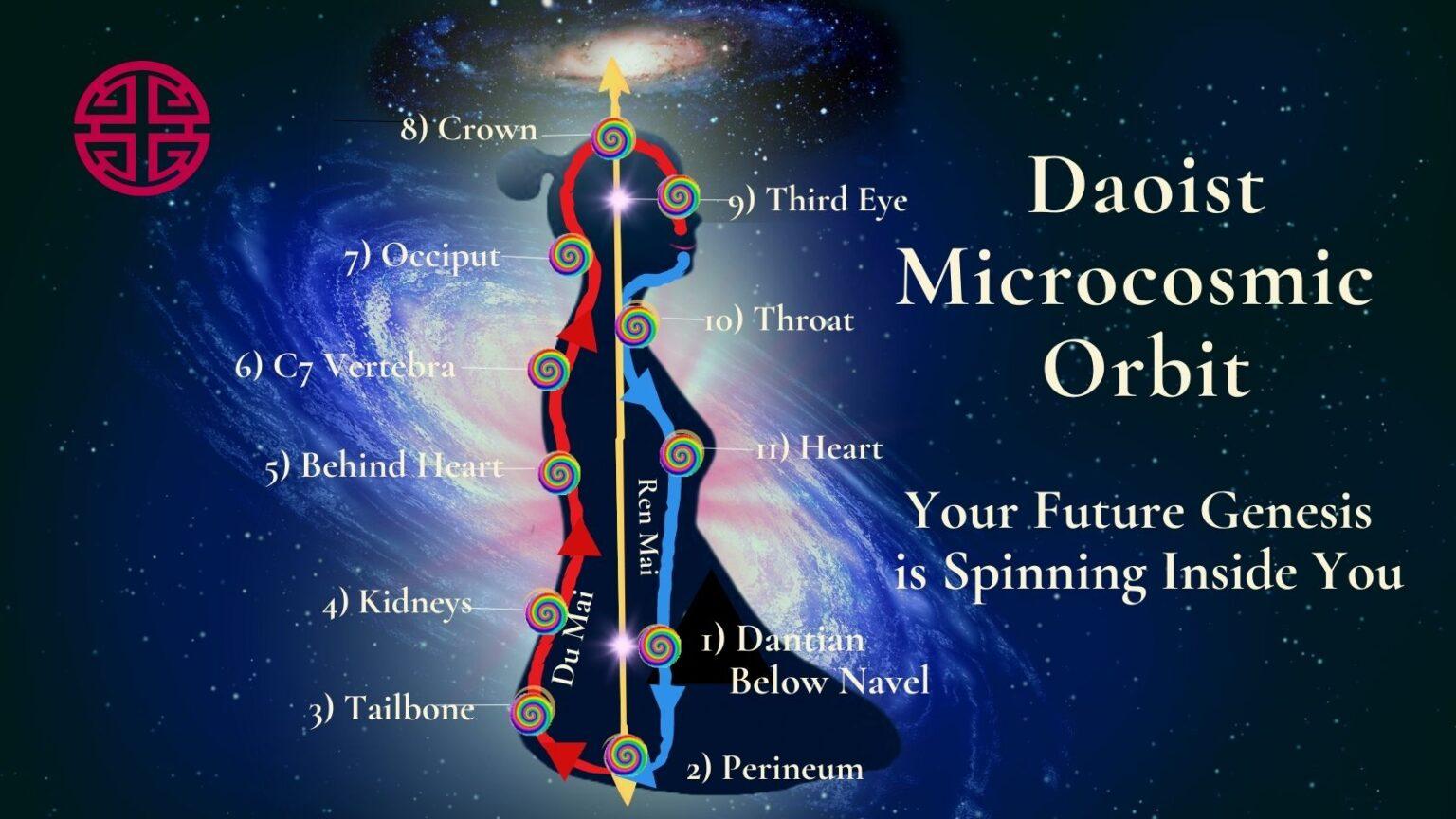
Relevance: Qigong practices, such as the Microcosmic Orbit, circulate Qi through the body’s meridians, fostering a direct experience of the body as a vibrating energy system within the cosmic field.

Practice:
Microcosmic Orbit: Visualize Qi flowing along the Ren (front) and Du (back) meridians, connecting the lower Dantian (energy center near the navel) to the crown. This practice enhances awareness of internal energy as part of the universal field.
Five Animals Qigong: Mimics animal movements to balance the body’s energy with nature’s rhythms, reflecting the Dao as a luminous waveform.
Why It Works: Qigong sensitizes you to Qi as the vibratory link between individual and universal consciousness, allowing for a Qi-Dao connection.

Daoist Meditation (Nei Dan – Internal Alchemy):
Description: Daoist meditation, particularly Nei Dan (internal alchemy), transforms the practitioner’s body, mind, and spirit by refining Jing (essence), Qi (energy), and Shen (spirit) into a unified state of harmony with the Dao. Practices like “Sitting and Forgetting” (Zuowang) and “Fasting of the Mind” (Xinzhai) cultivate stillness and non-dual awareness.
Relevance: These meditations align with your “universal neuro-field” by quieting the mind to reveal the Dao as the source of all vibrations, of which you are one.

Practice:
Sitting and Forgetting (Zuowang): Sit in stillness, letting go of thoughts and ego to merge with the Dao’s boundless awareness.
Kidney Breathing (Dantian Breathing): Focus on deep, abdominal breathing to gather Qi in the lower Dantian, fostering a sense of energetic unity with the cosmos.
Why It Works: These practices dissolve the illusion of separation, revealing the practitioner as an energy being within the Dao’s luminous matrix.

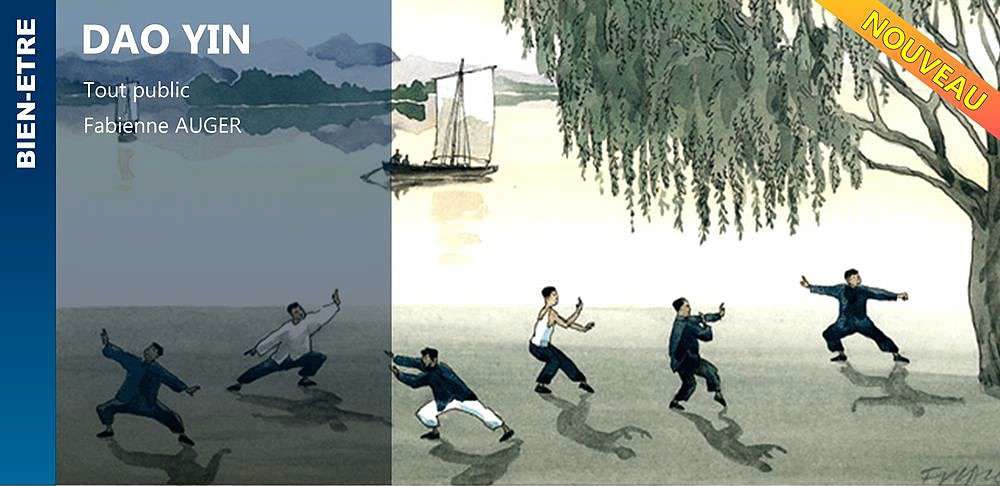
Daoist Yoga (Dao Yin):
Description: Dao Yin, often called Daoist Yoga, involves stretching, breath regulation, and meditative movement to open meridians and balance Qi. It emphasizes flexibility, energy flow, and alignment with nature’s rhythms.
Relevance: By stretching the body’s fascial network and meridians, Dao Yin enhances awareness of the body as a vibratory field, resonating with the universal energy matrix, akin to Indian yoga practice that views of the body as a sheath (kosha) of Brahman.

Practice:
Cloud Crane Immortal’s Daoist Yoga: A standing sequence that combines stretching, breath, and meditation to align Qi with cosmic energy.
Golden Fluid Returning to Dantian: A Dao Yin exercise that strengthens the body’s energy while calming the spirit, connecting individual Qi to the universal field.
Why It Works: Dao Yin’s focus on guiding Qi through movement attunes the practitioner to the vibratory nature of existence.

Tai Chi (Taijiquan):
Description: Tai Chi, a Daoist internal martial art, combines flowing movements, breath, and mindfulness to cultivate Qi and embody Wu Wei (effortless action). It harmonizes yin and yang energies within the body and with the cosmos.
Relevance: Tai Chi’s fluid movements reflect the Dao’s dynamic flow, aligning with the concept of “coherent luminous waveforms” experiencing energy as a manifestation of consciousness.

Practice:

It’s all about FLOW. Practice a Tai Chi form slowly, focusing on the flow of Qi and the balance of yin-yang. To experience the body as a resonant energy field, you must allow the FLOW rather than muscles to move the body.
Why It Works: Tai Chi cultivates a somatic awareness of energy as an expression of the Dao, again integrating Qi with consciousness.

NEXT: PART TWO: TEXTS AND STUDY RESOURCES

The I Ching has been used by the Chinese for thousands of years, mostly for divination. But some adepts, both Daoist and Buddhist, have consulted the oracle as a way to open up to Nature and the Universe, to look for meaning in life rather than fortune. To use the I Ching to know whether you will have success in some undertaking or if you should look for a new job or buy a new car is to do great disservice to the oracle.

In each of these cases, one is being lazy, one is avoiding one’s responsibilities in life. Consulting the oracle for fortune-telling is a cop out. To know whether you should look for a new job or buy a certain make of car does not require the I Ching. Simple left-brain logical deduction can handle those tasks. However, your direction in life requires introspection and close attention to what is happening around you and how it makes you feel. Strictly a right-brain task.

Let’s say you are not pleased with your progress in practicing tai chi. You think you have plateaued. Maybe you need another teacher or another tai chi group. You have so many details around you that are contributing to your displeasure that no oracle or fortuneteller could possibly account for most of them. But your body can and so can your feelings – if you pay attention to them. That is where you start – with yourself and your feelings. When you practice, take a deep breath and tell your judgmental left-hemisphere to shut up and listen closely to what your body is telling you. When you work with your teacher, pay attention to how you feel. These are all right-hemisphere techniques. This is the way we make major decisions about our next move in life

Taking this a step further to the next level, the I Ching is vital for how we look at life and our place in the world. And yes, how we relate our tai chi and martial arts practice to the whole of life.

Take Chapter 43 for example. The Wilhelm/Baynes edition translates “Kuai” as Breakthrough or Resoluteness. Thomas Cleary’s “The Taoist I Ching” translation titles the chapter “Parting.” In that version the text reads: “Parting is lauded in the royal court. The call to truth involves danger. Addressing one’s own domain, it is not beneficial to go right to war. But it is beneficial to go somewhere.”

The Wilhelm/Baynes version is very similar. It reads: “At the court of the king. It must announced truthfully. Danger. It is necessary to notify one’s own city. It does not further to resort to arms. It furthers one to undertake something.

While this could be taken as advice to a King or Commander to avoid going to war, that is the practical, fortunetelling aspect. But when we engage the oracle, it is about one’s own life up to now and the situation one finds oneself in. Like tai chi, it is really about our internal aspects and how they relate to the externals around us or the personal to the universal. Thus, if we look at the commentaries, we get a sense of how introspection may work not only for tai chi but for our entire outlook on life.

“One’s own domain” and “one’s own city” are both referring to our mind. The danger here is that in “the court of the king” the ego, our personal consciousness, having undergone years of temporal conditioning, discriminates between all it perceives, choosing pleasure over service, likes over dislikes. external distractions over introspection. The media blitz that deluges us with pleasures or with warnings about things that will bring displeasure leaves our minds in perpetual confusion.

As Thomas Cleary puts it in his commentary: “After people get mixed up in temporal conditioning, the discriminatory consciousness takes charge of affairs; wine and sex distract them from reality, the lure of wealth deranges their nature, emotions and desires well forth at once, thoughts and ruminations arise in a tangle, and the mind-ruler is lost in confusion. Because habituation becomes second nature over a long period of time, it cannot be abruptly removed.”

In the next line, “refraining from resorting to arms” cautions against allowing the ego to engage in war against its own self. This is why many meditators fail and soon give up meditation and introspection altogether. They take on a left-brain attitude of determination, intensely resolved paradoxically to combat ego into submission when just the opposite tact is required. The commentary in the Wilhelm/Baynes text suggest: “…we should not combat our own faults directly. As long as we wrestle with them, they continue victorious.”

Of course this is true of tai chi and the martial arts as well as life. The more we become frustrated with our progress and turn up the intensity and determination, the worse our practice becomes. We resort to using muscle rather than energy both in our forms and push hands.. We tense up; our body becomes tight and our breath rises rather than sinking.

So whether you hope to improve your tai chi practice or your meditation, some right-brain advice from the Thomas Cleary commentary should always be kept in mind: “It is necessary to work on the matter in a serene and equanimous way, according to the time.”

Of course, that is easier said than done. The problem of attachment is a very sticky one. It is not easy to get rid of our habitual clinging to one desire after another, to the monkey mind’s continual chatter, and the fear of missing out on the latest trend. In tai chi this translates into bouncing around from one teacher to another, learning one form after another, and  traipsing to one workshop after another. But each time we bring along the exact same baggage – our attachment and even fondness for looking to gain improvement from something out there, where the grass appears greener.

The problem is a deep-rooted one precisely because the ego has been in charge for such a long time. As Cleary points out: “Its roots are deep and its authority is tremendous; one cannot attack it impetuously, but must find the right way between intensity and laxity before it is possible to settle anything.”

What is vital to understand here are the final sentences in both texts. The Cleary text states: “But it is beneficial to go somewhere;” and the Wilhelm/Baynes text posits: “It furthers one to undertake something.” Whether it is going somewhere or undertaking something, both are urging some kind of movement or action. That action is wu wei – the action of no action.

Meditation and introspection are both forms of wu wei, in which we allow the mind to clear itself, as Cleary puts it “addressing one’s own domain.” Once this is done, natural intuition or instinctiveness will bring about a solution.

But going somewhere or undertaking something have a sense of leaving this danger or dilemma behind. So, if we are not to combat it, to fight the ego and the dilemmas it has created, we must then decouple from them. Decoupling falls in between flight or fight or Cleary’s intensity or laxity.

From the perspective of Nature, Awareness, the Dao or whatever you want to call it, life is inherently meaningful. Yes, even your tai chi practice. But it’s not about what we achieve, our successes, our conquests, how much money is in the bank. All of our experiences, even the terrible ones, turn over rocks and enable Nature, the Dao, or God, if you prefer, to look underneath where it would not ordinarily look. They give insight to God that God would not otherwise have. We are the Eyes of God.

Realize that the next time you are doing single whip or cloud hands or part the horse’s mane. This is decoupling. You decouple your conception of meaning from your conception of success. You decouple value from a sense of self-importance and truth from beliefs. This decoupling is vital. This is not about you as a person but as an extension of Nature, of the impersonal Tao. When your life and your practice become impersonal in a meaningful way without the arrogant baggage of self-importance, then you become a co-creator with Nature, with God.

Rather than struggling with our ego and its self-generated problems that chasing after personal desires like a dog chasing his tail create, this is the going somewhere and the undertaking something that Chapter 43 invites us to realize. This realization is truly the next level you are hoping to attain. Become that impersonal practitioner and allow Nature to work through you however it chooses.

Good luck on your practices.

It wasn’t just his unorthodox footwork, as seen in our last post., but his bewildering, confusing head and body movements that gained Willie Pep 229 victories, some 53 after a 1947 plane crash that killed three and left Pep with a broken leg and several cracked ribs. See how his elusive movements caused his opponents to clumsily stumble about the ring, swinging wildly at their ghostly nemesis.

So watch closely and imagine how you might incorporate these techniques into your martial arts and tui shou practices.

As always, my loving thoughts be with all who read this throughout all time. Good luck with your practice.

Willie Pep had arguably the greatest footwork of any fighter before or after him, moving in any direction like the Queen on a chessboard. It was Pep’s shifting V-Step that made his movements indefensible and created whole new angles of attack. As you watch this talented fighter of several decades ago confuse and stun his opponents with his unparalleled movements, see how you might incorporate this technique into your martial arts and tui shou practice.

As always, my loving thoughts be with all who read this through all time. Good luck with your practice.

In the world of Western Boxing before Muhammad Ali and Floyd Merriweather, there was Jersey Joe Walcott. Though there are no videos of Walcott as a young fighter, he still maintained incredible skills as he approached 40 years of age. In 1951, he became the oldest boxer to hold the Heavyweight Crown.

The video you are about to watch highlights Walcott’s incredible gravity-defying footwork, his head feints, draws and dodges, his half-step and balance control. These are all skills that you can modify and add to your martial arts toolbox. So pay close attention as you watch and replay often.

As always, though I am not personally present with you, may you receive my loving energies regardless of time and distance.. Namaste🙏


***Though I am not personally present with you, may you receive my loving energies in spirit as you read my posts. Namaste🙏

“Watch what you say, your words may come back to haunt you,” this is a common adage that I’m sure all of us have heard. Or “What you say can affect the entire Universe.” Could that be true? Can the sound waves from your speech affect the entire Universe?

It is very possible that what we say can affect  all of creation through the Toroidal Field and Scalar Waves. Have you ever heard a Karate Master affect his opponent with a booming KIAI? Or Boxers, UFC fighters, footballers and other sports pros taunt their opponents with deriding barbs in order to get the upper hand.. The power of sound and the human voice is very real. But how real?

Speech, as sound waves, starts as a macroscopic phenomenon, but its vibrations could, in theory, cascade down to the quantum scale. The harmonics of vowels—those resonant, sustained tones—might interact with the zero-point energy field, the buzzing sea of virtual particles that fills all space. Some theories suggest that coherent vibrations from intentional sound could amplify or organize this field into structured patterns, such as toroids.

Unlike typical electromagnetic waves with oscillating polarity, scalar waves are hypothetical non-Hertzian waves—pure energy potentials without direction or polarity. They’re often imagined as longitudinal waves that compress and expand space itself, moving faster than light or even instantaneously. Could toroidal fields from speech morph into scalar waves? Possibly, if the toroid acts as a kind of “vortex generator.” Picture the spiraling energy of a spoken vowel collapsing inward, shedding its wavy nature, and emerging as a scalar pulse.

If scalar waves can traverse space instantaneously, they might bypass the 3D limitations of distance and time, hinting at 4D spacetime—where time becomes a navigable dimension. In quantum terms, this could tie into entanglement, where particles linked across vast distances “communicate” instantly, or to the holographic principle, where all information in the universe is encoded on a boundary surface. A scalar wave, free of polarity, might act as a carrier signal, slipping through the fabric of spacetime into higher dimensions—5D, where parallel realities branch, or beyond, into realms we can barely conceptualize.

This concept is a fascinating one. Watch this video based on the research of Michael Tellinger who shows how this theory might work…


If speech-generated scalar waves can pierce the veil of 3D spacetime, they might touch parallel universes—alternate timelines or realities stacked alongside ours in a multiverse. Imagine a vowel’s toroidal field collapsing into a scalar burst, tunneling through the quantum foam of spacetime at the Planck scale, and popping out in a dimension where the rules differ. Some esoteric traditions claim that sacred sounds—like mantras—do exactly this, aligning the speaker with higher planes or parallel existences. Think God SAID, ” Let there be light.” Or the Incarnation of Christ: “And the WORD was made flesh.” Ancient scriptures from Babylonian, Egyptian, Greek and Hebrew are replete with reference to the spoken word and energy manipulation that launched Creation and human development. Could it be that the ancients knew more than we give them credit for, maybe even more than Darwin. After all, even many quantum physicists believe it was sound – the Big Bang! – that created the Universe and Life as we know it.

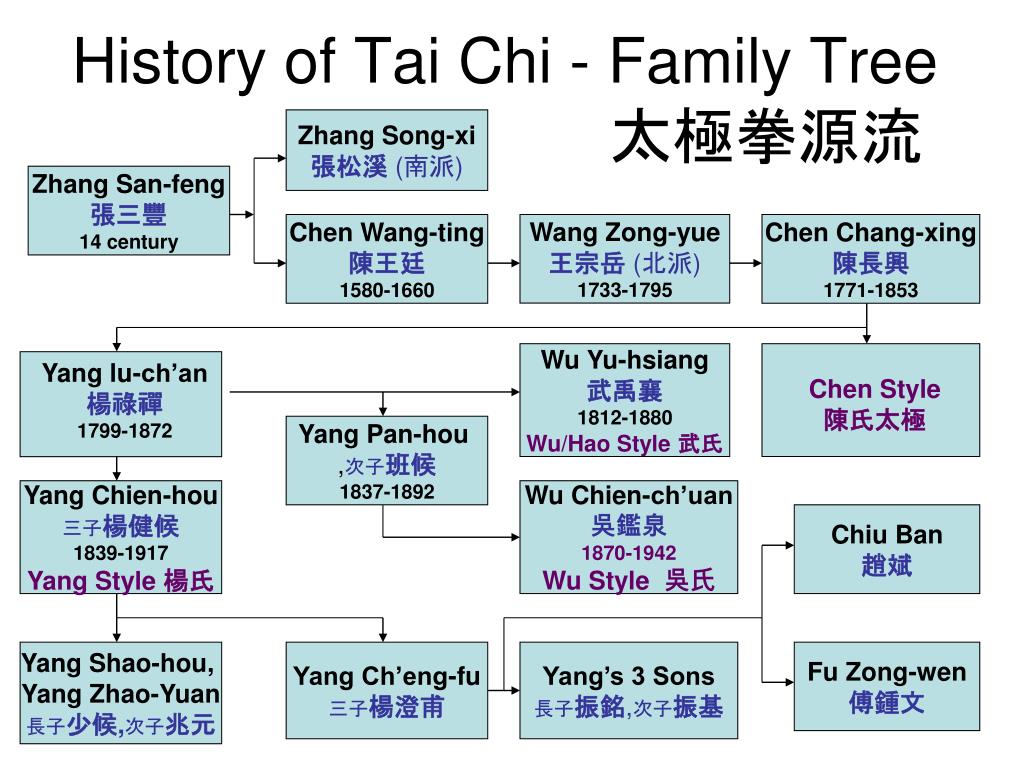
Many teachers will point to a prominent chart on the wall to impress upon potential students that they are standing in the hall of true masters. I remember this was my first experience with Tai Chi.

So how important is lineage when choosing a teacher? Well, it depends. The main styles of Tai Chi have been founded by extremely skillful masters. Most of them, in turn, passed their knowledge onto their immediate family as well as outside students. Those immediate family members also took on outside students while simultaneously passing their skills onto their children. Eventually, when an outside student progresses to a fairly high level they become an inside or “indoor” student and are considered disciples.

Here is an example of Tai Chi Family Tree…


A master may have scores of students, but only a dozen or two are considered indoor students or disciples. So, that’s the first thing to ask when the teacher points to his/her grand master and master on that chart: Were you and your master indoor students? You can usually know if the teacher is being truthful by the details they reveal. Most indoor students were close enough to their teachers to provide intimate details of their relationships with no hesitation while outsiders can only provide some general tidbits.

But the most important point to consider is that not everyone can teach. The teacher and his/her master and grandmaster may possess excellent skills but do not know how to effectively convey those skills to students. I personally know of two very prominent teachers who have great skills but cannot teach their students how to acquire those same skills. But this is something you can discover either in a sample class or after a few weeks of regular classes. Observing and talking to a teacher’s senior students will reveal a good deal about the teacher’s abilities.

Good luck on your journey.

TAI CHI: NOT THE EXTERNAL BUT THE INTERNAL


Of course, Tai Chi practitioners realize this is an internal art not an external one like most Kung Fu styles. So, why then all this focus on the externals?
With many Tai Chi groups it seems as though the externals are the more important, beginning with clothing We have all heard the misspoken phrase: “The clothes make the person.” Of course not, a person’s true worth is based on their values and principles, their ability to create, communicate and relate to others. These internal values are much more important than the clothes they are wearing.

This should hold true for Tai Chi as well, but that is not always the case. I have seen many so-called masters insist that their students wear a proper tai chi outfit much like the various karate and kung-fu uniforms. It seems as though once a student puts on their silk robes and satin tai chi slippers they will become the ultimate performer.

To the insistent master, the appearance of the group is everything. This is especially true of masters who extract a good deal of wealth from a burgeoning tai chi group. The flashy outfits and large external postures they believe will attract many new students. And unfortunately this is often true.
So, if you came to this website looking to find a Tai Chi group in your area, my first suggestion is to not judge the teacher or the group by their fancy duds. Most of the teachers and groups that I know as a first-hand practitioner wear basic street clothes that are loose and comfortable. One would be hard put to tell the difference between them and walkers and joggers passing by. This is true of the teachers as well. No fancy outfits, just ordinary everyday clothing. While some may have Tai Chi slippers, many are merely wearing sneakers.

These groups are not for show but for dedicated practice of Tai chi principles. And those principles are based on the development of internal energy not perfectly-correct external postures. Those types of externals are for show, to garner trophies and medals at various Tai Chi shows and performances.
Both a teacher’s internal movements and lack thereof as well as their mistakes remain hidden from view by the flowing costumes. Whereas, the teachers in casual clothes remains open for the world to see their internal principles as well as their mistakes even in full view of other teachers.

Now I’m not saying to avoid those teachers and groups adorned in Tai Chi threads. There may be some that practice genuine Tai Chi and its principles. But make sure you know what to look for. Ask questions to determine if this is a group for show or one authentically dedicated to furthering the art of Tai Chi and developing internal energy rather than external displays

THE LIFE FORCE

I AM – The Book, the Verse, and its Meaning.
I come not as another but as Thyself,
naked and unencumbered, with only Life,
with only Love to engage thy spirit.

Everything in its time, Everything in its space
Everything revealed in Grace.


Life Force is the Presence that flows within, without and throughout all manifestations. It is the same Presence that motivates and sustains the galaxies, the planets and their inhabitants. Only the levels or layers of that flow are different. Think of a three-layer cake sitting on a bakery shelf. It is the same icing between each layer. In some sections it may be thicker, in others thinner due to the texture of the flour. Or, take a brick and mortar storefront with the same mortar throughout holding the bricks in place. Though the thickness of the mortar may vary, it is, nevertheless, the very same mortar.

It is no different with humans. Depending on our acquired conditioning and habitual behavior, the Life Force may be stronger in some and weaker in others, but the flow of the Life Presence is constant throughout.

A wind farm is perhaps the best example. The earth on which the farm has been constructed will not be perfectly level nor is the construction of each windmill exactly the same without any deviations. Thus, when a steady gust picks up those mills that are slightly higher may receive a stronger effect than the lower ones. It depends on their positioning. While given two mills on the same level, the that has been better constructed will turn somewhat faster and thus generate more electricity.

So, too, with the Life Force or Dao. Though it flows evenly throughout the cosmos, due to the mass and positioning of the effected objects and, in the case of humans, their psychophysical stature, the Life Force will be stronger in some and weaker in others. Overall conditioning from family members, guardians, teachers, friends and neighbors as well as one’s social circle are all factors in determining the strength of the Life Force.

Actually, it is neither a force nor an energy. It is a presence or grace that generates various energies and forces within the manifested objects that it flows through – galaxies, planets and their inhabitants – just as the wind flowing through the mills in a wind farm generates electricity, which like the energies created by this presence can create, sustain or destroy.

Our one aim, our one most prominent activity in life is to cultivate this presence, honor it and recognize it in all life, human or otherwise.